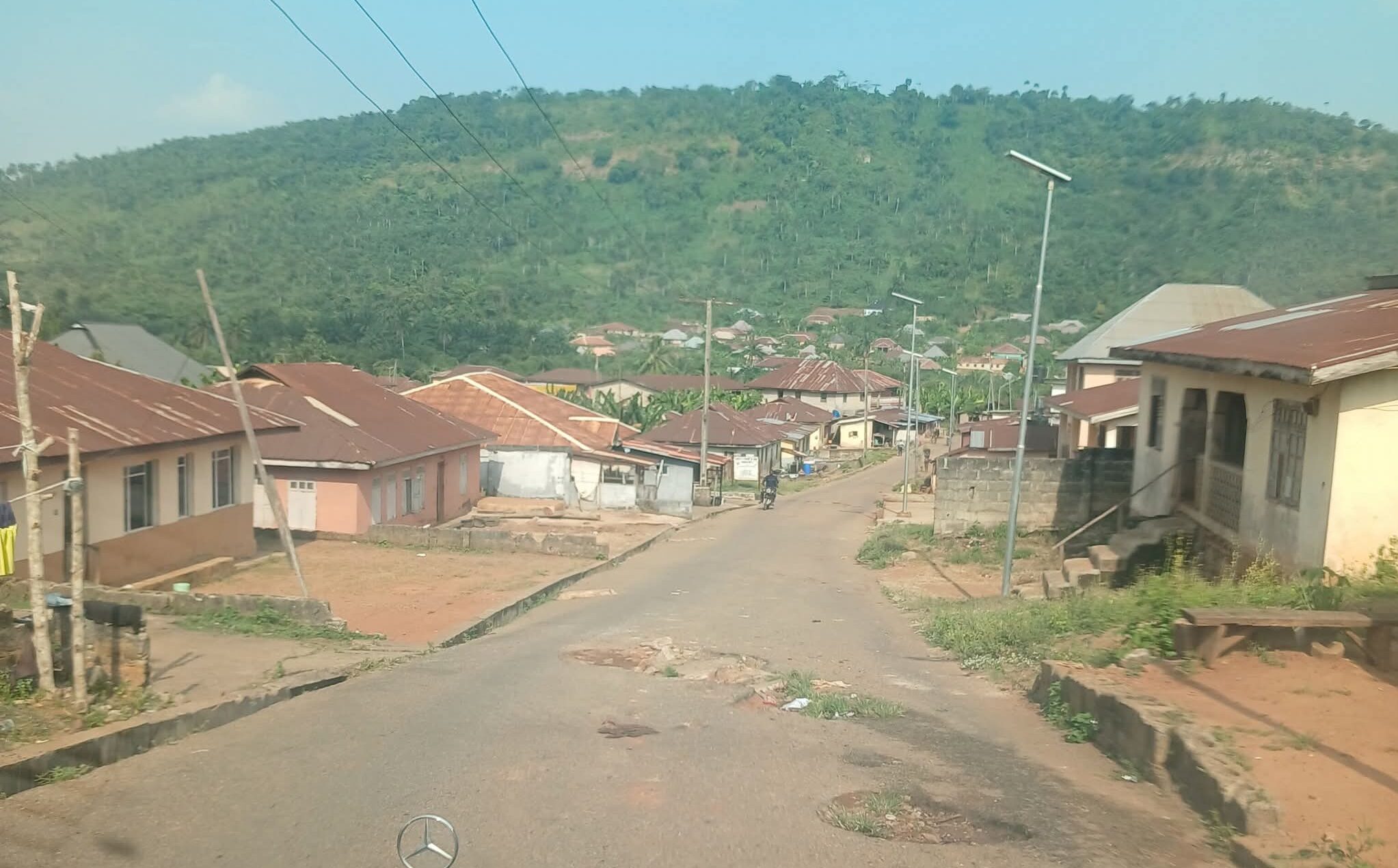
I spent part of my weekend in Oke Igbo, Ondo State. This town is famous for its most notable son, the Yoruba novelist, D.O. Fagunwa. His book, Ogboju Ode ninu Igbo Irunmole, became a hit when I was growing up. Wole Soyinka translated it as The Forest of a Thousand Demons.
I can't say much about literature. I am not good at it, maybe because I don’t care for it. Or maybe it’s the other way around. What I have written about Fagunwa is about all I know of him. I would have loved to visit his home just for the sake of it. Maybe it would have made me feel connected to him.
Oke Igbo has many hills, giving it a unique look. Sadly, I didn’t see much of it. The little I saw was unforgettable. From one side of the town, the houses looked like tiny toys scattered down a slope. Buildings that seemed big from the street looked small against the green hills.
But the trip to Oke Igbo was quite an adventure, and I would not recommend it for a simple road trip. Roadwork on the Ibadan-Ife Road made the drive tough. It started well. The lane to Ife, closed to vehicles in April when I last drove that way, had reopened. The concrete road felt great. Driving on it was pure bliss. For a moment, I thought life for drivers had gotten easier.
That feeling lasted about 15 kilometres. Then bliss vanished. We had to switch to the other lane, which was still rough. What followed was tiring. Drivers had to keep moving from one lane to another, depending on the road condition. Left to right, right to left, like a wiper. It was very annoying, made worse by not knowing what was around the next bend. We finally got to Ife after almost three hours.
I hadn’t driven through Ife in about 30 years. I had no reason to go there. My usual route to Ilesa and Akure avoided Lagere and Sabo, so I didn’t have to go through the town. This time, I saw more of Ife and was amazed at how much it had changed. I can’t say if it was for the better.
One familiar sight was Diganga Hotel, which used to be Ife’s version of Transcorp Hilton. I was surprised it still existed. It was one of those places that mattered in the town’s social life. I did not see Samtad Gardens or Mayfair Hotels. They might be gone or I just missed them.
On Ondo Road, I saw Olympic Hotel, known back then as a place for immoral activities. I also spotted the old Oyo State College of Arts and Science, where some of my friends studied for A-levels. It reminded me of a time when such colleges prepared young people for university.
The trip also brought back names I hadn’t heard in ages. Arubidi. Iyanfoworogi. Garage Olode. These places belong to memories, and seeing them again took me back. Garage Olode was where there was a violent clash between supporters of the National Party of Nigeria and the Unity Party of Nigeria in the lead-up to the 1983 elections. Those were tense times in old Oyo State when political differences could quickly turn violent.
Then there was Modakeke. This town has a history tied to its troubled relationship with Ife. Back when things were tough, my Ife friends called Modakeke people Modeko, not in a nice way. The relationship was complicated by issues of identity, land, and local government. These were not just neighborly disagreements but deep-rooted conflicts that sometimes led to violence.
I remember that time well, especially during the politics of the Second Republic. Ife was linked to the UPN, while Modakeke leaned towards the NPN. These political ties were not random. They connected to long-standing tensions, making the situation even more explosive.
One figure in this story was Wole Odelola, a politician from the old Oyo State House of Assembly and a UPN member. In July 1983, a UPN campaign team went to Modakeke to rally support for Governor Bola Ige’s re-election. They faced violent opposition. The visit coincided with a cultural festival in the town, leading to a bloody clash. Odelola was among those killed.
His death became part of the bitter Ife-Modakeke crisis and the political fights of that time. I remember Modakeke High School was renamed Wole Odelola High School by the old Oyo State government under Ige. This was a political move that was bound to stir controversy. Odelola was a UPN member, while Modakeke largely supported the NPN.
The renaming wasn’t just about honoring a fallen leader. It was a move in the community’s political space. A key figure was Chief Olaniyan Alawode, also known as 007. He was a strong community leader and played a vital role in the NPN’s support in that area. His leadership helped strengthen Modakeke’s opposition to the UPN and support for the NPN in the 1983 elections. This was because the community believed the NPN would help them get a separate local government.
Alawode was not just a party member. He was a powerful community figure whose political choices mattered a lot. His role in the crisis shows how politics and community issues can become dangerously tangled.
The school name did not last. After Ige lost the 1983 election to the NPN’s Omololu Olunloyo, the new government changed the name back. I can see why. Naming a school after someone from a rival party, especially someone killed in a conflict involving that community, was not wise. Whatever the intention, it was bound to upset people.
It is essential to remember that the Ife-Modakeke conflict was not just about political parties. The underlying issues were much older, involving land, identity, and traditional authority. Modakeke’s call for independence added to the tensions, often with serious consequences. The two towns went through many violent episodes, especially in the 1980s and 1990s.
Thankfully, that is not how things are between the two towns now. Modakeke looks very different from what I remember. It used to feel like a messy town. That description might be harsh, but it fits how it looked back then. Things have improved a lot. Most importantly, the tensions between the communities have eased. The burned buildings and signs of conflict that once made the area sad are no longer there. This is one of the best things about driving through Modakeke. Whatever issues remain, people can now focus on living without fear of more violence.
Beyond Modakeke, the road to Oke Igbo became much more enjoyable. The road is mostly empty and winding, with stretches of countryside and occasional settlements. There’s something nice about driving through a place not consumed by city chaos. For much of the journey, the road was in good shape and easy to drive on.
The countryside was truly the highlight. There were farms, small houses, and farmers selling their goods by the roadside. The stalls looked inviting. It’s nice to see fresh produce instead of stuff that’s been through many hands and questionable handling.
The plantains, vegetables, and other goods looked fresh, and I was sure of where they came from. These were not the kinds of things that had traveled for days before reaching Lagos, where you sometimes wonder what has been done to them. No carbide-ripened plantain or chemically treated food. Just fresh produce from the farms. There’s something honest about that kind of selling.
One delightful part of the journey was the greenery. I can’t remember the last time I drove on a road where lush plants, especially bamboo, formed such beautiful canopies. The trees seemed to lean towards each other, creating long stretches of natural tunnels. Their branches and leaves met above the road, letting in sunlight and casting nice patterns on the asphalt.
It was a daytime trip, and the sun was quite strong. But under those canopies, it felt much cooler. At times, the road seemed to vanish into a green corridor, with the vegetation providing shade from the heat. It was beautiful, especially after spending time in Lagos, where trees are seen as obstacles and shade is rare.
This experience reminded me of the joy of traveling through places where nature has not been completely taken over by humans. There was no crazy construction, loud honking, hawkers darting between cars, roadside generator noise, or someone trying to sell me something. Just the road, trees, some settlements, and the quietness of rural life. I also saw agbegilodo, the trucks that carry timber and have a dangerous reputation when they lose their loads.
I heard Oke Igbo has great palm wine. I found this interesting but didn’t act on it. I love palm wine, but I know the risks of choosing the wrong drink in new places. Explosive diarrhea is not something I want. I wasn’t about to ruin a nice weekend trip looking for a toilet.
There’s a limit to how adventurous one should be when traveling in rural Nigeria, especially knowing that healthcare isn’t always reliable in the countryside.
Still, I left Oke Igbo feeling good. The hills, green landscape, quiet roads, and overall vibe were a nice change from the usual hustle of Lagos. I also felt satisfied passing through places I remembered as names, political stories, and bits of history, and discovering they still exist, though changed over time.
That’s one of the joys of traveling. You revisit places you haven’t seen in years, find that some memories were blown out of proportion, discover that others were spot on, and meet new things you never knew you were missing.
I didn’t explore Oke Igbo enough to say I know the town well. I saw its hills, admired its beauty, and thought about the literary giant it produced. I also got a strong reminder of the complex history of the communities along the way. And for all the joys of rural life, I was reminded that it is best enjoyed in good health.

Drop your comment
No comments yet — be the first to drop the gist 👇