
The strength of MNI versus MNIPR in NIPSS is not just about disagreements between institutions. It shows how resilience can turn disappointment into something meaningful. The closing thought captures this well: “Institutions may grant opportunities, but they do not own ideas. Once knowledge becomes a mission, it acquires a life of its own. No withdrawal letter can take that away.” This line sums up not only Chapter Nine but also links the memoir to a related book on artificial intelligence.
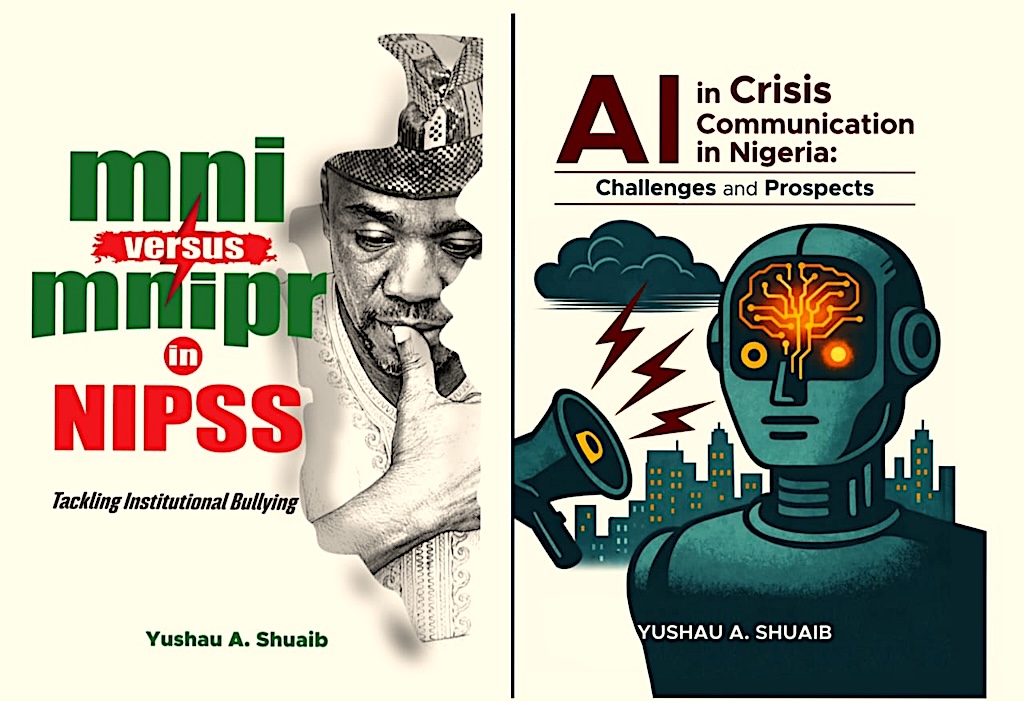
When I got my hands on MNI versus MNIPR in NIPSS: Tackling Institutional Bullying and AI in Crisis Communication in Nigeria: Challenges and Prospects, both written by Yushau A. Shuaib, I thought I was getting two very different books. One seemed like a memoir about conflicts in institutions, while the other looked like an academic piece about new technology and crisis communication.
After reading both, I found they are closely connected. Together, they show how personal struggles can turn into intellectual opportunities. They reveal how a disrupted academic path can lead to work that matters both nationally and internationally.
As Associate Editor of Spokespersons Digest, the magazine behind the National Spokespersons Awards, I was particularly interested in Chapter Eight of the memoir, “The NIPR Betrayal” in MNI versus MNIPR in NIPSS, which covers pages 139 to 161. Since I have been following the Nigerian Institute of Public Relations (NIPR) for years, I approached this chapter with genuine curiosity. What I found was a powerful story that raises important questions about institutional relationships, loyalty, and the balance between discipline and support for members.
According to the memoir, after withdrawing from the Senior Executive Course (SEC) 47 at the National Institute for Policy and Strategic Studies (NIPSS), Kuru, Shuaib was asked to speak before the NIPR Ethics Panel due to issues related to the dispute.
For someone who has been closely linked to the Institute for over thirty years, this experience was understandably painful.
Shuaib recalls his history with the NIPR from his university days at Bayero University, Kano, where he focused on Public Relations. In 1992, he became the first recipient of the NIPR President’s Prize for the Best Graduating Public Relations Student. Three years later, he was named the Public Relations Person of the Year by the Kano/Jigawa Chapter.
His career reached beyond Nigeria through further studies, including a Master’s degree in Public Relations from the University of Westminster, London. He also did professional research in online public relations and worked with international bodies like the Chartered Institute of Public Relations (CIPR) and the Public Relations Society of America (PRSA). Under his leadership, IMPR has won several international awards, including the SABRE Awards Africa and IPRA Golden World Awards.
Within this context, one seemingly small incident in the memoir becomes significant. The invitation from the NIPR reportedly addressed him as “ANIPR” instead of “MNIPR,” the title he used for years and which had appeared in previous official letters from the Institute.
At first, it seems minor. But anyone in public relations knows that titles and professional terms often carry deep meaning. They signify recognition, identity, and belonging.
Shuaib mentioned that after he pointed out the mistake to the Registrar, another invitation was sent, this time without any professional title at all.
Whether this was done on purpose or not, the incident made him feel that his long contributions were no longer valued by the institution.
The memoir also highlights the National Spokespersons Awards. The book explains that the idea was born in 2019 when Mallam Mukhtar Sirajo was President of the NIPR. IMPR independently organized the first edition in 2021, with the Institute’s support. In 2023, both groups signed a formal agreement to work together.
The awards have become a key platform in Nigeria for celebrating excellence in strategic communication, recognizing spokespersons, public information managers, corporate affairs professionals, military communicators, and crisis communication experts.
However, according to the memoir, the partnership ended before the agreement's time was up, led by Ike Neliaku’s NIPR.
What surprised me more was that after ending the partnership, the institute launched another awards program with a different name.
Reflecting on this, Shuaib writes: “Organizations can withdraw endorsements. Partnerships can be terminated. Titles can be withheld. But one’s name, carefully built over decades, must remain answerable first to conscience, history and truth.”
This statement captures the emotional core of Chapter Eight.
If that chapter shows the hurt, Chapter Nine, “A Blessed Disappointment”, shows the healing. In my opinion, it is the most inspiring part of the memoir.
Instead of focusing on conflicts, it tells how a disrupted academic path became a source of the author’s most important achievements.
Shuaib begins by discussing the personal impact of the crisis. The combined stresses of withdrawing from NIPSS, the NIPR investigation, and the legal battles led to something he had never faced before, hypertension.
His first reflection is both simple and deep: “As someone who had spent decades helping individuals and institutions handle reputational crises, I suddenly found myself at the center of one.”
Yet, the chapter is not just a list of complaints. It shows how challenges redirected his focus to new possibilities.
One source of support came from his family, who encouraged him to take a restorative trip to Canada. He was also touched by visits and messages from graduates of the Young Communication Fellowship, many of whom traveled far to support their mentor.
These moments reinforced one of the book’s key messages: “True success is not measured by certificates, titles or institutional recognition. It is measured by the positive impact one leaves in the lives of others.”
The memoir also describes how the NIPSS experience unexpectedly strengthened his vision for expanding the Young Communication Fellowship.

Inspired by the residential model at NIPSS, he planned to create hostel facilities at the PRNigeria Centres in Kano and Ilorin. During a visit to the Kano Centre, Professor Adamu Abubakar Gwarzo, President of MAAUN, inquired whether similar facilities were available in Abuja.
When Shuaib explained that he couldn’t afford such a project, Professor Gwarzo generously donated a large building in Lugbe, Abuja, to serve as a training and residential center for the Fellowship.
This is an amazing example of how one setback opened the door for another chance.
The chapter’s most compelling story, however, is about the research project that turned into AI in Crisis Communication in Nigeria: Challenges and Prospects.
Originally approved as a research proposal during SEC 47 at NIPSS, it was called “Artificial Intelligence and Crisis Communication in Nigeria’s Public Sector: An Assessment.”
After he withdrew from the program, the support for the research vanished. Many scholars would have given up on it.
But Shuaib did not. Driven by his professional passion and encouraged by colleagues at the Centre for Crisis Communication, he finished the study on his own in three months.
The findings were quite relevant. The research pointed out what he calls Nigeria’s “awareness-adoption gap.” While many communication experts know about artificial intelligence, its actual use by institutions is mainly limited to writing documents, monitoring media, and generating reports.
More advanced uses, like predictive analytics, crisis forecasting, sentiment analysis, and misinformation detection, are still rarely used.
The study also reveals a “trust paradox.” While AI speeds up processes and makes them more efficient, communication professionals hesitate to trust it during crises because of fears over deepfakes, misinformation, algorithmic bias, and the unique value of human empathy and judgment.
Its main conclusion is timely: artificial intelligence should help human decision-making, not replace it.
Beyond just identifying issues, the research found structural barriers to AI adoption, such as poor digital infrastructure, inconsistent electricity supply, limited internet access, lack of specialized skills, weak institutional coordination, and inadequate policy frameworks.
Importantly, this work did not stay within academic walls. It fueled discussions at the Centre for Crisis Communication and the National Information Technology Development Agency (NITDA). It contributed to the National Symposium on Artificial Intelligence and Crisis Communication held at the National Defence College, Abuja, in November 2025.
One result of that symposium was the start of the Crisis Communication Hub (CCHub), a platform aimed at improving crisis management and fighting misinformation in Nigeria.
The research eventually became the 200-page book AI in Crisis Communication in Nigeria: Challenges and Prospects, endorsed by NITDA Director-General, Malam Kashifu Inuwa Abdullahi; Major General Chris Olukolade (Rtd); Professor Abdalla Uba Adamu; and Professor Abiodun Adeniyi.
The book’s biggest achievement was being shortlisted for the 2026 International Public Relations Association (IPRA) Golden World Awards in Athens, Greece.
There is a twist in this outcome. A research project that faced interruptions in one institution gained wider importance beyond it.
Had it only been an academic project at NIPSS, it might have ended up as just another paper in a filing cabinet.
Instead, it sparked a national symposium, became a published book, influenced policy discussions, and gained international recognition.
This is perhaps the memoir’s greatest lesson. Institutions create opportunities. They help develop ideas, shape careers, and provide platforms for learning. But once ideas fully develop, they often go beyond the institutions that nurtured them.
The lasting strength of MNI versus MNIPR in NIPSS is not just about recounting institutional disagreements. It shows how resilience can change disappointment into lasting contributions.
The closing thought captures this well: “Institutions may grant opportunities, but they do not own ideas. Once knowledge becomes a mission, it acquires a life of its own. No withdrawal letter can take that away.”
This line sums up not just Chapter Nine but also the connection between the memoir and its companion book on artificial intelligence.
Together, they share the story of a disrupted journey that eventually reached far beyond its starting point.


Drop your comment
No comments yet — be the first to drop the gist 👇