
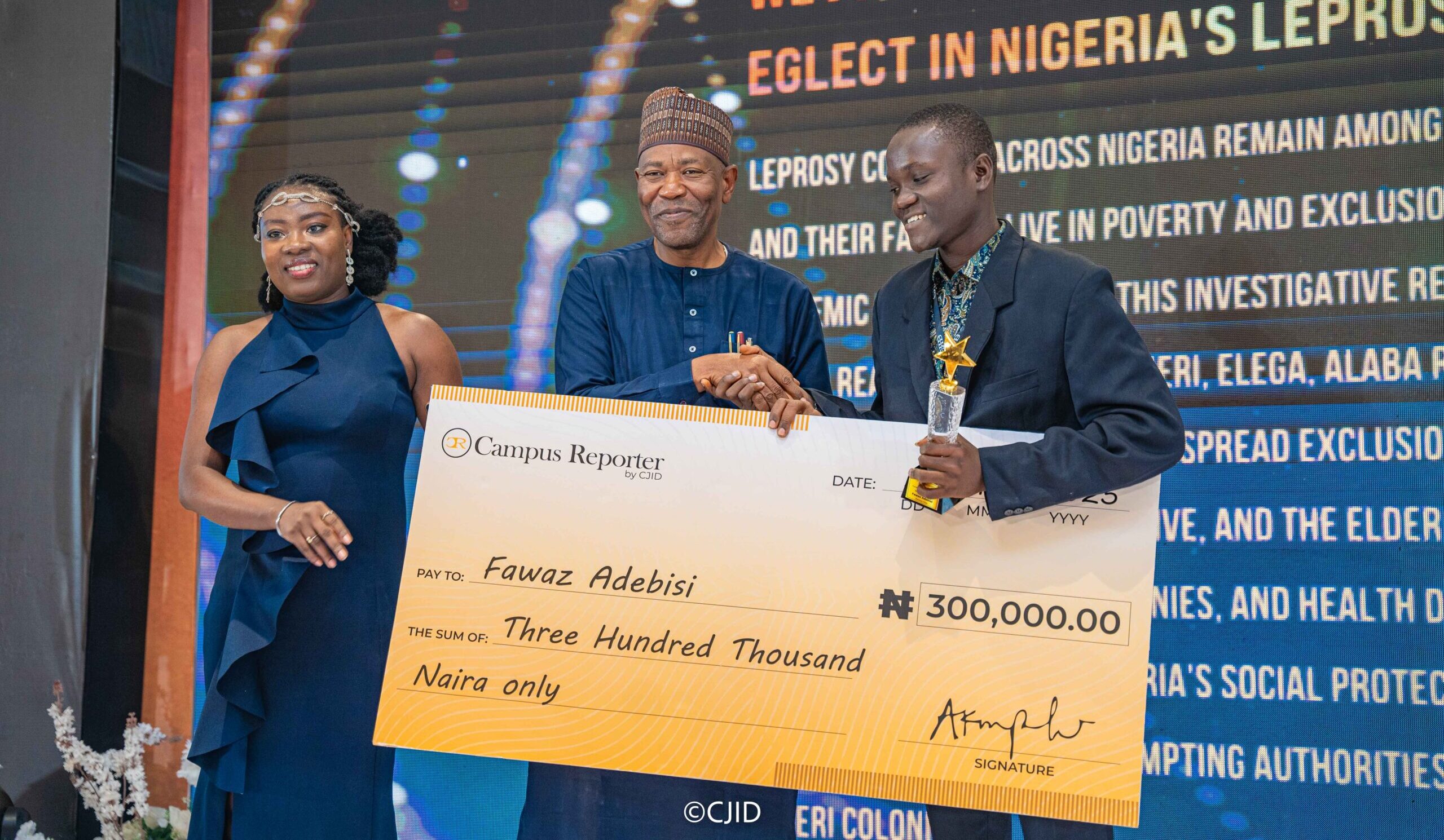
The Centre for Journalism Innovation and Development (CJID) has celebrated top student journalists at the 2026 Alfred Opubor Next-Gen Awards for Campus Journalism. They received cash prizes and awards for their work.
These awards are part of CJID’s Campus Reporter Next-Gen Project. They recognise exceptional campus journalists who show commitment to public-interest journalism. They also focus on accountability and giving a voice to those often ignored.
The 2026 edition took place on Wednesday and marked the end of the Media and Development Conference (MDC) 2026.
The awards were given in six categories: Investigative Journalism, Health Reporting, Campus Affairs, Data Journalism, Community Reporting, and Inclusion.
Yisau Babatunde from Usmanu Danfodiyo University, Sokoto (UDUS) was named the overall winner.
Winners
Yisau Babatunde won the Investigative Journalism category for his story, "How Farm Destruction Threatens Food Production in Nasarawa". Habeeb Olokooba was the first runner-up with his investigation, "How Online Platform Slipcraft Helps Scammers Fake Transfers, Generate Fraudulent Receipts".
Muheeb Mashood took home the award for Health Reporting with his investigation, "The Unsafe Water Sources Serving Humans and Animals in Sokoto Communities". Kamaldeen Luqman was the first runner-up with his report, "Seven Injections, No Diagnosis: How Fear of Delay Pushes UDUS Students Into Unsafe Medical Care".
In the Campus Affairs category, Muhammed Akindele won for his report, "Inside UDUS Where Breads With No Verifiable NAFDAC Registration Are Sold to Students". Yisau Babatunde was again the first runner-up with his report, "Millions in Student Sports Fees Fail to Stop University Facilities from Collapsing, A UDUS Report".
Abdullateef Sebiotimo won the Data Journalism category for his report, "How UDUS Students Miss Global Opportunities Over Poor Student Email Access". Abdulrasaq Kamaldeen was the first runner-up with his report, "Inside Nigeria’s Banking Fraud Crisis: How Unsuspecting Customers Are Scammed".
In Community Reporting, Ayodele Aduwo won with his report, "How Oyo Govt’s Neglect Leaves Ayegun Community With Empty Schools, Unsafe Roads, Blackout". Shero Abbas was the first runner-up with his report, "The Abandoned Highway Project That Arms Bandits and Drives Away Contractors in Kwara North".
Habeeb Olokooba won in the Inclusion category with his report, "The Deadly Trend: How Nigerian Influencers Fuel Ethnic Stereotypes Online". Maryam Umar was the first runner-up with her report, "How Malnutrition, Child Labour Threaten Sokoto Girls’ Future".
Judges Speak
Oge Udegbunam, head of the five-panel judges, said this year's entries were very competitive. This made it hard for the judges to select winners in the six categories.

The other judges included Ibrahim Adeyemi, Editor of Investigations at HumAngle; Kunle Adebajo, Editor of the African Academy for Open Source Investigations (AAOSI) at Code for Africa; Adejumo Kabir, senior researcher at Good Governance Africa; and Iretomiwa Dele-Yusuff, a former Project Officer of the Campus Reporter Project.
Ms Udegbunam noted that the judges looked at each entry independently. They used agreed criteria like accuracy, fairness, originality, innovation, research, storytelling, writing quality, public impact, ethical standards, timeliness and the use of data and multimedia.
According to Ms Udegbunam, the strongest entries had original reporting with solid evidence, clear storytelling, and fair representation of different views. She said that entries from northern Nigerian institutions were generally stronger than those from southern institutions, based on what they assessed.
The judges suggested that CJID should engage alumni from its Campus Reporter Project to encourage student journalists from less-represented schools to join future editions. She said that alumni could share their experiences, raise awareness about the awards, and mentor students to create better public-interest stories.
Earlier, Busola Ajibola, Deputy Director of Journalism at CJID, said campus journalists are key in nation-building. They highlight issues affecting their institutions and communities, give a voice to marginalised groups and hold university leaders and public officials accountable.
“They amplify issues affecting their schools and local communities. They amplify marginal voices, especially at the grassroots. They hold campus authorities and public decision makers accountable, and in doing all of this, they defend human rights and democracy. So the awards recognise and reward their inspiring resilience,” Mrs Ajibola said.
She added that CJID has trained more than 4,600 students through 61 campus journalism clinics across 50 tertiary institutions in Nigeria, Ghana, The Gambia and Liberia since starting the Next Gen Campus Reporter Project in 2017.
About the Awards
The Alfred Opubor Next-Gen Awards are organised through CJID’s Next Gen Campus Reporter Project. They aim to recognise and encourage outstanding student journalists in Nigerian tertiary institutions.
Named after Alfred Opubor, Nigeria’s first Professor of Mass Communication, the awards began in 2018. They aim to identify, mentor and celebrate up-and-coming journalists.
The awards honour students who use evidence-based storytelling to explore issues, highlight challenges affecting their communities and institutions, and contribute to public discussions.
The 12 finalists were chosen from 111 entries submitted by undergraduate student journalists from Nigerian tertiary institutions.

Drop your comment
No comments yet — be the first to drop the gist 👇