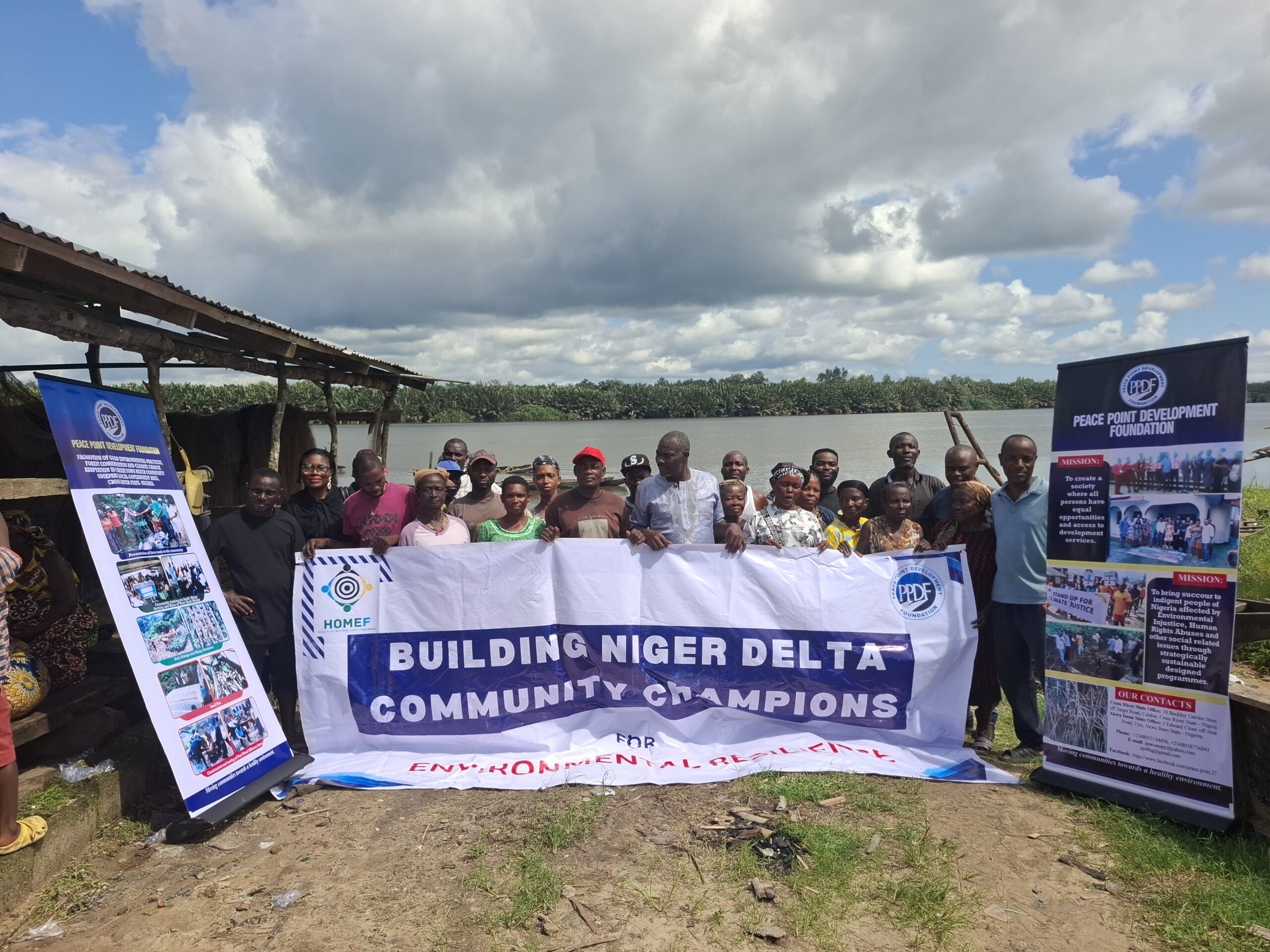
Fishers in Esuk Atu, a coastal community in Calabar, Cross River State, are worried about low fish catches, increasing pollution, vanishing mangroves, and flooding. They say these issues are making fishing harder and more expensive.
The fishers spoke on Friday during a community rights defenders training organized by Peace Point Development Foundation (PPDF) and Health of Mother Earth Foundation (HOMEF) at Esuk Atu.
This training is part of PPDF's second phase of its "Building Community Rights Defenders in the Niger Delta" project. The project aims to equip fishers, youths, and community leaders with knowledge and tools for environmental monitoring, documentation, and advocacy.
The first phase of the project took place last year in Essierebom, Calabar South, Cross River State, and Opolom in Ibeno Local Government Area of Akwa Ibom State.
The second phase is now extending to Esuk Atu in Calabar and Esuk Itu in Itu Local Government Area of Akwa Ibom State.
During the training in Esuk Atu, fishers pointed out several changes affecting their livelihoods. These include lower fish catches, smaller fish, pollution from oil spills, plastic waste, destruction of mangroves, flooding, and erosion.
They also mentioned changing weather patterns, insecurity, attacks by robbers, and damage to fishing gear by vessels in smaller waterways.
A PREMIUM TIMES investigative series previously reported how Nigerian small-scale fishers and women traders face threats from sea robbery and climate change. The government has no clear plan to assist them.
Mmayen Archibong, a fish seller in the community, said the drop in fishing is not getting enough attention. She believes consumers are more concerned about rising fish prices than the reasons behind the decline in supply.
"People are not giving attention to the fact that fishing is declining because what the fishers bring out from the water is no longer much as before," she said.
"People are only complaining that fish is expensive but are not asking why it is expensive. We no longer see adequate fish to buy.
"As we continue to keep quiet and act as if everything is okay, one day it will get to an alarming point."
A fisher, Effiong Otu, said the destruction of mangroves for firewood and mining is a major threat to fishing in the area. He explained that mangroves are breeding grounds for fish but are disappearing quickly, with some areas taken over by nipa palms.
He stated that although Cross River waters may not have the same level of oil pollution as some parts of the Niger Delta, increasing mining activities are making the water dirtier. He also complained about the growing presence of plastics in the water.
"These days, you stay longer in the water before you can catch fish," Mr Otu said. "This is because our water is becoming too polluted, making fish migrate to cleaner water. To get to such waters, you burn more fuel. That is why fish is becoming more expensive."
Scientific studies have also shown environmental pressures around Esuk Atu and the Great Kwa River. A study of aquatic organisms in the area linked low abundance and distribution of zooplankton to pollution and human activities, including domestic waste and industrial effluents.
Another recent study of sediments in the lower Calabar and Great Kwa rivers found the mangrove creek system is a spawning habitat for fish and other aquatic species. It also examined the potential ecological risks from toxic metals in the river sediments.
In his presentation on NSAC and NDAC, Peace Point Development Foundation Coordinator, Umo Isuaikoh, explained that these frameworks aim to promote development that does not harm people, land, or water.
He said the NSAC principles include ecological limits, protection of communal resources like rivers, creeks, and mangroves, and community participation in decisions about extractive projects.
For fishers, he said, this means they should be part of decisions about pollution and environmental cleanup. Mr Isuaikoh added that communities should be consulted when investigating and cleaning up environmental damage. Compensation should restore livelihoods instead of just providing financial settlements.



He stressed that preventing environmental damage is better than just monetizing it. The NDAC framework promotes a shift from oil and mining-driven development to life-centered development, focusing on environmental restoration, community control of resources, and economic alternatives.
For fishing communities, this includes restoring polluted rivers and mangroves, enforcing the polluter-pays principle, and ensuring communities have a voice in decisions affecting their resources.
"The Niger Delta cannot feed Nigeria if its waters are poisoned," Mr Isuaikoh said in his presentation.
The NSAC arose from national discussions on Nigeria's ecological challenges. This led to the adoption of the Nigeria Socio-Ecological Alternatives Charter, which identifies ecological justice, people's participation, sustainability, accountability, solidarity, and partnership as core principles.
Environmentalist Idongesit Essien, who led sessions on grassroots organizing and environmental justice, told participants that individual fishers have limited power to influence environmental decisions. He encouraged them to build collective strength through organization.
He pointed out obstacles to effective community advocacy, like fragmented communities, fear of speaking out, political co-option, and the exclusion of women.
He urged participants to strengthen networks like the FishNet Alliance, Women’s Eco Defenders, and Youth Ambassadors. Through the proposed FishNet Alliance, fishers can share information about pollution, document incidents together, negotiate for fair compensation, and set up early-warning systems.
He said women should play a key role in environmental advocacy since they often face health risks from pollution and reduced income from fish processing.
He also called on young people to engage in environmental monitoring, data collection, and digital storytelling using photos, videos, and location information.
The training introduced participants to community mapping, documenting pollution and environmental incidents with mobile phones, recording testimonies in local languages, keeping fisher logbooks, and engaging officials through town hall meetings.
"What is documented is harder to deny," Mr Essien said.
In another presentation on communication, storytelling, and sustainable alternatives, Mr Essien urged fishers to share their experiences about environmental changes in their communities.
He encouraged them to use petitions, media engagement, state assembly discussions, and alliances with farmers, traders, and health workers to pursue their demands.
Mr Essien also asked fishers to use local radio, community meetings, social media, WhatsApp, and other platforms to tell their stories.
The Cross River State Commissioner for Environment, Bassey Mensah, represented by ministry official MaryDoris Opue, praised the Peace Point Development Foundation and HOMEF for choosing Esuk Atu for the program.
Mr Mensah described the community as part of Cross River’s coastal ecological heritage. He noted that environmental degradation, climate change, and livelihood pressures are affecting coastal communities.
He added that coastal communities in Calabar South, Bakassi, and Akpabuyo are facing the impacts of climate change. The commissioner said the state government values environmental justice and community stewardship as part of its environmental agenda.
He called the Community Rights Defenders project an empowerment initiative. It will help participants understand their environmental rights and the laws that protect them. It will also give women, fishers, farmers, and youths a stronger voice in environmental matters.
Mr Mensah promised that the ministry would work with the initiative. He said they are ready to include community rights defenders in community-based environmental monitoring. He also pledged stronger collaboration in reporting environmental violations, mangrove destruction, and illegal activities. Community demands and reports will be taken to the State Executive Council.


Drop your comment
No comments yet — be the first to drop the gist 👇