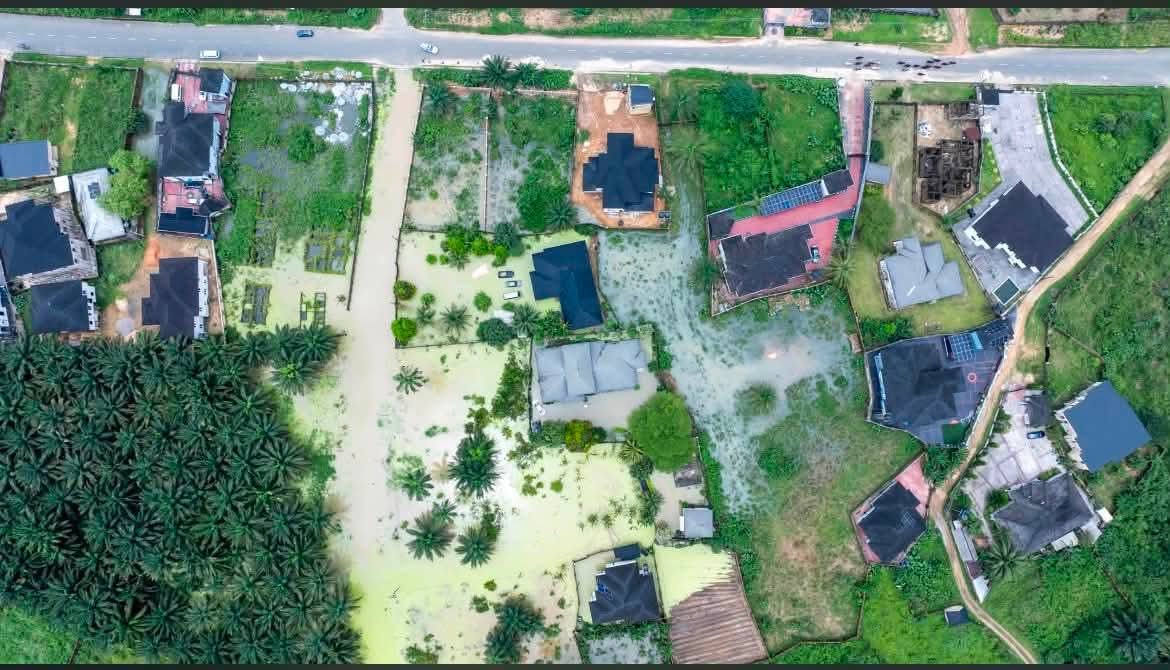
Every day, Mfon Ndanyongmong’s kids ask her the same thing: "Mummy, when are we going back home?"
For weeks, she has struggled to find an answer.
Her family’s house at Ifa Ikot Akpabio, Shelter Afrique Extension, Uyo, Akwa Ibom State, is under floodwater. Her car is stuck in the compound, slowly sinking, while her family has had to stay in a hotel.
What should be a comforting home is now unreachable for her.
"I have gone through severe loss, emotional stress, mental trauma," Ms Ndanyongmong told PREMIUM TIMES, tears in her eyes.
She said things got worse on 22 September when officials from the National Emergency Management Agency (NEMA) visited and told residents to leave.
That day, she waded through waist-high water with her husband and three children to get to safety.
Since then, she has not been able to go back home.
"It breaks my heart that every day my kids ask me, ‘Mummy, when are we going back home?’ And I do not have an answer to that question," she said.
Her family is among those suffering from severe flooding at Ifa Ikot Akpabio, close to Professor Nse Essien Avenue and Grace Land School in Shelter Afrique Extension, a high-end residential area in Uyo.
Five households have had to leave their homes, according to residents, while others, especially those in storey buildings, are still there because they have nowhere else to go.
PREMIUM TIMES visited the area and saw that the floodwater was still too high to access the affected homes. Because of the water level and safety risks, the newspaper could not check the full extent of the damage inside the compounds.
Residents blamed the flooding on an abandoned road construction project, incomplete drainage channels, and the buildup of runoff water from nearby streets in their low-lying neighborhood.
But the state environmental protection agency said the area used to be a brook, and some houses might have been built on a natural waterway.
These different views raise questions about building approvals, urban planning, drainage design, oversight of public works, and how the government has responded to residents who say they have repeatedly asked for help.
Abandoned Road and Unfinished Drainage
Residents said the state government gave Blagadat Construction Limited the contract for the road, but the contractor left the project hanging around October 2025.
PREMIUM TIMES could not confirm the contractor’s involvement or the reasons for the abandonment. There was no visible signboard for the project, and the state government had not replied to questions about it at the time of publication.
During its visit, PREMIUM TIMES noted that drainage channels built along the road connected to drains from other streets but stopped abruptly halfway along the flooded street.
Residents said the unfinished drainage had left the area receiving water from surrounding roads without a proper outlet.
They pointed to runoff from Rev. Amaowo Road, built by Hensek Construction Company, as a major cause of the flooding.
They explained that the issue was not just about the amount of rain but also how water from many directions was directed into their neighborhood.
Ms Ndanyongmong said drainage channels from four sides now converge in the area, which she described as lower than its surroundings.
She said the drains along Professor Nse Essien Avenue and Rev. Amaowo Road did not drain properly, causing water to pool in the community.
"After the attempt at road construction, drainage on both sides were done, but it stopped halfway," she said.
"All the waters from neighboring communities coming into Shelter Afrique Extension drain into this point. And this point happens to be low."
She added that the flooding has also affected their water supply. "In my compound, if you turn on the tap from the borehole, you see dirty water. Our soakaway has been filled with water," she said.
PREMIUM TIMES could not independently confirm the exact engineering cause of the flooding or whether the drainage designs were approved or well executed.
The Ministry of Works had not replied to questions about the project by the time of publication.
Government Says Area Was a Brook
The Chairman of the Akwa Ibom State Environmental Protection and Waste Management Agency, Prince Ikim, told PREMIUM TIMES that the government sympathizes with the affected residents but argued that the flooding was not solely due to blocked or inadequate drains.
He said the government has set up an Emergency Flood Response Committee led by the Deputy Governor to deal with such situations.
According to Mr Ikim, after the flooding at Ifa Ikot Akpabio was reported, the committee met and sent a team, including himself, to inspect the area.
"Some of the flooding that we see is not caused by clogged drainage. Some are caused by building on waterways. This particular location used to be a brook. Unfortunately, they went and built there. Most of the water is coming from the ground," he said.
He shared that the government’s efforts to remove the water included sending a fire service truck to pump it out, but it did not yield the expected results.
Mr Ikim mentioned that their findings suggested that solving the problem might require demolishing some structures to allow water to flow out.
"But who will be willing to allow his building to be sacrificed?" he asked, noting that demolition is an option that might be needed to address the situation.
When PREMIUM TIMES told him that residents claimed they had received government approval before building their houses, Mr Ikim said he did not know if such approvals had been granted.
He acknowledged hearing residents say that water from nearby streets and the abandoned drainage project had worsened the flooding.
But he maintained that the affected area is one of the two lowest points in Shelter Afrique and that its natural layout was recognized in the estate’s design. "When there was no development there, because of the natural terrain of it being a brook, water was usually channeled to that point. It served as a natural waterway," he said.
He added that some buildings in the area had concrete foundations, suggesting the owners knew the land was prone to flooding. "We sympathize with them. But this is no fault of the government," he said.
Mr Ikim said the emergency committee hopes to meet again to look for ways to address the situation. When asked when residents could expect help, he said it would happen "soon" but did not give a specific date.
The agency did not provide PREMIUM TIMES with the technical assessment, drainage plans, or other documents backing its claim of the area’s historical status.
Residents Challenge Government’s Account
When PREMIUM TIMES shared the agency’s position with affected residents, they disagreed with the idea that they built their homes without the necessary government approvals.
Each resident contacted by the newspaper insisted that they had obtained the required approvals and that no government agency had stopped them from building in the area.
Charles Ndanyongmong questioned why the government had not made it public that the area was a brook where construction should not happen.
"Where has it been gazetted that the area is a brook and no one should build?" he asked.
He also wondered why the government had approved and started a road construction project in the area if it was not suitable for building.
Another resident, Shedrach Mattias, said they had all gotten government approvals before building their houses.
"In an estate and urban area like ours, would any reasonable person build without approval?" he asked.
Mr Mattias expressed disappointment that residents had not received what they considered meaningful government help despite the ongoing flooding.
He disputed the claim that the government had tried to provide emergency relief, saying residents had paid for interventions, including the fire service’s attempt to pump out the water.
He said he reached out to the Ministry of Environment and was told that the government would wait until the dry season before taking action.
"But how do we cope without relief until the dry season?" he asked.
PREMIUM TIMES could not confirm the residents’ building approvals or whether the relevant authorities had designated the area as a natural waterway before the houses were built.
The newspaper’s inquiries on 26 October to the government sought clarity on the approvals, drainage infrastructure, and emergency response, but the relevant officials had not provided the requested information by the time of publication.
The conflicting accounts leave key questions unanswered: whether the houses were approved, whether the drainage design properly accounted for the area’s terrain, and whether the reported road project has made the situation worse.
‘We Have Nowhere to Go’
For Dennis Hanson, the flooding has turned an ordinary residential street into a place where leaving home is a struggle.
He said he first noticed unusual flooding in July. Back then, residents could still move around, although they sometimes had to roll up their trousers or drive through the water to leave the area.
Things got worse in September when water started coming into the street from nearby roads, along with water flowing through the drainage channels.
"From that point, no one could go out," he said.
Mr Hanson, who lives with a family of six, said they are still trying to cope despite damage to their property and disruption to their daily life.
"We don’t just have where to go," he said.
For other families, staying in their homes is impossible.
Grace Shedrach said she cannot access her house, and her belongings have been lost to the flooding. Her dog is trapped inside.
"It has been a horrible experience. I don’t even know whether my dog is still alive," she said, blaming the unfinished road project and lack of proper drainage.



She mentioned that affected residents had pooled their resources to find a solution, but their efforts have not significantly reduced the water.
"The money we spend to stay in the hotel with family for about five weeks is too much. We want to return home," she said.
The long displacement has disrupted children’s schooling and added extra costs for families who have to pay for accommodation while their homes are still not accessible.
Ms Ndanyongmong said preparing her child for school from a hotel has become very difficult.
She has lived in the community for 12 years and said she has never seen flooding like this before.
Residents’ Efforts Fail as Appeals Await Response
Before reaching out to the government for help, residents tried to tackle the flooding on their own.
Ms Ndanyongmong said affected households came together to buy sandbags, use tarpaulins to block their gates, and hire pumping equipment to remove the water.
They even brought in a geologist and bought pipes to redirect the water away from their properties.
Residents said they called the State Fire Service to pump out the water, but the equipment and tanker were too small to make a real difference.
They said their efforts were overwhelmed by the sheer amount of water coming into the neighborhood.
"Intervention would need government effort, not individuals or community effort," Mr Hanson said.
The residents have also sent formal requests for government help.
PREMIUM TIMES saw a letter received by the Ministry of Works on 5 October from one of the affected households. Another letter, sent to the Office of the Deputy Governor, was received on 6 October.
In the letter to the Ministry of Works, the resident explained how drainage from Rev. Amaowo Road and the abandoned road project had focused water in the area without a proper discharge point.
The resident requested the immediate deployment of a high-capacity pumping machine to remove the floodwater through a temporary hose to a suitable underground drainage system.
The letter also asked that the construction company be instructed to return to complete the abandoned road and drainage works.
However, when PREMIUM TIMES visited the community on 26 October, the floodwater was still high, and some households remained displaced.
Residents said no government agency had come to assess their situation after the flooding and their formal requests, apart from the fire service intervention they said they paid for.
The affected area is also only a short distance from the residence of the Secretary to the State Government, Enobong Uwah. Residents said they had made many attempts to get the authorities’ attention to their plight.
Billions Budgeted, But What Has Been Delivered?
The flooding has raised questions about how Akwa Ibom spends its public funds for flood control, especially since recent state budgets have set aside billions of naira for drainage infrastructure.
A look at the 2026 approved budget shows that the state allocated N1.5 billion under the Ministry of Works for the construction of the 6.1-kilometre Shelter Afrique/Nung Ette Flood Control Tunnel in Uyo Local Government Area.
The project received N500 million in 2024 and N2 billion in 2025.
These allocations raise questions about how the project is being carried out, how much money has actually been released and spent, and whether the planned infrastructure is in place to protect vulnerable communities.
Just because money has been budgeted does not mean it has been spent or that it has turned into completed infrastructure.
PREMIUM TIMES on 26 October asked the Ministry of Works for details on the project’s status and spending, as well as what measures are being planned to address the flooding at Ifa Ikot Akpabio.
The newspaper also inquired whether the ministry checked the drainage designs and discharge points of nearby roads before approving the works, if it awarded the alleged abandoned road project, what led to the contractor’s abandonment of the site, and when work would resume.
The Commissioner for Works, Eno Ibanga, did not answer calls from PREMIUM TIMES. A formal media inquiry sent to the commissioner also went unanswered at the time of this report.
The state budget includes other provisions aimed at supporting emergency response and flood management.
The Office of the Deputy Governor received N9.3 million for buying equipment for emergency services.
The Akwa Ibom State Infrastructure and Assets Management and Maintenance Agency got N3 million for first-aid kits, emergency alarms, and response equipment.
The Ministry of Science and Digital Economy also received N10 million for a security-reporting app for citizens to report crimes and make emergency calls.
Separately, the Akwa Ibom State Environmental Protection Agency was allocated N2.5 billion for drainage, canal clearing, and flood control in Uyo and surrounding areas.
These provisions make the implementation of the state’s flood-control plans and its response to residents’ complaints a matter of public accountability.
Social Media Appeals, Lingering Questions
Residents have not only sent formal letters for help.
On 3 October, Ms Ndanyongmong made a Facebook post about the flooding under the name Mfon Essien. The post, which got 98 shares, tagged the verified Facebook page of Governor Umo Eno, the Niger Delta Development Commission (NDDC), and the South South Development Commission.
Victor Antai, the NDDC’s Executive Director of Projects, also has a house in the estate, according to information shared with PREMIUM TIMES.
The residents’ appeals have also highlighted the role of ecological funding in tackling environmental issues in the Niger Delta.
A review of Federation Account Allocation Committee reports cited by our reporter shows that 50 per cent of ecological funds meant for states and local governments in the Niger Delta are taken at source for the NDDC. This raises questions about how ecological resources meant for the region are used to address ongoing environmental challenges.
Many commenters on Ms Ndanyongmong’s post tagged the governor, official Akwa Ibom State Government accounts, and other notable political figures, calling for action.
On 22 and 27 October, more posts about the flooding led to further public calls for government help.
Yet residents said they are still struggling to pay for temporary housing after five weeks away from their homes.
PREMIUM TIMES reached out to the Commissioner for Information, Aniekan Umanah, on Monday for the state government’s response to the flooding. A call to Mr Umanah was rejected, and a media inquiry sent to him had not received a reply by the time of publication.
The newspaper also contacted the Press Secretary to the Deputy Governor, Omen Bassey, on Monday.
Mr Bassey said he was about to board a flight and should be contacted later. PREMIUM TIMES informed him that it was ready to send a formal media inquiry, which was later shared with him.
When the newspaper called again later in the afternoon, he said he had yet to settle in Abuja and would speak to PREMIUM TIMES later. He had not responded to the inquiry by the time of publication.
The newspaper asked whether the Office of the Deputy Governor had received the residents’ complaints, what action was taken, if any assessment was done, and what emergency measures the government would provide to help affected families.
It also sought clarification on the government’s plans to drain the affected area, restore access to homes, and address the root causes of the flooding.
Another Test of Emergency Preparedness
The unresolved issue at Ifa Ikot Akpabio raises concerns about the state’s ability to prevent disasters and to respond when they occur.
In a May 2026 investigation, PREMIUM TIMES reported that traders at Akpan Andem Market in Uyo suffered huge losses when a fire broke out and the nearby fire service station could not respond quickly due to a diesel shortage.
The investigation revealed that a proposed Akwa Ibom disaster risk management and emergency response plan, developed through consultations with government agencies and other stakeholders, has yet to lead to visible reforms.
The report highlighted worries about delays in execution and the need for an organized emergency response system. The Office of the Deputy Governor said the proposed plan is being reviewed against current laws and that legal advice is being sought.
The flooding at Ifa Ikot Akpabio presents another test of whether emergency planning and public budget allocations can lead to timely action when residents face immediate threats.
In July, PREMIUM TIMES also reported that flooding affected several communities in Uyo, damaging homes and prompting residents to protest over delayed road projects and drainage issues. The report looked into significant budget allocations for flood control and asked government officials about the execution of planned responses.
The latest incident raises another question: what happens when residents report a crisis, file formal complaints, and make public appeals, but still remain displaced while the underlying infrastructure problems persist?
The government’s claim that the affected area was a natural waterway also raises another point of contention. If the area was not suitable for building, what measures were taken to prevent construction? If residents got the necessary approvals, why were they given, and what checks informed those decisions?
If the flooding is mainly due to the area’s natural layout, the government still must explain what immediate steps can protect residents and whether the proposed demolition of structures is necessary and backed by a technical assessment.
Residents of Ifa Ikot Akpabio insist that their top priority is to remove the floodwater, restore safe access to their homes, and have a reliable plan to prevent future flooding.
They also want the government to clarify why the water has built up in their street, if the abandoned project worsened the crisis, and which authorities or contractors should take responsibility for fixing it.
Until the water goes down, families like the Hansons are stuck between the costs of leaving home and the dangers of staying.
For Ms Ndanyongmong, the hardest part is the question she faces every day from her children.
She still has no date to give them. The government has not given one.
And as the floodwater continues to fill the place her family calls home, the question of when they can return remains unanswered.


Drop your comment
No comments yet — be the first to drop the gist 👇