When the FIFA World Cup kicks off in Canada, Mexico, and the United States, one of Africa's football giants will not be there. Nigeria did not qualify for the expanded 48-team tournament, meaning the country will miss out on football's biggest show once again.
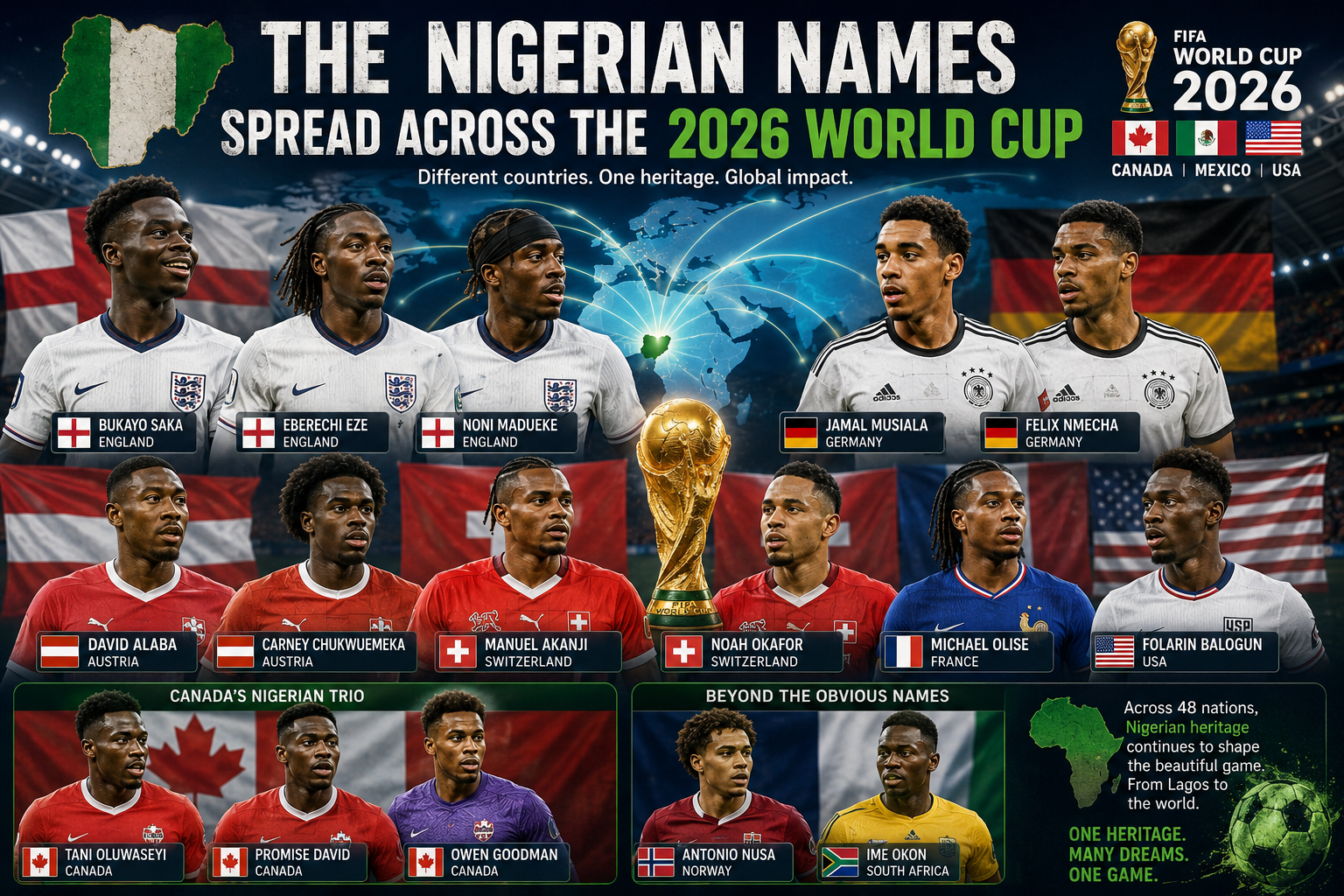
But as fans check FIFA’s final squad lists, something interesting stands out: players with Nigerian names and roots are everywhere. Even if the Super Eagles are not in the World Cup, players with Nigerian heritage will be on teams like England, Germany, France, Switzerland, Austria, Canada, and the United States.
This development shows that while Nigeria won’t be competing for the trophy, its impact on football is still strong.
FIFA’s squad lists show 1,248 players from 48 countries at this tournament, the biggest World Cup yet. Among these players are many whose family stories connect cities from Lagos and Enugu to London, Vienna, Zurich, Toronto, and New York.
England’s Nigerian connection
England is a clear example of Nigeria's influence. The Three Lions will head to the World Cup with three top attacking players who have Nigerian roots. The squad includes Bukayo Saka, whose full name is Bukayo Ayoyinka Saka. Alongside him are Eberechi Eze, listed as Eberechi Oluchi Eze, and Noni Madueke, whose full name is Chukwunonso Azuka Tristan Madueke.
Saka is a crucial player for England, known for being one of the Premier League's best. Together with his Arsenal teammates Eze and Madueke, they aim to help England end their fifty-year wait for another World Cup win since 1966. They represent a group of players born in England but raised in homes that kept strong Nigerian cultural ties.
Germany’s Nigerian roots
Germany also has a good number of players with Nigerian backgrounds. The star is Bayern Munich's Jamal Musiala, known for being one of the best attacking midfielders at the tournament. Musiala, born to a British-Nigerian father and a German mother, had options to play for different countries before choosing Germany.
He is joined by Borussia Dortmund's Felix Nmecha, whose Nigerian roots show in his full name, Felix Kalu Nmecha. Both players may play important roles as Germany looks for its fifth world title.
Nigerian heritage across central Europe
Nigeria's influence spreads beyond the usual football powers. Austria's captain David Alaba is one of the most famous players with Nigerian heritage. Born in Vienna to a Nigerian father and a Filipino mother, Alaba has been the face of Austrian football for over a decade.
Austria’s squad also includes midfielder Carney Chukwuemeka, another player with a well-known Nigerian family background. Switzerland will count on two players with Nigerian roots: defender Manuel Akanji and forward Noah Okafor. Both have become key players after going through Switzerland’s youth system.

France and America
France’s team features Bayern Munich winger Michael Olise, whose father is Nigerian. Olise’s journey from English youth football to being one of France's most exciting players shows the global nature of modern football.
The United States, one of the tournament hosts, will rely on striker Folarin Balogun. Born in New York to Nigerian parents and raised in England, Balogun reflects the international aspect of today’s football identities.
Canada’s Nigerian trio
Canada’s team gives a clear view of Nigeria’s growing football presence. Forward Tani Oluwaseyi was born in Abuja before moving to Canada. He is joined by striker Promise David and goalkeeper Owen Goodman, all of whom had the chance to play for Nigeria.
FIFA’s records show the Nigerian family ties of all three players. Their inclusion highlights the increasing influence of Nigerian communities in Canadian football.
Beyond the obvious names
The Nigerian presence goes even further. Norway’s promising winger Antonio Nusa has a Nigerian father and is seen as one of Europe’s bright young talents. South Africa’s defender Ime Okon also has Nigerian roots.
Across the World Cup, Nigerian names and family stories can be found in teams from Europe, North America, and Africa.
A World Cup without Nigeria, but not without Nigerians
The story of Nigerian heritage at the 2026 World Cup is bigger than just questions of who qualifies or missed chances. It tells a story of migration, identity, and how football connects generations across the world. While Nigeria’s absence is a disappointment for many fans, the tournament will still showcase a strong Nigerian presence. From Saka in England’s attack to Musiala in Germany’s midfield, from Alaba leading Austria to Balogun leading the United States, the impact of Nigerian heritage will be seen throughout the competition.

Drop your comment
No comments yet — be the first to drop the gist 👇