
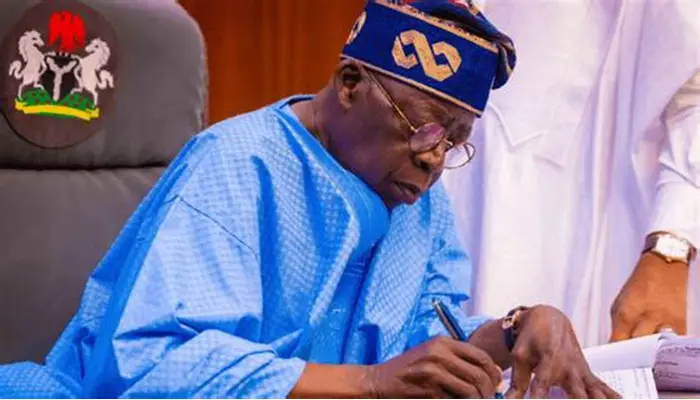
President Bola Tinubu has requested the National Assembly to approve a new edition of the Laws of the Federation of Nigeria. This comes after a government review found 268 existing laws to be outdated or repealed.
Mr Tinubu explained that a special committee, led by the Attorney-General of the Federation and Minister of Justice, Lateef Fagbemi, looked over 932 laws. They suggested that 664 of these should be part of the 2025 edition of the Laws of the Federation of Nigeria.
The president's request was shared in a letter read by Senate President Godswill Akpabio during the plenary session on Tuesday.
In the letter, Mr Tinubu said the committee was set up to check the current laws and update them according to the legislative, constitutional, institutional, and technological changes seen in the last twenty years.
He noted that updating these laws will make them easier to access and will provide a better reference for Nigeria’s legal framework, which will help strengthen democracy in the country.
Mr Tinubu urged lawmakers to review and approve the revised compendium, which will update the Laws of the Federation of Nigeria for 2025.
The president stated that this compendium will be an important legal reference for judges, lawyers, government institutions, local and foreign investors, and the general public.
“An updated, accurate, and easily accessible compendium of federal laws is essential for our democratic and economic growth.
“Once passed, the Laws of the Federation of Nigeria 2025 will provide a reliable legal reference for judges, lawyers, government institutions, and the public, boosting legal certainty, institutional efficiency, and public trust in our justice system,” the president said.
After reading the letter, Mr Akpabio sent it to the Senate Committee on Judiciary, Human Rights and Legal Matters. This committee will work with the Committee on Rules and Business for a detailed review and next steps.
Mr Akpabio also asked his colleagues to ensure that no parts of the laws are changed during the review.
“This is a very good exercise. But as lawmakers, it is important to take a careful look to ensure that the changes are accurately reflected and that every detail is properly considered and that nothing has been altered by those who sent the laws as passed by the National Assembly.
“After that, we will formally approve these Laws of the Federation 2025, so they can be circulated and used immediately,” he said.
Yahaya Abdullahi (APC, Kebbi North) warned his colleagues not to rush this process, considering its impact on Nigeria’s legal system.
“After almost 21 years, this exercise is very important and serious. We cannot rush into this because of the consequences for our justice system.
“We need to send this to the Committee on Judiciary, Human Rights and Legal Matters before we discuss this important issue. The laws affect many parts of justice delivery in Nigeria,” he said.
Deputy Senate President Barau Jibrin suggested that the National Assembly could hire consultants to create a summary of the compendium to make it easier for lawmakers to review.
Nigeria’s outdated laws
The last official update of the Laws of the Federation of Nigeria was done in 2004 and included federal laws in effect as of December 31, 2002. This 16-volume set, called the Laws of the Federation of Nigeria 2004 (LFN 2004), was approved by the National Assembly through the Revised Edition (Laws of the Federation of Nigeria) Act, 2007, which took effect on May 25, 2007.
This compilation organized the existing federal laws, but it has not been updated since then. This means that many laws passed after December 2002, including amendments and repeals, are not included in the official collection.
There was an attempt to update the compilation in 2010, but it did not get the needed legislative approval to become law.
Not having an updated collection has made it hard for lawyers, judges, lawmakers, researchers, government bodies, and the public to know the current status of federal laws. It has also allowed repealed or outdated laws to stay in older collections, while new laws and changes must be checked separately.
The National Assembly recognized this issue before. In November 2023, the Senate passed a motion directing its Committee on Judiciary, Human Rights and Legal Matters to work with the Attorney-General's Office to start revising the 2004 compilation.
The federal government set up a 46-member committee on October 24, 2024, led by the Attorney-General of the Federation and Minister of Justice, to review, update, and consolidate the country’s federal laws.
This committee was tasked with identifying laws that have become outdated, spent, or repealed; harmonizing conflicting provisions; including new laws and amendments; and producing an updated, easy-to-use collection of federal laws.
Legislative approval process


The revised collection will need to be carefully checked and approved by the National Assembly before it can be recognized as the official updated edition of the Laws of the Federation of Nigeria.
Under the current law, the Attorney-General of the Federation is in charge of compiling federal laws, but it must be approved by the National Assembly through an Act.
The request from President Tinubu means lawmakers will need to review the proposed collection, especially to confirm that the changes made to existing laws accurately reflect what the National Assembly passed and the President signed into law.
The Senate has sent the request to its Committee on Judiciary, Human Rights and Legal Matters, along with the Committee on Rules and Business, for in-depth examination. The House of Representatives will also consider the presidential request.
If the proposed update is to become law, both chambers must discuss and pass the necessary legislative instrument and the President must sign it. This will give the legal support needed for the new edition to take the place of the current official collection.
Effects on Nigeria’s legal system
Approving the revised collection could help the justice system by giving judges, lawyers, and other legal professionals a more updated and complete reference for finding applicable federal laws.
It could also lessen confusion from using outdated laws, especially where laws have been changed, repealed, or replaced. This will help courts and legal professionals understand the current laws when interpreting legislation and resolving disputes.
For lawmakers, an updated collection would make it simpler to find existing laws, identify needed amendments, and avoid creating laws that repeat ones that already exist.
This effort could also help improve access to justice by making it simpler for citizens, researchers, law students, and others to understand the laws that govern their rights and duties.
For businesses and investors, a clear and accurate collection could enhance legal certainty by providing better information about the rules that guide economic activities in the country.
But for this effort to succeed, the revised collection must be accurate and complete, and the public must have access to the updated laws.
Also, just removing a law from the collection does not repeal it or change its provisions. The legal status of each law must be determined by the relevant repealing legislation, expiration, judicial decision, or other legal processes. Similarly, the consolidation process must not be used to introduce changes that were not legally approved by the National Assembly.




Drop your comment
No comments yet — be the first to drop the gist 👇