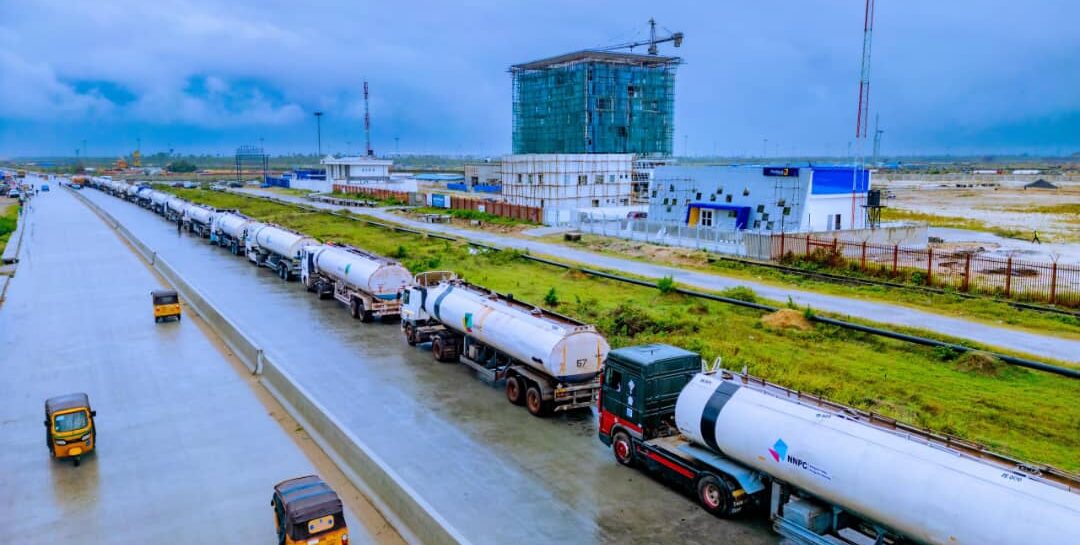
Nigeria’s state oil company, NNPC Limited, made a profit after tax of ₦462 billion in May 2026. This is a drop of ₦19 billion from the ₦481 billion reported in April, even though crude oil production, natural gas output, and pipeline availability improved.
The company shared its monthly report summary on Wednesday. The profit for May was 3.95 per cent lower than the previous month.
Revenue also took a hit during this period. NNPC reported revenue of ₦4.335 trillion in May, down by about ₦635 billion from the ₦4.97 trillion recorded in April.
According to the report seen by PREMIUM TIMES, total statutory payments to the Federation between January and May reached ₦4.858 trillion.
Even though production improved, the company is still facing operational challenges. These include declining reservoir pressure, underperforming oil wells, lifting constraints, and maintenance activities across several upstream assets.
The report showed that combined crude oil and condensate production rose to 1.73 million barrels per day (mbpd) in May. This is the highest monthly output the company has achieved in the past 12 months.
Crude oil production increased to 1.47 mbpd, while condensate production held steady at 0.25 mbpd. This shows a gradual recovery from the lows experienced late last year, when crude theft, pipeline vandalism, and ageing infrastructure impacted output.
Despite the rise, NNPC noted that production was still below target due to various operational issues. These include challenges at TotalEnergies-operated assets (TEPNG), declining reservoir pressure at the Bonga field, lifting-related curtailments affecting Nembe production, and maintenance work at the Stardeep Agbami field.
Natural gas production continued to rise during the month. The report said average daily gas production reached 7,774 million standard cubic feet per day (mmscf/d), the highest level recorded during this review.


Gas production had dropped to 6,284 mmscf/d in September 2025 but has steadily recovered since then. This rise reflects Nigeria’s focus on gas as a transition fuel and a key source of export earnings.
However, gas sales eased slightly to 4,921 mmscf/d, down from 5,044 mmscf/d in April and 5,059 mmscf/d in March.
The report showed mixed results for NNPC’s downstream operations. Premium Motor Spirit (PMS) availability at NNPC Retail Limited (NRL) stations was at 57 per cent. This indicates that fuel supply at the company's retail outlets is still below optimal levels.
On a positive note, pipeline operations performed better. The Obiafu-Obrikom-Oben (OB3) gas pipeline achieved 97 per cent availability, while the Ajaokuta-Kaduna-Kano (AKK) pipeline recorded 94 per cent availability. Overall, upstream pipeline availability stood at 98 per cent.
A heat map in the report showed different fuel availability levels across Nigeria. Central Nigeria and parts of the South had better product availability compared to some northern and eastern states.
NNPC said it is taking steps to boost production and improve asset reliability. This includes addressing issues like declining reservoir pressure, poor well performance, lifting constraints, maintenance shutdowns, and facility reliability problems.
On the AKK Gas Pipeline Project, the company mentioned that construction of the mainline and equipment installation is well advanced. Early gas delivery to Abuja is expected in 2026.
For the OB3 Gas Pipeline Project, NNPC reported progress on the River Niger crossing and expects to commission the remaining pipeline section before the end of the third quarter in 2026. Both gas infrastructure projects are important for Nigeria’s plan to expand domestic gas use, support industrial growth, and improve electricity generation.



Drop your comment
No comments yet — be the first to drop the gist 👇