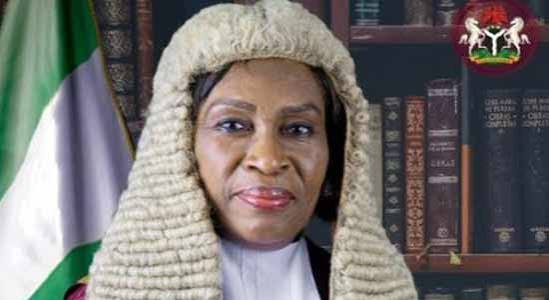
A retired Justice of the Court of Appeal, Oludotun Adefope-Okojie, has called on Nigerian courts to hold political parties responsible when they break their own rules or electoral laws. She warned that the idea of party independence should not shield illegal actions from court oversight.
She also advised judges not to declare candidates who lost elections as winners. Courts should not take away the power of voters to choose their leaders.
Ms Adefope-Okojie spoke on Tuesday in Lagos. She delivered the annual lecture of Gavel International, titled Electoral Process in Nigeria: Managing the Boundaries of Judicial Intervention.
"The courts must no longer refuse to intervene where political parties violate their own constitution and ‘rubbish’ the Electoral Act. They must intervene to sanitise the system," she stated.
The chairman of the event, Anthony George-Ikoli, a Senior Advocate of Nigeria (SAN), said the judiciary must protect the integrity of elections without taking over the roles of voters or electoral bodies.
"The judiciary must neither become an alternative electoral commission nor abdicate its responsibility as the ultimate guardian of electoral legality. That is the delicate boundary we are here this morning to interrogate," he said.
Mr George-Ikoli said courts must be ready to deal with unlawful actions without going beyond their constitutional duties.
"Judicial restraint should not amount to judicial retreat, just as judicial courage should not degenerate into overreach," he said.
He added that an election cannot be seen as credible just because a winner was declared. It must also be because the process that produced the winner can hold up to legal examination.
Ms Adefope-Okojie pointed out that the 1,209 petitions filed after Nigeria’s 2023 general elections show how much distrust exists in the electoral system.
These petitions involved 1,280 elective positions, which means there were about 94.5 petitions for every 100 positions contested. Some seats had several petitions against them.
Only 103 of the petitions were successful, she said.
Comparing Nigeria with other countries, she noted that Zambia had about 83 parliamentary petitions following its 2021 elections for 156 seats. Malawi had 44 petitions for 193 seats after its 2019 elections.
In Kenya, there were 388 petitions tied to 1,882 elective positions after the 2017 elections. This number dropped to 123 after the 2022 elections, which is about 6.5 petitions for every 100 seats. Ghana had 16 petitions for 275 parliamentary seats after its 2020 elections.
She also provided figures from the United Kingdom, South Africa, and the United States. The UK had 302 petitions across various elections from 1900 to 2016. South Africa received 579 objections to its Electoral Commission after the 2024 elections, while the US recorded 756 election-related cases in 2023 and 2024, mainly about pre-election rules.
She acknowledged that these figures cover different types of disputes and cannot be directly compared.
"These figures do not measure the quality of justice. They measure trust, and on that measure the Nigerian electoral process is in severe deficit," she said.
Ms Adefope-Okojie used Kenya's drop in election petitions as proof that stronger electoral bodies and good dispute-resolution methods could lighten the load on courts.
She urged Nigeria to better handle disputes within political parties and at the electoral commission level. This way, more disagreements could be sorted out before they reach election tribunals.
A report by the Policy and Legal Advocacy Centre (PLAC), titled From Ballot to the Courts: Analysis of Election Petition Litigation from Nigeria’s 2023 General Elections, also looked at how these disputes played out.
PLAC reviewed 1,503 court records. This included 895 Election Petition Tribunal judgments, 588 Court of Appeal judgments, and 20 Supreme Court judgments.
At the tribunal level, 99 petitions succeeded, while 794 were dismissed. The Court of Appeal allowed 115 appeals and dismissed 446.
PLAC also found 43 cases where petitioners won at both the tribunal and appeal levels. Another 42 petitioners lost at the tribunal but won on appeal, while 30 who initially won at the tribunal lost their cases on appeal.
The organization stated that 4.8 percent of the tribunal petitions analyzed ended in victories that were maintained through the appeal stage.
It said the ability of petitioners to prove their cases with credible and admissible evidence decided about 73 percent of the petitions reviewed. Missing mandatory procedures accounted for 14.7 percent, lack of jurisdiction for 8.5 percent, and lack of legal standing for 3.7 percent.
Ms Adefope-Okojie said political parties cannot hide behind internal autonomy when they break their own rules or electoral laws.
She referred to the Supreme Court’s ruling in PDP v Alhaji Sule Lamido, Appeal No. SC/CV/164/2026, given on 30 April 2026. This case was about Mr Lamido trying to get a nomination form for the position of national chairman of the Peoples Democratic Party at its 2025 national convention.
In a split 3-2 decision, the Supreme Court ruled that courts can intervene when a party violates its constitution or acts against the law, even though they usually try to stay out of political parties' internal matters.
Justice Stephen Jonah Adah led the majority, along with Justices Tsammani and Abubakar Sadiq Umar. Two justices disagreed.
Ms Adefope-Okojie supported the majority view, emphasizing that courts should not ignore claims of violations just because they involve the internal matters of political parties.
She also mentioned Zamfara APC v Marafa, the Bayelsa governorship dispute involving the PDP and Degi-Eremienyo, and the Plateau election disputes as clear examples of the fallout from unlawful party decisions and nomination processes.
This issue is especially significant under the Electoral Act 2026, which became law on 18 February and replaced the 2022 Act.
Section 83(5) prevents lawsuits concerning the internal affairs of political parties, while Section 88(2) allows a candidate to approach the Federal High Court if a party does not follow the Act or its nomination rules.
Section 85 also limits the criteria parties can use in selecting candidates.

The retired judge pointed out four ways to look at electoral justice: corrective, protective, substitutive, and abdicative.
She explained that corrective justice means fixing a wrongful election or making a lawful vote right. Protective justice may require a new election when the original process cannot yield a trustworthy result.
Substitutive justice happens when a court declares a candidate who did not get the voters' approval as the winner. Abdicative justice occurs when a court refuses to look into credible claims of malpractice due to procedural or evidence problems.
"No longer should an election be upheld in favour of a person the electorate did not vote for. The matter must be returned to the electorate for their own choice. Their choice must not be hijacked by the substitution of non-deserving candidates," she said.
If a candidate's qualification is faulty but the lawful votes cannot determine who really won, she said a new election might be better than declaring the runner-up as the winner.
"The test of a good election judgment is not only whether it applies the law correctly, but whether, at the end of it, the person who holds office is the person the lawful votes chose, or, if that cannot be known, whether the choice has been returned to the voters," she said.
She cited Kenya’s Raila Odinga v IEBC judgment in 2017, where the Supreme Court annulled a presidential election and ordered a new poll within 60 days.
She also mentioned Malawi’s Mutharika v Chilima and Chakwera case, which led to the cancellation of the 2019 presidential election and a rerun.
Other cases from Ghana, South Africa, India, the United States, and the United Kingdom showed how courts in different places have dealt with election disputes.
Ms Adefope-Okojie said proving electoral malpractice remains a huge challenge for petitioners.
She noted that petitioners often have to show irregularities at each polling unit and prove that the alleged issues significantly changed the election outcome. With around 176,000 polling units nationwide, this task could be tough.
She pointed to the Edo State governorship election petition filed by Asue Ighodalo of the PDP against Monday Okpebholo of the APC after the 2024 election.
The tribunal dismissed the petition due to issues with the evidence presented. This decision was later confirmed by the Court of Appeal and the Supreme Court.
The retired judge questioned how documentary evidence is handled, especially the need for petitioners to bring witnesses to support the contents of public documents.
She referred to Sections 102 to 105 of the Evidence Act, which say public documents, including certified copies, can be admitted.
She also pointed out Paragraph 46(4) of the First Schedule to the Electoral Act 2026, which allows documentary evidence to be submitted and considered read, with lawyers addressing the court on its contents.
She urged judges to properly consider admissible documentary evidence instead of rejecting it just because the person who created or certified it was not called to testify.
She also raised concerns about the challenges petitioners face in getting electoral officials to testify.
Since the Independent National Electoral Commission often appears as a respondent in election petitions, she said its officials might be hesitant to testify against the commission unless forced.
She called for changes to Paragraphs 4(5) and 4(6) of the First Schedule to the Electoral Act. This would exempt subpoenaed witnesses from needing to submit witness statements in advance.
She also asked for clearer rules on electronic evidence, especially regarding the Bimodal Voter Accreditation System (BVAS) and the INEC Result Viewing Portal (IReV).
According to her, the unclear use of the term "communication failure" could create confusion in disputes about electronic result transmission and weaken trust in the electoral process.
These worries arise as the judiciary gets ready for another wave of election disputes ahead of the 2027 general elections.
The presidential and National Assembly elections are set for 16 January 2027, while governorship and State House of Assembly elections will take place on 6 February.
At a meeting with election tribunal judges on 10 November, the Chief Justice of Nigeria, Kudirat Kekere-Ekun, and the Attorney-General of the Federation, Lateef Fagbemi, warned judges against political interference, intimidation, and inducement.
The President of the Court of Appeal, Monica Dongban-Mensem, noted that 375 judicial officers have been nominated to serve on election petition tribunals. This includes 237 new members and 138 returning members.
INEC Chairman Joash Amupitan also pointed out disputes over electronic result transmission, BVAS, IReV, party primaries, and candidate nominations as likely sources of legal battles after the elections.
The 2023 elections put a lot of pressure on the judiciary. In September 2023, Ms Dongban-Mensem said 98 panels were needed to handle the 1,209 petitions filed after the polls.
Ms Adefope-Okojie urged the Chief Justice of Nigeria, the President of the Court of Appeal, and other court leaders to choose judges with proven integrity and political neutrality for election tribunals.
"The Constitution places sovereignty in the people and makes the Courts the guardians of that sovereignty, not its holders," she said.
She stressed that the ultimate goal should be a trustworthy electoral process where voters decide the winners and fewer disputes need court intervention.
"The final aim of electoral adjudication should be its own decline: a democracy in which elections are won and lost at the ballot box, not in the courtroom."


Drop your comment
No comments yet — be the first to drop the gist 👇