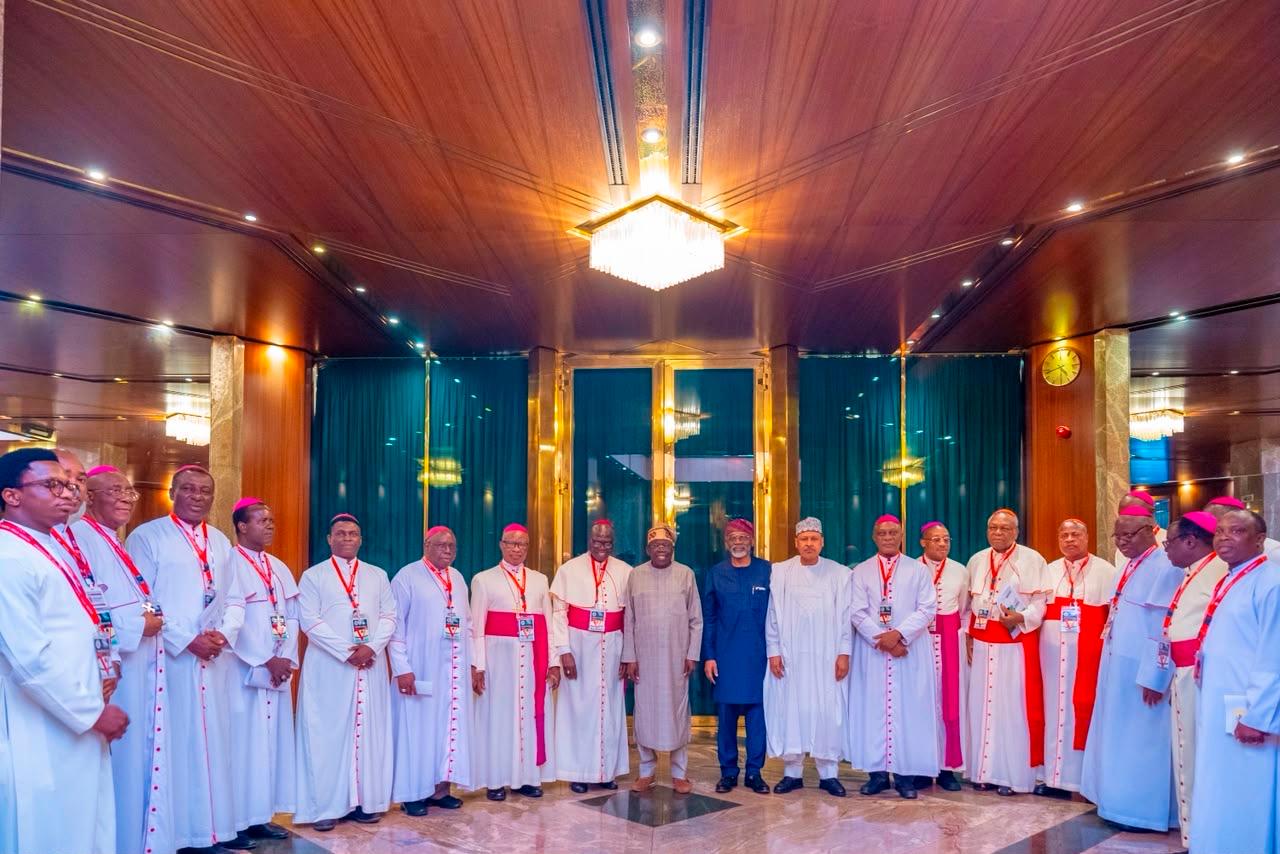
The Presidency first told Nigerians about President Bola Ahmed Tinubu's meeting with the Catholic Bishops' Conference of Nigeria on 28 July 2026.
In a statement from presidential spokesperson Bayo Onanuga, the Presidency said Tinubu met with a delegation led by Most Rev. Matthew Man-Oso Ndagoso, Archbishop of Kaduna.
The statement, titled "We Are Stabilising the Nation, Prosperity on the Horizon, President Tinubu Tells Catholic Bishops," mentioned that restructuring security operations would help overcome terrorism, banditry, and kidnapping.
"I have just approved the expansion of the armed forces," the President said. "We are getting more equipment, building new barracks. We will defeat terrorism."
The composition of the delegation showed that this was a wide-ranging discussion with the Catholic hierarchy. The bishops voiced concerns about security, university spaces, democracy, credible elections, and poverty. They also made requests for mission schools and equal access to places of worship.
Tinubu pointed to the Nigerian Education Loan Fund, the absence of long strikes by the Academic Staff Union of Universities, and what he called the recovery of the economy.
"I can tell you categorically with sincerity that the country has been placed on a sound footing. The economy has recovered," the President stated. "This government has stabilised, and there is prosperity on the horizon. Life is improving."
Regarding the 2027 elections, he defended the Independent National Electoral Commission, saying, "The opportunities are equal. INEC is neutral. They have never intimidated anyone."
After the meeting, the full text of Archbishop Ndagoso's address, titled "Partners in Building a Just, Peaceful and Prosperous Nigeria," became public. It showed that the bishops had a broader view than what the Presidency shared.
Their address was not a complete rejection of the administration. They praised the NELFund, thanked the government for hosting Archbishop Paul Gallagher, and acknowledged the rescue of kidnapped schoolchildren and their teachers. They recognized some government efforts but questioned if those efforts had led to enough improvement.
The bishops expressed worry about the position of Christians after the shift from the informal Christian-Muslim balance in the presidency. They did not claim the Muslim-Muslim ticket was unconstitutional. They asked the President to reassure Christians of their equal rights and place in Nigeria through deliberate policies and actions.
On education, they praised the student loan program but said loans alone could not fix the shortage of university spaces. They also questioned the recent federal moratorium on new tertiary institutions, fearing it would limit the needed expansion for Nigeria's growing youth population.
The moratorium raises a real policy question. Nigeria has many underfunded and underused institutions, and random expansion could weaken academic standards. But limiting new institutions does not solve the shortage of spaces. Access, affordability, staffing, infrastructure, and quality must all be tackled together.
The bishops also warned about the risk of a one-party-dominant state. They asked President Tinubu, as the leader of the ruling party, to ensure a fair playing field and strengthen the democratic institutions he once relied on as an opposition figure.
They connected this worry to low voter turnout and increasing public distrust in elections. They called for easier access to permanent voter cards, timely funding for INEC, transparent processes, and results reflecting voters' choices. They warned that anything less than a credible election in 2027 would be an "invitation to avoidable disaster."
Insecurity was one of the most pressing issues raised. The bishops acknowledged successful rescues but argued that these were isolated compared to attacks on schools, farms, homes, places of worship, and highways. Their statement that Nigeria was "bleeding" presented insecurity as a moral crisis, not just an operational problem.
They linked insecurity to economic hardship, unreliable electricity, poor roads, and policies whose promised benefits had been slow to reach citizens. They repeated their call for the return of mission schools and equal application of religious freedom, especially for Christians who reportedly struggle to obtain land for churches in parts of northern Nigeria.
The disagreement became sharper when Cardinal John Onaiyekan, a member of the delegation, appeared on ARISE News on 31 July 2026.
"His reply is that the nation is not bleeding," Onaiyekan said of the President. "We told him our economy is not helping our poor people. He told us the economy is doing fine."
The Cardinal claimed that people around the President were "giving him a rosy picture of what the country is, which it is not." He said the bishops felt they had a duty to help Tinubu understand the country's reality as they saw it.
"When the nation is bleeding, you can't expect a polite meeting with the head of state," he noted. "We need to let him know."
Onaiyekan also attributed to the President the statement, "In politics, all is fair." He saw it as proof of a strong desire to win elections and argued that the government was "bent on winning by all means."
This remark does not appear in the Presidency's original account of the meeting, and there is no independent transcript to confirm its exact wording or context. It should be considered Onaiyekan's memory rather than a verified quote.
On 1 August, the official State House website published "Cardinal Onaiyekan's Abuse of Clerical Privilege," a response by Temitope Ajayi, Senior Special Assistant to the President on Media and Publicity.
Ajayi wrote in his own name, calling Onaiyekan's choice to share and interpret the private meeting "fundamentally inappropriate" and "an abuse of clerical privilege." He said the bishops requested the meeting, presented a "notably harsh" submission, and received the President's response. He argued that they should have respected the confidentiality of the engagement.
He also defended the administration's position. The bishops' assessment, he wrote, was "neither scripture nor an article of faith," but a view that could be challenged with facts and evidence.
According to Ajayi, Tinubu recognized that serious economic and security issues still existed but believed Nigeria had come out of a "dark tunnel" and set the stage for recovery. Ajayi mentioned fiscal stability, more regular salary payments, and achievements by the armed forces and intelligence agencies.
He dismissed the idea that officials were shielding Tinubu from the truth, stating that the President gets information through newspapers, television, intelligence reports, operational briefings, and contacts from across the nation.
One sentence sharpened the main issue: "The real question is not whether they know the truth but what choices they make in response to it."
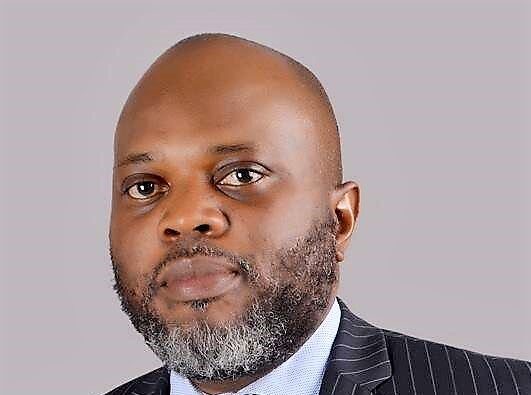
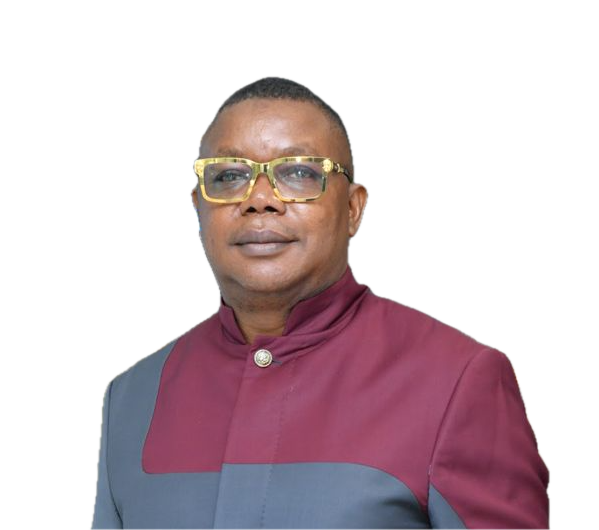
On 3 August 2026, Catholic priest Ugochukwu Ugwoke publicly disagreed with Ajayi's confidentiality argument. He insisted that the meeting was neither a sacramental confession nor a legally protected process and argued that, without a clear agreement, there was no absolute obligation of secrecy.
This later statement does not decide if Onaiyekan used good judgment. It highlights the difference between a legal or church duty of confidentiality and a political expectation of discretion.
I look back at this exchange to examine what each side said, the evidence behind their positions, and the questions that remain unanswered. Neutrality does not mean avoiding tough conclusions. It requires applying the same standards of evidence, fairness, and context to everyone.
The difference between the two accounts came from how they measured the country. The Presidency focused on fiscal stability, government programs, university stability, and security operations. The bishops emphasized household welfare, political competition, public trust, and citizens' experiences of insecurity.
On Christian inclusion, the issue is not just if the Muslim-Muslim ticket was legal. A political decision may be constitutional yet leave people feeling excluded. The bishops' concern should be judged against the administration's record on appointments, policies, and equal treatment, not only by its electoral legality.
On political competition, one-party dominance can happen without formally banning opposition parties. It can arise through pressure on opponents, unequal access to state resources, or misuse of incumbency. Defections alone do not prove competition has ended. The real test is whether opposition parties can organize, campaign, and contest elections without unfair disadvantages.
Neither presidential assurance nor public distrust settles the matter of INEC's independence. Its credibility should be assessed by the transparency of appointments, adequacy of funding, consistency of procedures, integrity of collation, and verifiability of results.
INEC's 2024 Review of the 2023 General Election recorded 93,469,008 registered voters. About 26.7 percent participated in the presidential election on 25 February 2023, alongside National Assembly elections, based on total votes against the complete register.
This number does not prove electoral manipulation. Low turnout can come from voter apathy, distrust, insecurity, logistical issues, not collecting permanent voter cards, and problems at polling units. Still, it shows a serious problem of low electoral participation, even if the causes need more evidence.
Having once helped manage security in one of Nigeria's most sensitive states, I know the current crisis did not happen overnight. It reflects social tensions, institutional failures, policy weaknesses, and ignored warnings over many years. I looked at part of this history in my article, "National Security Reflections on Maitatsine, Bullum-Kuttu and Boko Haram Uprisings."
This history helps explain the complexity of the problem without removing the government's responsibility. While the current administration did not create every part of the crisis, it has the constitutional duty to tackle it. Progress must be measured not only by operations carried out, arrests made, or weapons seized but by whether those efforts lead to lasting safety.
Classified intelligence and citizens' experiences measure different parts of security. Operational reports may show what security agencies are doing; citizens judge results by whether they can travel, farm, go to school, and worship without fear. Both are needed for a fair assessment.
The economic disagreement can also be looked at using published data. The economic disagreement can also be examined against published data from the fact-checking perspective of a journalist studying conflict and security governance. That is what I have done, as the next paragraph shows.
According to the National Bureau of Statistics' Nigerian Gross Domestic Product Report Q1 2026, Nigeria's real GDP grew by 3.89 percent year-on-year in the first quarter of 2026, compared to 3.13 percent in the same quarter of 2025.
The NBS June 2026 CPI Report, dated 15 July 2026, recorded year-on-year headline inflation of 15.91 percent and food inflation of 17.52 percent. While headline inflation was slightly lower than May's 15.93 percent, food inflation rose from 16.96 percent in May.
These figures show growth in overall real output and a lower headline inflation rate than Nigeria recorded before. They do not prove that living standards or purchasing power have bounced back. Positive inflation means that the general price level is still rising, while June's increase in food inflation indicates that the improvement was not even.
The World Bank's October 2025 Nigeria Development Update, titled "From Policy to People: Bringing the Reform Gains Home," noted "substantial progress on macroeconomic stabilization." It also stated that these gains had "yet to substantially improve Nigerians' livelihoods."
These findings explain how the Presidency and the bishops could have different views of the same economy. The Presidency can highlight measurable macroeconomic progress, while the bishops can point to families struggling with food prices, transport costs, unreliable electricity, and less purchasing power.
The two views tackle different stages of the same process: stabilization at the national level and its incomplete impact on families. Government revenue may rise while households stay under pressure. Salaries may be paid regularly but buy fewer essential goods.
On mission schools, the Presidency was mostly correct that decisions about schools taken over and run by state governments typically belong to those states. The President could still use his political sway to encourage governors to engage the original owners.
On religious freedom, the bishops did not oppose the Supreme Court's protection of Muslim students at Rivers State University. They asked that the same constitutional principle apply to Christians who reportedly have trouble getting land for churches or practicing their faith. Their view was that equality should exist in practice, not just in law.
Onaiyekan's presence at the meeting adds value to his recollection of what was said. Still, a difference must be made between his memory of statements and his interpretation of the President's expression and advisers. He did not name those allegedly presenting a rosy picture or specify what information they withheld. That part of his account remains an interpretation rather than a verified fact.
The Presidency's objection rests mainly on the expectation of discretion after a closed-door meeting. Yet its statement on 28 July 2026 already revealed parts of the President's responses on the economy, security, education, INEC, and mission schools. Ajayi's later article shared more details.
The disagreement was thus not only about privacy. It was also about who had the right to present the meeting to the public.
The bishops shared a view focused on insecurity, hardship, electoral distrust, and equal citizenship. Onaiyekan supported that view but added memories and interpretations needing separate evaluation. The Presidency defended its record and its right to disagree while questioning the appropriateness of the Cardinal's comments.
Nigeria's situation will ultimately be judged by outcomes: if people feel safer, if their earnings buy more, if electricity and roads become more reliable, if opposition parties can compete fairly, if trust in INEC improves, and if religious rights receive equal protection.
Presidential assurances and bishops' statements can shape the debate. But neither can settle it. That needs credible evidence, honest public engagement, and a willingness to look at Nigeria's condition as it truly is.


Drop your comment
No comments yet — be the first to drop the gist 👇