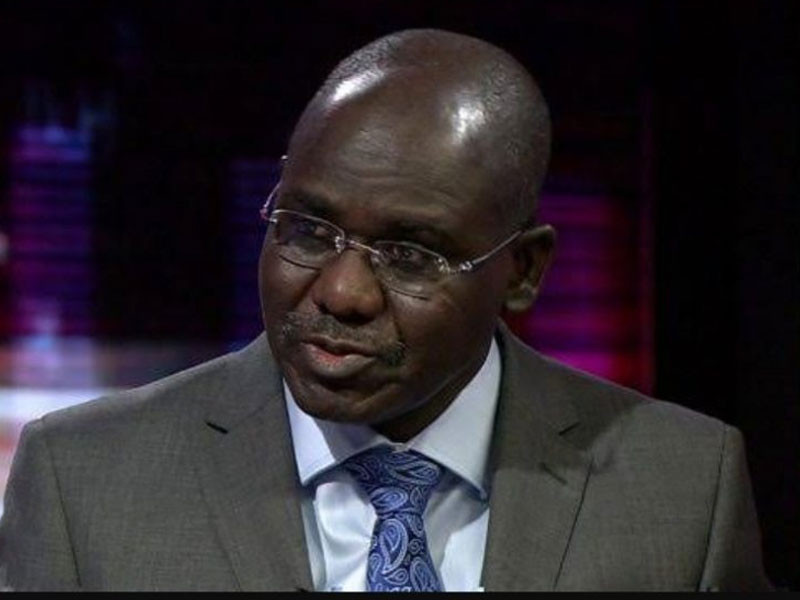
Nigeria’s former Chief of Army Staff, Tukur Buratai, led the army during a tough time when terrorists and armed groups killed many people and forced even more to flee their homes. He has now suggested ways to address the country’s security problems.
Mr Buratai was in charge of the Nigerian Army from 2015 to 2021, a period that saw serious violence from Boko Haram and the rise of armed robbers in northern Nigeria. He made his comments on Monday in a statement sent to PREMIUM TIMES.
During his time, the army managed to take back some territory from insurgents. But insecurity did not go away. There were many kidnappings, and human rights abuses were reported. This included the killing of over 300 Shiites and burying them secretly in mass graves. The military denied these claims.
While he could not end the insecurity during his service, Mr Buratai is now suggesting solutions.
The retired general pointed out that Nigeria is now seeing what he warned about in 2021. He had said that without strong action, the issues of insurgency and banditry could last for two decades.
He spoke about the capture, torture, and death of senior military officer Rabe Abubakar. He said this is “not merely a tragedy” but “marks a dangerous threshold.”
Mr Rabe, a retired major general and former defence spokesperson, was kidnapped on 30 May with his wife, Amina, while driving on a rural road in Katsina. He died in captivity two weeks later. The Katsina State Government confirmed his death on Saturday, and his body was retrieved and buried.
His wife is still missing. At least six senior military officers have been killed by terrorists this year. Since the Boko Haram insurgency started, about 14 officers have lost their lives.
“When a general falls into the hands of non-state actors, it signals a serious erosion of tactical deterrence,” Mr Buratai said. During his time as army chief, at least eight senior military officers were lost to insurgents and bandits.
He warned that ongoing insecurity could put even high-ranking political leaders in danger. “Let me be clear: if this trend continues unchecked, the next targets may not be soldiers or civilians alone. They could include ministers, senators, and even state governors. No leader will be immune,” he cautioned.
He called this situation another wake-up call and questioned how many more warnings Nigeria could ignore.
Offering “frank advice” to the federal and state governments, Mr Buratai urged them to recognize the problems with the current security plan.
“Bandits and insurgents now operate with intelligence, heavy weaponry, and audacity that rival conventional forces,” he said. He added that “the current reactive strategy, paying ransoms and negotiating with criminals, must end.”
He called for “a full-scale, coordinated military and intelligence offensive.” He noted that significant successes were seen from 2015 to 2019 through consistent operations.
He also suggested a security lockdown of states with insurgents and bandits to clear their hideouts and remote areas.
Mr Buratai stressed the need for a National Emergency Command. He sees insecurity as “a national emergency” rather than just a regional issue.
“The Federal Government should establish a unified command with direct authority over all security agencies in high-risk states, eliminating bureaucratic delays,” he said.
He added that this command should report directly to the president and should have a clear, time-bound goal to dismantle terrorist and bandit bases.
On criminal networks, Mr Buratai pointed out that armed groups survive thanks to supporters and collaborators. “Bandits do not survive on AK-47s alone. They rely on networks of corrupt middlemen, illegal miners, ransom negotiators, and local collaborators,” he explained.
He urged authorities to identify, arrest, and prosecute such individuals, insisting that “the cost of supporting terrorism should be made unbearable.”
The former army chief challenged state governors to take more responsibility for security in their areas. “It is no longer acceptable for state governors to leave security responsibilities entirely to the military,” he said. He recommended strengthening state policing initiatives, vetted local vigilante groups, and community intelligence networks to fit into the larger security plan.
While hoping political leaders would not become direct targets, he warned that “the coming months may witness direct attacks on political leaders.”
He suggested improving security measures for senior officials with better counter-ambush training and real-time intelligence sharing. Authorities must dismantle “the criminal ecosystem that enables such attacks.”
Mr Buratai explained his motivation for these warnings, saying: “I am a patriot. I fought for this nation, and I have no interest in scoring political points.”
He warned that failure to change how the country deals with insecurity could lead to serious problems. “If we do not radically change our approach today, the headlines of tomorrow may make today’s tragedy seem like only a warning,” he said.
He concluded by saying that while “the abduction of ministers or governors is not inevitable,” it could become “a real possibility if we continue with business as usual.”
“Let the death of Maj. Gen. Rabe Abubakar be the last preventable sacrifice,” he added.


Drop your comment
No comments yet — be the first to drop the gist 👇