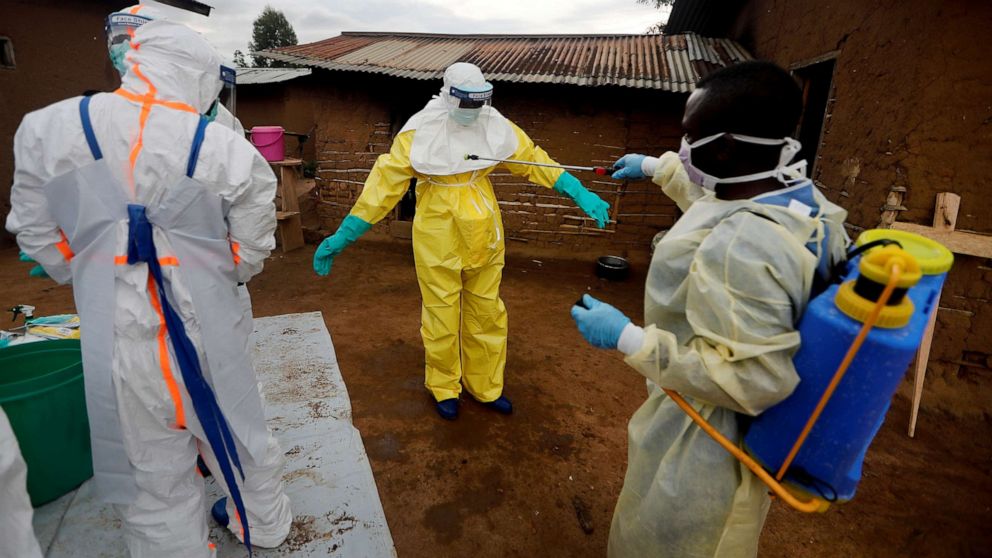
The World Health Organisation (WHO) is hopeful that the Ebola outbreak in the Democratic Republic of the Congo (DRC) can be controlled. This is despite confirmed cases of Bundibugyo virus disease exceeding 10,000.
This optimism comes after the DRC’s Ministry of Public Health released data on Tuesday, showing confirmed cases at 10,060 and deaths at 4,887, as reported by Al Jazeera.
The outbreak began on 15 May and is now the largest and deadliest Ebola epidemic ever recorded in the DRC.
It is also the second-largest and second-deadliest Ebola outbreak in the world, following the 2014, 2016 West African epidemic, which had about 28,600 cases and over 11,000 deaths.
Reasons for hope
On Tuesday, Mohammed Janabi, the WHO Regional Director for Africa, shared a message on his official X account. He said the rising numbers reflect the impact of the outbreak on families and communities, but progress in recovery, research, and response efforts gives reasons for hope.
Mr Janabi mentioned that over 2,600 people have recovered, and new vaccines and treatment options are moving forward in clinical trials.
He added that efforts are being made to improve laboratory testing, treatment capacity, infection prevention and control, community engagement, and surveillance to help manage the outbreak.
“Our teams are on the ground, working closely with the government and partners to stop transmission and save lives,” he said. He called for continued commitment, community trust, and solidarity, along with safe access to the affected areas.
Spread beyond the DRC
The increasing numbers raise concerns about the virus spreading beyond the DRC. Kenya and Nigeria have reported infections linked to the wider outbreak.
PREMIUM TIMES noted last week that Kenya has recorded nine confirmed cases, including two deaths, after the virus was brought in by a traveler from the DRC via Uganda.
Nigeria confirmed its first Ebola case in over ten years on 20 October. A woman who traveled from Uganda tested positive in the Federal Capital Territory (FCT).
In a follow-up report, PREMIUM TIMES mentioned that the Africa Centres for Disease Control and Prevention (Africa CDC) is looking into a possible link between the Nigerian case and the one in Kenya.


Both patients traveled through Entebbe International Airport in Uganda on 3 October, leading to investigations into whether they had shared equipment or had other contact. Health officials noted that a direct link between the cases has not been confirmed.
Nigeria’s health minister, Muhammad Pate, later said genomic sequencing showed that the viruses found in Nigeria and Kenya differed by just one mutation. He warned that this finding did not prove where the Nigerian patient got the virus.
Contact tracing challenges
According to the Al Jazeera report, about 80 percent of new cases in the DRC are happening outside the known transmission chains being tracked by health authorities.
This means many infections are showing up among people who have not had any recorded exposure to confirmed cases. This complicates efforts to identify contacts and stop further spread.
The Africa CDC stated that at least 95 percent of cases must be linked to known contacts of infected individuals for an outbreak to be considered under control.
Vaccine research underway
The lack of an approved vaccine for the Bundibugyo strain is another major challenge in the response.
PREMIUM TIMES reported on Friday that the WHO has started the Tumaini clinical trial in Bunia, eastern DRC, to test potential vaccines against this strain.
The trial kicked off with the first participants getting vaccinated on 23 October and will assess several vaccine candidates. This includes Ervebo, which is licensed for a different Ebola virus species, and experimental candidates developed by Moderna and the University of Oxford, in partnership with the Serum Institute of India.
The trial aims to see if these candidates can safely produce an immune response and protect against the Bundibugyo virus, though their effectiveness has not been confirmed yet.
This follows a previous WHO recommendation reported by PREMIUM TIMES in August, suggesting that Ervebo be prioritized for clinical trials after early animal studies indicated it might provide some cross-protection against Bundibugyo virus disease.




Drop your comment
No comments yet — be the first to drop the gist 👇