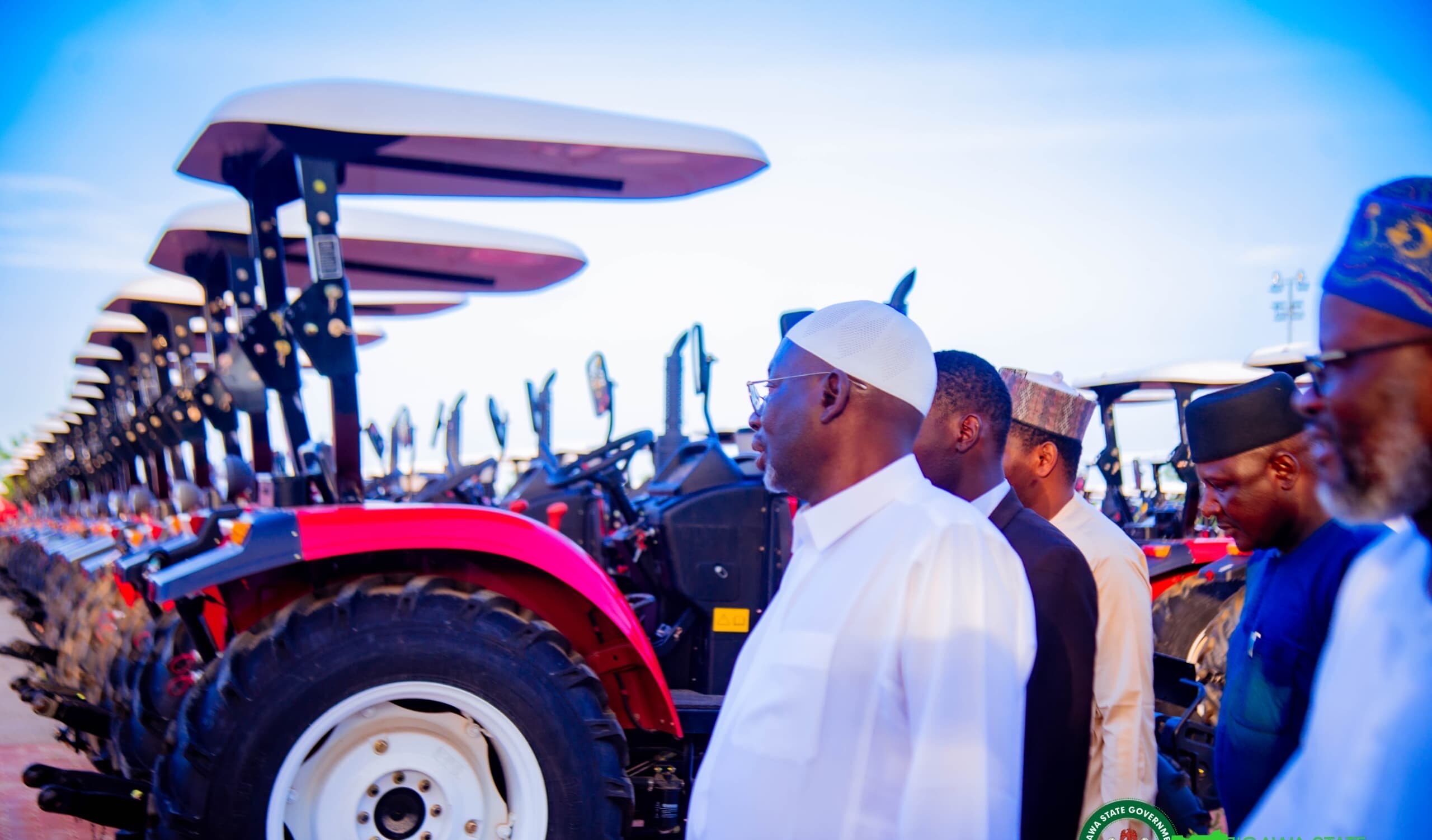
For many years, farming in Nigeria has been filled with promises but often disappointing results. Governments announce tractor purchases, spend millions of naira, and showcase new machines. Yet, many farmers still work their farms with just a hoe and cutlass.
The issue has never been just about having tractors. The real problem lies in not having a system that keeps those tractors working.
A tractor sitting idle in a government yard does not help anyone. A tractor without fuel, a trained driver, spare parts, and good maintenance is just a heavy piece of metal. If farmers cannot get the tractor when they need it most, it will not bring the change they expect.
Jigawa’s New Farming Strategy
This is why Jigawa State's new approach to farming deserves our attention. Under Governor Umar Namadi, the focus seems to be changing from just asking, "How many tractors can the government buy?" to a more crucial question: "How can we create a system so farmers can always access machinery when they need it?" This is a different way of thinking.
Setting up mechanisation service centres across the state, investing in tractors and harvesters, assigning agricultural workers, training technical staff, and using digital tools shows they are trying to build a farming system instead of just handing out equipment.
This difference could be what makes this investment successful or just another story of unused farming machinery in Nigeria.
Old Issues with Tractor Purchases
For decades, agricultural mechanisation programs in Nigeria have followed the same pattern. The government buys tractors, gives them to farmers or cooperatives, but soon questions arise about how they are used, maintained, and accounted for.
Some tractors break down because they are not properly cared for. Others are hard to use because of high fuel costs. Sometimes, farmers cannot access machinery when they need it most during planting and harvesting periods.
This means that huge public investments might not lead to better farming results.
That is why Jigawa’s approach should be looked at not just by how many machines they have but by how well they support the system around those machines.
Shifting from Ownership to Services
Creating the Jigawa State Farm Mechanisation Service Company could be a key part of this program. The idea is simple: farmers do not need to own tractors to benefit from them.
What they truly need is reliable and affordable access to tractor services. This is especially important in Jigawa, where many farmers are smallholders.
It is unrealistic to expect individual farmers to buy tractors, take care of them, hire operators, and pay for repairs. A well-managed mechanisation service can solve these problems.
Instead of each smallholder buying a tractor, the government or a professional service can run a fleet of tractors and provide services like land preparation and harvesting. One tractor can help many farmers during a farming season.
This is how commercial equipment rental works globally, and it can help small farmers access machinery better.
Bringing Machinery Closer to Farmers
The plan to create 60 mechanisation service centres in Jigawa’s 30 constituencies is crucial. The machinery needs to be close to farming areas to be useful.
Farmers cannot afford to wait weeks for a tractor when the rainy season starts. Timing is everything in farming.
If a farmer plants late, they risk lower yields. If they cannot harvest on time, they could lose a lot. Mechanisation matters not just because it eases work but also because it helps farmers do their tasks on time. Having machines close to farmers can greatly improve productivity.
Need for Better Seeds
But the tractor is just the start. It’s critical not to think that farming transformation ends with buying tractors. A tractor is only one part of a bigger farming system.
Farmers also need better seeds, fertiliser, irrigation, extension services, pest control, storage, processing facilities, transport, and market access.
If a farmer has a tractor but lacks quality seeds, their yields could still be low. If they have a big harvest but no storage, they may lose money.
If they produce more food but cannot access good markets, increased production will not improve their lives. So, mechanisation must fit into a wider agricultural value chain.
Role of Agricultural Extension Workers
One encouraging part of Jigawa’s farming plan is the focus on extension services. Agricultural extension workers connect scientific farming knowledge with local farmers.
They can guide farmers on better seeds, planting methods, fertiliser use, pest control, soil care, and practices that can boost productivity.
Providing motorcycles for extension workers is not just about logistics.
It can change how extension workers connect with farmers. With reliable transport, they can visit more farms, check crops better, and respond quickly to farmers’ issues.
This is especially necessary when introducing mechanisation because farmers need to learn how to combine machine use with better farming practices.
Cooperatives for Efficiency
Another area for growth in Jigawa’s program is farmer cooperatives and farm grouping.
Mechanisation is usually more effective when larger areas are farmed together instead of moving machines between many small plots.
The government should encourage farmers to form strong cooperatives. Farmers do not have to give up their farm ownership.
They can plan their planting schedules and group their farms to allow for better machinery use.


Imagine a tractor working on a 200-hectare farming group rather than travelling from one small farm to another. This could save fuel, time, and costs.
Cooperatives could also help farmers get better prices for supplies and market their products together.
Technology and Accountability
Another important issue is accountability. Public farming machinery needs to be traceable. Ideally, every tractor should have a digital ID and GPS to track its location, hours of use, and how it is being used.
Jigawa’s new mechanisation system is already using digital tracking and fleet management. This is the way agricultural governance should go.
Technology can help show where government-owned machines are, how much they are used, and if they are helping the right people. It can also offer useful data for planning.
If records show that one service centre helps more farmers than another, the government can decide if more machines or staff are needed there. Data should be a key part of agricultural planning.
Maintenance Matters
One of the biggest challenges for any mechanisation program is poor maintenance. A tractor that costs millions of naira can become useless if a small part fails and there is no replacement.
That is why training technical staff is so important. Teaching Nigerian technicians to fix agricultural machinery can reduce downtime and build local skills.
Training Young Technicians
Training young agricultural technicians in China is a valuable part of the program. Over time, Jigawa should work to create a strong local group of tractor mechanics, agricultural engineers, welders, spare parts suppliers, and machinery operators.
This could create new jobs in rural areas. Mechanisation can attract youth to farming. Many young Nigerians see farming as hard work with low pay. Mechanisation can help change that view.
The future farmer does not have to spend all day using a hoe. They can drive a tractor, manage irrigation, use digital tools, track farm productivity, and join modern farming systems.
Farming can become a tech-driven job. This is vital in Jigawa, where bringing younger people into productive farming is crucial.
Mechanisation and Irrigation Must Work Together
Another important area is irrigation. Jigawa’s farming potential cannot be fully reached if it relies only on rain.
Mechanisation helps farmers prepare land fast, but irrigation gives them control over when and how they grow crops.
Investments in irrigation and solar-powered equipment support the mechanisation program. Together, mechanisation and irrigation can lead to more intensive farming and, in some places, multiple growing seasons.
This is key for crops like rice, wheat, vegetables, and other irrigated produce.
Building an Agricultural Value Chain
Lastly, Jigawa should look beyond just farming. More production should come with better investment in storage, processing, and marketing.
Instead of sending raw products to other states or countries, Jigawa should aim to process more locally.
Rice should be milled. Grains should be processed. Sesame should be cleaned. Livestock products should be processed. Crop waste can also be turned into animal feed and other products.
This creates more jobs and allows farmers to keep more value from their work.
A Sustainable Model
Governor Umar Namadi should be praised for shifting the focus from just buying tractors to creating a working mechanisation system.
The real achievement will not be the number of tractors bought. It will be whether the systems around those tractors stay functional for years.
This means ensuring that mechanisation services are affordable, machinery is well-maintained, technicians are trained, operators are supervised, farmers are organised, extension services are active, and digital tracking is used.
Most importantly, future governments should keep and improve the systems that work. Changing agriculture cannot happen in just one term. It needs continuity.
Measuring Success
At the end of the day, Jigawa’s farming success should be measured simply. Can farmers cultivate more land? Can they plant on time? Can they harvest effectively?
Have their costs gone down? Has their yield increased? Has their income improved? Are more young people getting jobs in farming? Is Jigawa producing more food for its people and markets beyond?
These are the real questions. A tractor is just a tool. A tractor that sits unused is a waste. A tractor working well in the field is an investment. A connected network of tractors, technicians, extension workers, irrigation, cooperatives, processors, and markets is a strategy for agricultural change.
That is why Jigawa’s approach is important. The state’s goal is not just to get machinery but to create a farming economy where mechanisation is a lasting service for ordinary farmers.
If this system is managed well, watched closely, and maintained over time, it could lead to better land use, more food production, job creation, stronger rural economies, and make farming more appealing and profitable for the next generation.
The true agricultural revolution starts when tractors shift from being just a government symbol to becoming reliable tools for farmers.



Drop your comment
No comments yet — be the first to drop the gist 👇