For over twenty years, Nigeria has looked to renewable energy to help solve its electricity problems.
The Nigerian Electricity Regulatory Commission (NERC) reported that the average power supply from grid-connected plants was around 5,400MW in the fourth quarter of 2025. Meanwhile, World Bank data showed that access to electricity was at 62.5 percent in 2024.
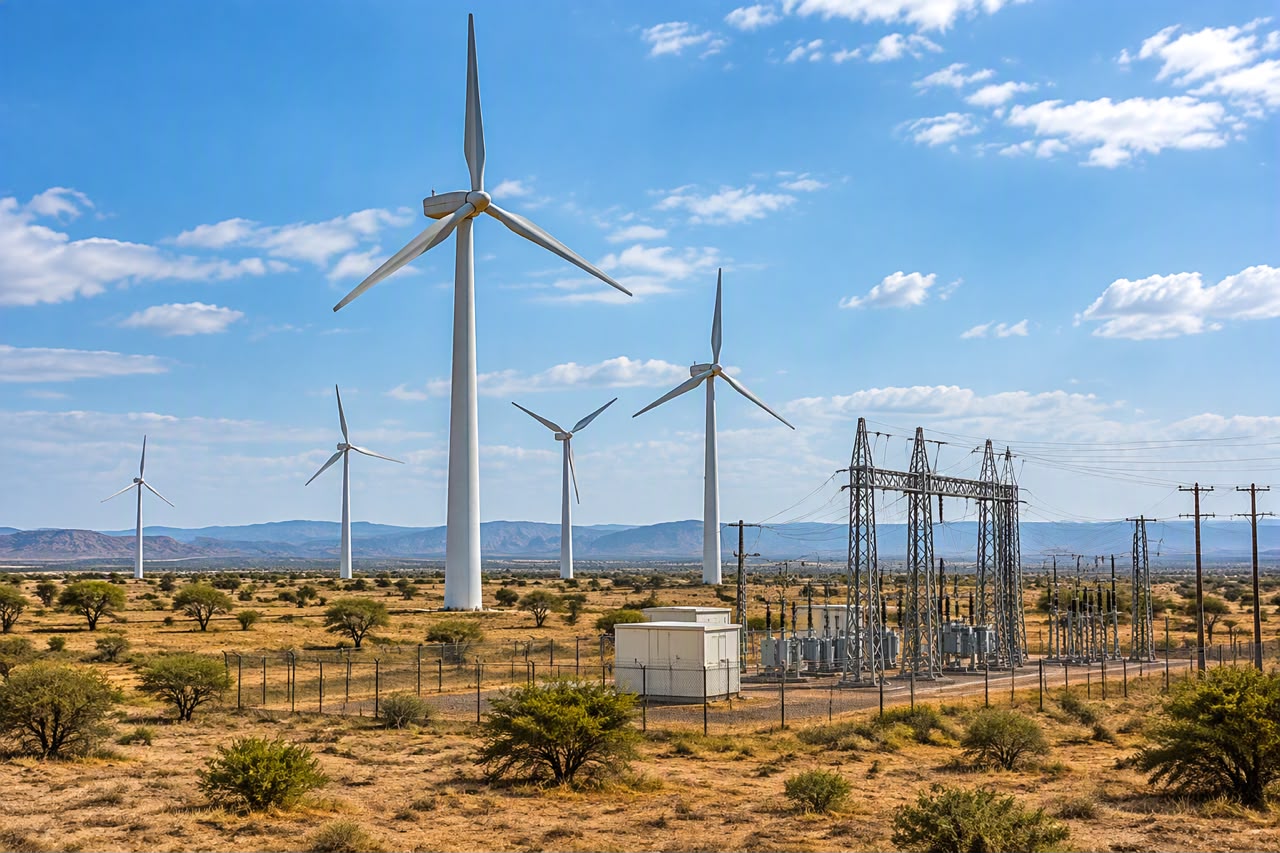
Officials have tried to boost power generation through solar and wind initiatives. But the 10MW Lambar-Rimi wind farm project in Katsina State reveals how tough it has been for the country to turn plans into real power sources.
Lambar-Rimi wind farm
The Katsina State Government started the project in 2005. Since then, the wind farm has changed hands twice, first in 2007 when the federal government took over.
After this takeover, the federal government awarded a contract in 2010 to a French company, Vergnet S.A., to build the wind farm in 24 months. The plan included 37 turbines, each expected to produce about 275 kilowatts of electricity. The contract had offshore components worth €18.5 million and onshore parts costing N494 million.
Clearly, things did not go as planned.
The project faced many challenges, especially in a state dealing with serious security issues. After the abduction of a French engineer, the company got permission to shift some work to a local contractor, Credco Nigeria Limited.
This new plan increased the contract cost to €20.85 million offshore and N573.90 million onshore.
By 2016, a government budget report noted progress, mentioning the delivery of two 7.5MVA transformers, repair of a vandalized 33kV line, completed foundation work, installed towers and turbines, and built medium-voltage rooms. However, it also highlighted that some work was still pending, including the overhead line connection to the 33kV network and a substation at Liyafa.
The 2017 budget report claimed that the project was about 95 percent complete.
But six years later, in 2023, the Kano Electricity Distribution Company (KEDCO), which is supposed to take power from the wind farm, said the project was only 80 percent complete.
An article published on 31 August 2026 by the Nigerian Wind Energy Council (NWEC) noted that years of inactivity had left the Lambar-Rimi wind farm’s turbines in poor condition and needing a lot of repairs.
New Twist
In April 2025, the Katsina State Government requested to take back control of the facility. The federal government approved this request, with the Minister of Power, Adebayo Adelabu, saying it was in line with the Electricity Act 2023 and the growing role of states in the electricity market.
By September 2025, Katsina announced that it had reacquired the wind farm and planned to combine it with a 10MW solar plant.
The state government is now working with Vergnet to check the turbines, electrical systems, and grid infrastructure. They expect the new hybrid facility to start operating in the fourth quarter of 2026.
The ups and downs of the Lambar-Rimi wind farm story show how Nigeria has struggled to generate and distribute enough electricity for its 240 million people.
PREMIUM TIMES reached out multiple times to Abubakar Ibrahim, the Special Adviser on Power and Energy to the Katsina State Governor, for more details on the project's current state, funding, and progress. Unfortunately, there was no response.
We also tried to contact officials at the Federal Ministry of Power to understand why the project has taken more than 15 years to finish. Our calls went unanswered, and the ministry did not reply to our messages either.
Lambar-Rimi not alone
Many other large renewable energy projects in Nigeria are also stuck at different stages of development.
This includes the 100MW Maraban Pushit wind farm in Mangu Local Government Area of Plateau State, which is promoted by JBS Wind Power Limited.
A World Bank project document shows that the company had secured a 45-year land lease, completed environmental assessments, and got initial approval to send electricity through a 132kV substation at Makeri in Plateau State. The project appeared in regulatory records in October 2012, 14 years ago, but has yet to become a working wind farm. Public records did not show how much has been spent on the project or if public funds were used.
Solar projects in Nigeria also have a mixed history.
The 50MW Onyi project in Kokona, Nasarawa State, linked to Afrinergia Power Limited, received a generation license in April 2016. However, Global Energy Monitor lists the project as cancelled, indicating this happened in June 2024.
Another project, a 75MW Kankia solar project in Katsina State, was promoted by Pan Africa Solar Limited, with JCM Capital as the project owner. The Nation newspaper reported in July 2016 that the company and the federal government signed a power purchase agreement, with a proposed investment of $146 million.
NERC records show that Pan Africa Solar got a generation license in December 2014, which expired in December 2024. The regulator lists the project as non-operational, while Global Energy Monitor classifies it as cancelled, with the cancellation inferred to have occurred in February 2025.
Despite the setbacks in some renewable energy projects, others have been successfully completed. A 10MW solar project in Kumbotso, Kano State, developed by the Nigeria Sovereign Investment Authority (NSIA), was commissioned in 2023. This project proves that large renewable projects can succeed when funding, management, infrastructure, and a clear market align.
A project is not an ecosystem
In an interview with PREMIUM TIMES, NWEC’s Research and Operations Consultant, Ojodomo Odiniya, pointed out that Nigeria lacks a system that can turn power resources into viable projects.
He mentioned issues like policy uncertainty, grid problems, funding, lack of wind data, poor coordination between institutions, and land and community challenges as major obstacles.
Investors need a clear path from resource assessment and land acquisition to permits, financing, power purchase agreements, grid connections, and ongoing operations.
Mr Odiniya suggested a systematic approach to develop the sector. He recommended focusing on localizing parts of the renewable energy value chain instead of trying to manufacture entire wind turbines right away.
He said that parts like foundations, civil works, tower fabrication, electrical installation, transportation, engineering, operations, and maintenance could create opportunities for Nigerian companies.
He stressed that the goal is not to start with a fully Nigerian-made turbine. It is to ensure that each project builds skills that can be used in future projects.
The consultant also cautioned against developing power generation without the necessary transmission infrastructure to deliver it.
For future wind projects, Mr Odiniya said site selection should consider wind strength and factors like grid access, logistics, security, land, and operating costs over time.
Egypt built system around projects
Egypt, a strong economy in North Africa, shows what happens when projects are developed alongside the necessary institutions and infrastructure.
In written answers to questions from PREMIUM TIMES in September, Jauad El Kharraz, senior advisor to the TERAMED Initiative and former executive director of the Regional Centre for Renewable Energy and Energy Efficiency, said Egypt’s growth followed a series of decisions that reduced uncertainty for investors.
Egypt’s Electricity Law, Law No. 87 of 2015, set up a framework for the electricity market and allowed more private generators to participate.
Egypt also introduced a separate Renewable Energy Law, Law No. 203 of 2014, which created ways to develop renewable energy projects.
Initially, they used feed-in tariffs to attract private investment in renewable energy and develop projects like the Benban solar park.
Later, they moved towards competitive auctions and build-own-operate arrangements as the market matured. Egypt’s New and Renewable Energy Authority (NREA) lists feed-in tariffs, competitive auctions, build-own-operate projects, and independent power producer setups among the methods used to grow renewable energy projects.
This approach mattered because developers were not just asked to build renewable plants. They were given a clearer framework for how electricity would be bought and how investors could get their money back.
The Benban example illustrates this well.
The European Bank for Reconstruction and Development (EBRD) invested over $1.1 billion in 16 photovoltaic plants at Benban, with a combined capacity of 750MW.
These plants were connected to Egypt’s national grid in 2019. The bank also supported Egypt’s shift from feed-in tariffs to competitive renewable energy auctions.
Mr El Kharraz said Egypt also tackled infrastructure issues before they became problems.
The New and Renewable Energy Authority helped make land available in resource-rich areas, and the government invested heavily in transmission.
According to figures he provided, Egypt’s 500-kilovolt transmission lines grew from 2,364 kilometers in 2014 to 8,250 kilometers by late 2024. Substation capacity rose to about 48,000 megavolt-amperes (MVA).
The lesson for Nigeria is that a renewable energy project cannot be seen as just a power generator. The land, transmission system, power buyers, financing structure, approvals, and maintenance need to develop together.
Egypt’s model also relied a lot on development finance.
EBRD financing helped create the Benban pipeline, while the bank worked with Egyptian authorities to design and implement competitive renewable energy tenders.
Mr El Kharraz said Egypt used government-backed arrangements, standard contracts, risk-sharing strategies, and development finance institutions to lessen risks for private investors.
He mentioned that some of these principles could adapt to Nigeria, including standardized bankable power purchase agreements (PPAs), renewable energy zones with prepared land and grid connections, and improved permitting coordination.
A Nigerian model
For Nigeria, the solution is not to copy Egypt’s model completely.
Tobi Oluwatola, associate partner at AP3 Advisory, noted that Egypt’s large, centralized renewable energy parks developed under a different electricity market structure. Nigeria, on the other hand, has been focusing more on commercial and industrial projects, mini-grids, and decentralized systems.
He said Nigeria needs contracts that assure investors that electricity will be purchased, that there are reliable buyers ready to pay for the power, as well as transmission infrastructure and ways to manage foreign exchange and other risks.
Mr Oluwatola suggested Nigeria could adapt some parts of the Egyptian experience, like pre-permitted renewable energy zones, standardized power purchase agreements, and local content requirements linked to public procurement.
Both experts agree that a renewable energy project cannot be treated as just a standalone generating plant.
Land, financing, contracts, transmission, regulation, and electricity markets must all develop around it.
The equipment problem
Segun Ajayi-Kadir, director-general of the Manufacturers Association of Nigeria (MAN), told PREMIUM TIMES that Nigerian companies can produce or put together some renewable energy equipment, like solar panels, mounting structures, cables, and battery packs.
But many specialized technologies and critical inputs still depend heavily on imports.
Government figures mentioned by officials showed that Nigeria’s solar technology import costs were over N400 billion in 2025 and more than N200 billion in the first half of 2026.
Mr Ajayi-Kadir noted that manufacturers face high financing costs, unstable foreign exchange, expensive and unreliable electricity, infrastructure gaps, skill shortages, and uncertain demand.
This creates a cycle problem.
Manufacturers are hesitant to invest heavily without reliable demand, while renewable energy developers often turn to imports because local suppliers cannot yet deliver enough scale, technology, or competitive prices.
The government’s Distributed Access through Renewable Energy Scale-up (DARES) program could help break this cycle by creating predictable demand.
The program aims to provide electricity access for over 17.5 million Nigerians through thousands of connections and mini-grids.
Another example is the proposed Solarge Nigeria Limited solar manufacturing facility, established by the Rural Electrification Agency (REA), Infrastructure Corporation of Nigeria (InfraCorp), and Dutch company Solarge BV.
The proposed facility is designed to connect manufacturing to a guaranteed market, with plans for local content growth and procurement commitments.
Drop your comment
No comments yet — be the first to drop the gist 👇