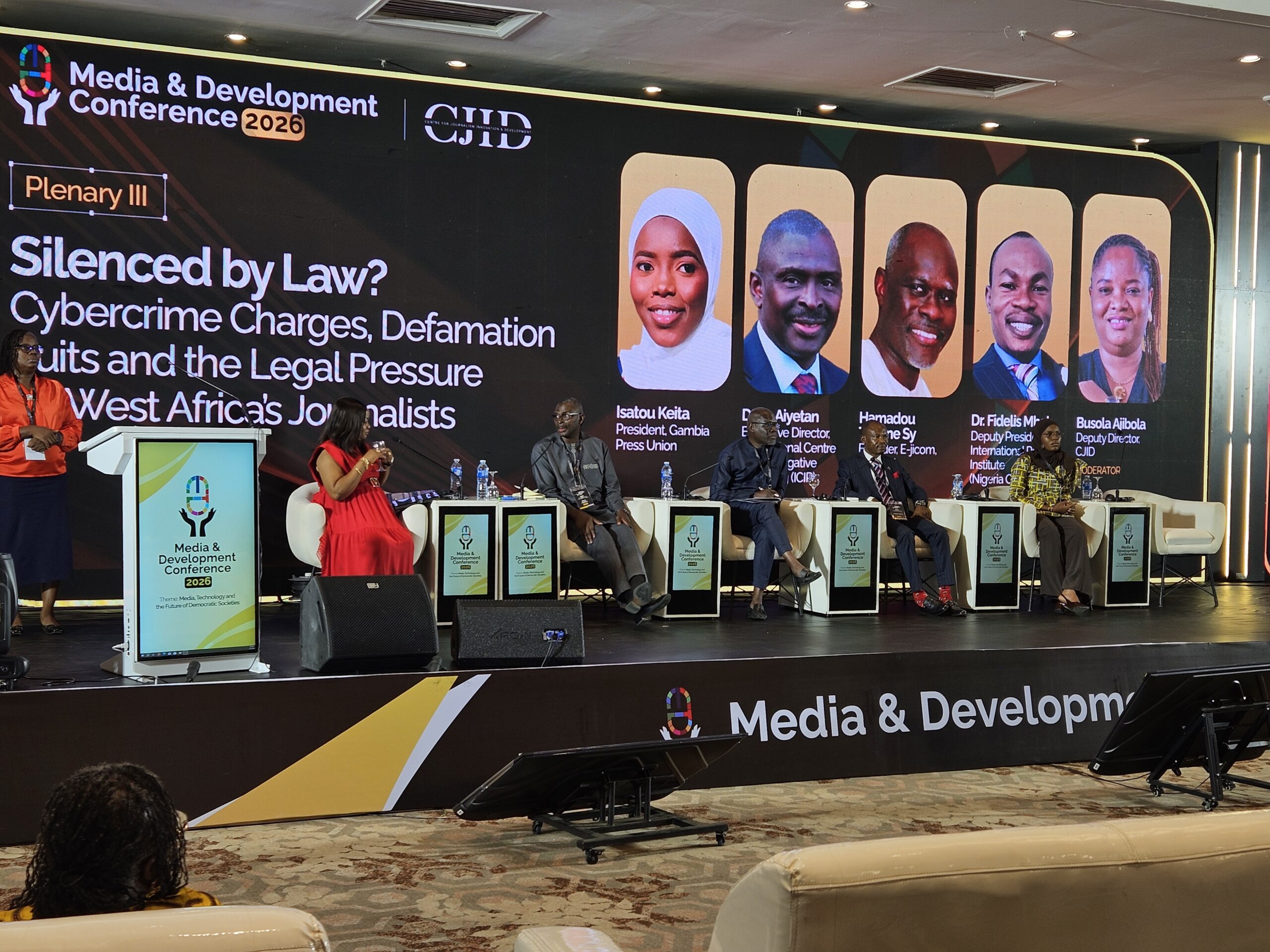
Journalists and advocates for press freedom are speaking out against the use of criminal defamation and cybercrime laws to intimidate and prosecute journalists. They say this is happening just for asking questions and doing their jobs.
At a panel session on Monday during the Media and Development Conference (MDC 2026), media leaders from different West African countries shared their experiences with legal pressure on journalists. They called for stronger unity to protect press freedom.
The session was titled "Silenced by Law? Cybercrime Defamation Suits and the Legal Pressure Against West Africa’s Journalists". Busola Ajibola, the deputy director of the Centre for Journalism Innovation and Development (CJID), moderated the discussion.
Mrs Ajibola opened by asking everyone to support journalists who speak out for others, often at great personal risk. "To have somebody who is speaking courageously on behalf of millions and millions of people, putting everything that they have on the line, it can clearly be a very lonely journey, I tell you," she said.
"Again, I’m calling on you, all of you in the room, at least to press this gospel, that we all have to stand together and make sure that we support journalists, and that we are all in the same boat."
The MDC is a three-day event that gathers journalists, policymakers, researchers, tech companies, civil society leaders, and development institutions from across Africa. They discuss the challenges facing journalism and democratic governance in a fast-changing tech world. This year’s conference theme is "Media, Technology and the Future of Democratic Societies".
Earlier, Mrs Ajibola led the participants in showing solidarity with West African journalists being persecuted for their work. The journalists include Nigeria’s Daniel Ojukwu, Moussa Kaka from Niger, and Serge Oulon from Burkina Faso.
Mr Ojukwu was sent to prison in a criminal defamation case filed by the Nigerian Police Force (NPF). This case came after he wrote stories in 2023 about Adejoke Orelope-Adefulire, a senior special assistant on sustainable development goals (SSAP-SDGs) to former President Muhammadu Buhari. He was charged under the Cybercrimes Act, which the government has used to attack critics and journalists.
Fidelis Mbah, deputy president of the International Press Institute (IPI), Nigeria chapter, said the vague wording of these laws allows authorities to misuse them against journalists. "The framing is so bogus that it gives room for anybody to exploit," he said.
Mr Mbah, who has also been arrested, shared a story about a journalist who was detained over a factual report on a bank. He said the IPI is continuing to pressure authorities to free detained journalists and challenge cases of persecution in court, noting that one of the cases is still pending.
When asked how the media could get the police and anti-corruption agencies to act on findings from investigative reports, Dayo Aiyetan, executive director of the International Centre for Investigative Reporting (ICIR), said journalists cannot count on the agencies. He expressed little trust that they would act on journalists' investigations, even when they show billions of naira in public funds misused.
He specifically called out the Economic and Financial Crimes Commission (EFCC) for not acting on such reports. "We are talking about public funds," he said. "And the media has listed billions of naira of public funds that may not have been judiciously expended. But the anti-corruption agency is not interested, even after we have called their attention to it. So what are we talking about?"
He also criticized the use of public money to defend people who sue journalists for defamation over reports that hold them accountable. When Ms Ajibola asked him about regional advocacy for repealing criminal defamation laws, Mr Aiyetan mentioned he wrote a report on cybercrime laws in four African countries.
He pointed out similar issues across these countries and urged media unions and advocacy groups to unite for legal reforms. Regarding media regulation, Isatou Keita, president of the Gambia Press Union, said the government should never control the media.
Ms Keita mentioned that journalists in her country rejected a government plan to regulate who could practice journalism in The Gambia. She said the Ministry of Information had started a process to introduce rules for the profession, including requiring journalists to register.
"Everybody wants to be regulated," she said. "But it can never be done by the government." She noted that the media already has a self-regulatory body, the Media Council of The Gambia, and that the union refused to take part in the ministry’s process.
She warned that divisions in the media would only benefit the government. She also mentioned that government officials had said media organizations that do not cover government events might lose funding. The registration requirement was later removed from the draft document.
Ms Keita added that a meeting last Friday between the press union, the Gambia Bar Association, and the ministry agreed that experts should review the document and suggest a way forward. "We are not against regulation, but we have our own media council," she said.



Drop your comment
No comments yet — be the first to drop the gist 👇