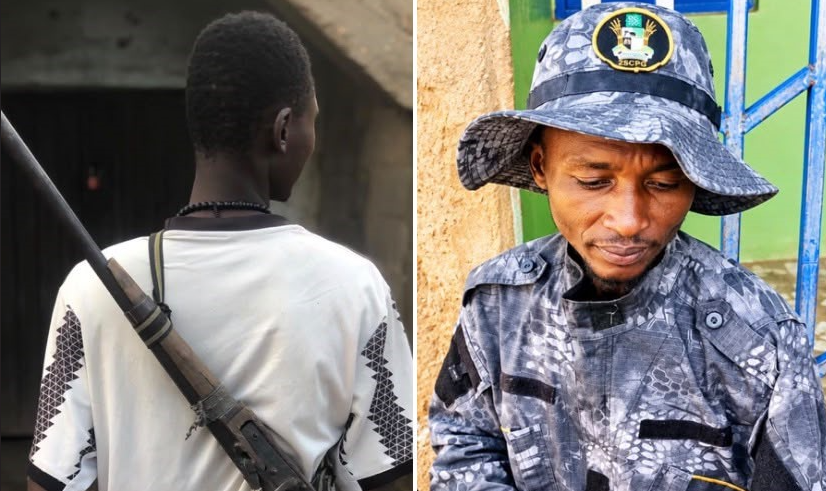
Abdullahi Ibrahim still carries a gun. But now he holds it with one hand.
His left hand was amputated after he was shot in 2024 while defending his village, Gima, in Anka Local Government Area of Zamfara State.
Sitting on a wooden bench, Mr Ibrahim showed the worries on his face. He said that in 2020, bandits started attacking frequently, and he became worried about Gima’s safety.
In that same year, armed men invaded his community and kidnapped two people. One, who was pregnant, was released later. The other was freed after her family paid a ransom of ₦1 million. As the attacks continued, local volunteers like Mr Ibrahim took up arms to defend their homes.

Having lost his left hand in a fight against bandits, Abdullahi Ibrahim still holds on to his role as a community vigilante in Gima. [Photo: Mustapha Usman/The ICIR]
Like many others, Mr Ibrahim knew the risks of joining a vigilante group. But he never expected that one encounter with the attackers would cost him his hand.
Although he still carries a gun, Mr Ibrahim now faces this fight with one hand. The injury changed his life and brought a heavy financial burden. He spent over ₦250,000 on medical treatment and care. He did not receive any help from the government.
Across Nigeria, civilian vigilante groups are becoming part of community security, especially in places facing constant attacks by armed groups. Some work with government-backed security, while others operate independently, raising their own funds to buy equipment and support injured members.
In Zamfara, Niger, and Kogi states, government-supported vigilante groups are called Community Protection Guards (CPGs), Niger State Vigilante Corps (NSVC), and Kogi State Vigilante Service, respectively. The independent community vigilantes are called ‘Yan sa-kai’ (volunteers).
These groups help security agencies to rescue kidnapped individuals, protect farmers and farmlands, and hand over suspects to the police.
They also work with police and military in joint operations to rescue abducted residents and confront armed groups.
But interviews with government and community vigilantes in Zamfara, Niger, and Kogi states showed there are still limited measures to protect and support those who get injured. Many widows and parents of those killed receive no financial help.
Some groups say they have no life insurance or compensation for members killed or injured while helping Nigeria’s security forces.
Although Nigeria’s Employees’ Compensation Act 2010 offers compensation for eligible employees injured on the job, it does not cover community vigilantes who are not formally employed.
Similarly, the International Labour Organisation’s Employment Injury Benefits Convention (No. 121), which outlines standards for medical care and compensation, has not been ratified by Nigeria.
So, community vigilantes, like the volunteers and members of the Vigilante Group of Nigeria, who are not employed by the government, do not have automatic rights to compensation under existing laws.
How They Operate
Vigilantes in Zamfara, Niger, and Kogi states do not all operate the same way. Some recruited by the state or local governments receive support like vehicles and guns. Others are community-organised and confront armed groups without official backing.
In many local governments across Zamfara, especially in Anka and Bukuyyum, these groups have been active for six to eight years due to frequent attacks. Yusuf Sani, commandant of a volunteer vigilante group in Anka, said community members complained to authorities but were told that help would come, even as attacks continued.
Yusuf Sani uses a locally acquired firearm to fight bandits in Anka, Zamfara State. Photo: Mustapha Usman/The ICIR
“We contribute to security. We sacrifice our time, including staying awake at night, especially when there are security challenges,” he said.
The group includes members from different jobs, like farming and trading. Instead of getting government funds, they contribute money from their earnings to support their activities.
Some sell their crops or livestock to raise money for equipment and ammunition. “Whatever we earn from our labour, we use to support our activities,” Mr Sani said.
He estimated their group has over 200 members, but the wider network across Anka could be larger. He also mentioned that since 2020, about 28 to 30 members have been killed, while around 20 have been injured.
The group is not officially registered, despite repeated attempts for recognition and support from authorities.
Another leader in the area, Sani Garba, described a similar setup. His group has been around for more than 20 years, originating from the Yan Banga (community protection) system, which helped maintain order.
He said they revived the group about six years ago. Although local officials know of their activities, the group is not formally registered.
“We handle everything. No government agency gives us assistance or financial support for medical treatment or burial of our members,” he said.
Meanwhile, some government-backed officers have a different situation. Lauwali Anka, commandant of the CPG in Anka, oversees 175 personnel. They were recruited by Governor Dauda Lawal in January 2024 to protect lives and property.
Unlike community-backed groups, these personnel get government pay. But their contracts lack provisions for health insurance or compensation for injuries or deaths during operations.
In Niger and Kogi states, local volunteers also help with community security. Aliyu Yakubu, assistant chairman and intelligence officer of the vigilante group in Erena, Shiroro LGA of Niger State, said members mainly use pump-action guns to confront attackers armed with more powerful firearms.
The group operates around Erena and nearby villages, with members from the communities they protect. Their knowledge of the area gives them an advantage, but Mr Yakubu said their limited equipment makes them vulnerable to heavily armed attackers.
Compared to the sophisticated weapons used by armed groups, he said they use firearms he calls “battery-powered guns,” as authorities refused to provide stronger weapons.
According to Nigeria’s Firearms Act, certain weapons require a presidential license. The Inspector-General of Police issues licenses for personal firearms, including shotguns and sporting rifles.
But muzzle-loading firearms, such as dane guns and flintlocks used by some vigilante groups, do not require a license unless banned by police in a specific state.

A close-up view of a pump-action shotgun, locally known as a “rubber-rubber” gun, provided to vigilante officers in Anka, Zamfara State.
With their limited weapons, the vigilantes split into smaller teams and patrol the town at night. They stop and search suspicious individuals and often serve as the first line of defence for their communities.
Nigeria’s Security Crisis
For years, communities in north-western Nigeria have faced attacks by bandits who kill, abduct, steal cattle, extort money, and kidnap for ransom.
An analysis by The ICIR using data from the Armed Conflict Location & Event Data Project (ACLED) found 27,608 deaths from 17,475 attacks on civilians by non-state actors across Nigeria from 2020 to 2026.

Attack on civilians by non-state actors between January 2020 and June 2026
The analysis showed that the North-west had the highest number of deaths, with 11,802 from 7,125 incidents. The North-central followed with 8,128 deaths from 4,434 incidents, while the North-east had 4,382 deaths from 1,956 incidents.
Together, these three northern regions accounted for 24,312 deaths, about 88 percent of all deaths recorded in the analysis.

Zamfara is one of the states most affected during this time. Ongoing insecurity has disrupted farming, trade, education, and access to basic services, forcing many to flee their homes and others to band together for self-defence.

States most affected by attacks and fatalities
Zamfara recorded 3,431 deaths from 1,965 incidents. Katsina followed with 2,863 deaths, and Borno had 2,813, according to the ICIR analysis.
In Niger State, the security situation is more complicated with attacks from bandits and violence linked to a Boko Haram faction.
In Shiroro LGA, one of the hardest-hit areas, communities face attacks from armed bandits and a Boko Haram faction known as Jama’atu Ahlis Sunna Lidda’awati wal-Jihad (JAS).
JAS is one of two major factions that split from Boko Haram in 2016. The other is the Islamic State West Africa Province (ISWAP). While both groups maintain strongholds in the North-east, JAS has a presence around Lake Chad and the Gwoza Hills in Borno State.
ISWAP has expanded its operations into parts of the Lake Chad Basin and surrounding areas.
However, JAS has also moved beyond its usual areas into north-central Nigeria. In Niger State, its growth is linked to a faction led by Abubakar Saidu, also known as Mallam Sadiku, who was sent to the state in 2014 to connect with members of the Darul Islam group.
Mr Sadiku set up a JAS cell in Alawa Forest Reserve in Shiroro, with attacks escalating since 2021.
A July 2025 analysis by the Institute for Security Studies described a Boko Haram cell operating in forested areas of Shiroro LGA that has formed links with local bandits.
The ICIR analysis showed that in the year reviewed, Niger State saw 1,765 deaths from 1,069 incidents, ranking it eighth nationally, while Kogi had 381 deaths from 455 incidents.
Unlike Zamfara and parts of Niger State, where banditry and jihadist violence are common, Kogi faces increasing kidnappings and armed attacks, particularly in rural areas like Kabba/Bunu Local Government Area.

Yakubu Dada a few months after sustaining a gun injury. [Photo: The ICIR/Mustapha]
Volunteers Face Armed Groups Without Training
When the gunmen surrounded Yakubu Dada and his fellow vigilantes, the volunteers were already in a tough spot. In April 2026, they went to Bagna community in Shiroro LGA of Niger State to help security personnel retrieve the remains of officers killed in an attack. But the armed men were waiting for them.
“They came in large numbers and encircled us,” Mr Dada recalled.
He said the volunteers were overwhelmed. Mr Dada, known in the community as Sarkin Yaki (war chief), had spent at least 10 years with the Erena Vigilante Group. Despite his experience, he said he and his colleagues never received formal training for the dangerous situations they face.
After the attack, Mr Dada went to the hospital, but his family paid most of the bills. His uncle and local officials each gave him ₦10,000, but he said no government agency provided further help.
“We have no formal training, and we don’t get any assistance from the government or any organization,” Mr Dada told The ICIR.
Aliyu Yakubu, 31, the group's assistant chairman, said they received information early in the morning about a possible attack. They moved towards Unguwan Dakaci, where they met the attackers.
According to him, 11 of the victims were from his group, while the other seven were from nearby villages.
“We don’t have formal training or assistance from the government or individuals,” he said. The group mainly uses pump-action guns against attackers with more advanced weapons.
Although some vigilante groups have upgraded from locally made guns to pump-action shotguns, many members say these weapons do not match the firepower of armed groups using AK-47 rifles and other military-style guns.
Training Varies Across Vigilante Groups
Training is not the same in every state. In Kogi, many government-backed vigilantes went through a four-month training program between 2017 and 2018 after recruitment started. Military personnel, police, and security officials conducted the training.
A senior vigilante officer in Kabba/Bunu LGA in Kogi State, who asked to remain anonymous, said it has been eight years since their men had formal training.
Office of the Kogi State Vigilante Service in Kabba/Bunu LGA of Kogi State
In 2018, recruits spent four months training in Lokoja for community security duties. However, there has been no regular training since then. Some members have had opportunities for more recent weapons training, but this is not available to everyone, especially those in rural areas.
A similar government-backed setup was launched in Zamfara, where the state announced in March 2022 that it had recruited 4,200 Community Protection Guards, including former security personnel, volunteers, and other residents, who began basic training.
But the community volunteer groups in Anka are not part of that arrangement. Their members organize themselves, raise money for guns and ammunition, and rely on experience from night patrols and encounters with armed groups.
Over 1,500 Vigilantes Killed Since 2020
An analysis by The ICIR using data from SBM Intelligence and media reports found 1,557 vigilantes killed across Nigeria from 2020 to mid-2026.
This analysis showed that Zamfara, Kogi, and Niger states had a significant share of these deaths.

Media-reported killings of vigilantes in Kogi, Niger and Zamfara states between 2020-2026
A breakdown of fatalities showed that 505 vigilantes were killed in 68 incidents from 2020 to mid-2026. Niger State had the highest number, with 248 vigilantes killed in 33 incidents. Zamfara followed with 236 deaths in 24 incidents. Kogi State had 21 deaths in 11 incidents.
These three states account for about a third of the total 1,557 vigilante deaths in the nationwide analysis, highlighting the heavy toll on local security volunteers in areas affected by armed groups.
In 2023 alone, 123 vigilantes were killed in nine incidents, making it the deadliest year. This was followed by 2022 with 108 deaths in 12 incidents, and 2020 with 75 deaths in nine incidents.

Trend in vigilante fatalities between 2020 and 2026
In 2021, 61 vigilantes were killed in 10 incidents. In 2024, 21 deaths were recorded in seven incidents, while 2025 saw 84 fatalities in 16 incidents. Between January and mid-2026, another 33 vigilantes were killed in five incidents.
The ICIR found that bandits were behind most attacks. However, there was also an incident where military personnel accidentally killed vigilantes during an operation.
Many commandants and vigilante members told The ICIR that the real number of deaths is likely higher than reported. They said many casualties were not covered by the media, leaving some deaths out of public records.



Drop your comment
No comments yet — be the first to drop the gist 👇