Nigeria has given us unforgettable moments in sports, both good and bad. The country has experienced great victories and painful losses in sports since independence in 1960. Here are some of the key achievements and heartbreaks in Nigerian sports history.
Super Eagles’ AFCON Titles and World Cup Journey
The Super Eagles have had several remarkable moments in their history. Nigeria won its first Africa Cup of Nations title in 1980, beating Algeria 3-0 in Lagos. Captain Christian Chukwu led the team, which included Segun Odegbami, who scored twice to secure the win.
They claimed their second AFCON title in 1994 after defeating Zambia 2-1 in Tunisia. Emmanuel Amuneke, who later won the 1994 African Footballer of the Year, scored both goals. That same year, Nigeria made its FIFA World Cup debut in the United States, winning 3-0 against Bulgaria and reaching the round of 16. The team reached fifth in FIFA rankings, a record for African nations until Morocco matched it in 2026.
Nigeria’s third AFCON win came in 2013 in South Africa, where they beat Burkina Faso 1-0, thanks to a goal from Sunday Mba. The late Stephen Keshi became the second person to win the tournament as both a player and a coach, having captained Nigeria to the title in 1994.
Super Falcons’ Success in Women’s Football
Though they lost their continental title, the Super Falcons remain the most successful team in African women’s football, with 10 Women’s Africa Cup of Nations titles. They won five titles in a row from 1998 to 2006 before Equatorial Guinea took over in 2008. The Falcons reclaimed their title in 2010, then Equatorial Guinea won again in 2012.
Nigeria won three consecutive titles in 2014, 2016, and 2018, and in 2025, they secured their 10th title. At the 2024 edition, held in 2025, the Falcons made a stunning comeback in the final, coming from two goals down to beat hosts Morocco 3-2.
Nigeria also made history at the 1999 FIFA Women’s World Cup, being the first African team to reach the quarter-finals. Individual awards reflect Nigeria's dominance, with Asisat Oshoala (six), Perpetua Nkwocha (four), Cynthia Uwak (two), and Mercy Akide (one) winning 13 of the 20 CAF Women’s Player of the Year awards.
Dominance at FIFA U-17 World Cup
The Golden Eaglets were the first African team to win the FIFA U-17 World Cup in 1985, defeating West Germany 2-0 in China. They won their second title in 1993, beating Ghana 2-1 in Japan. Their third title came in 2007 under coach Yemi Tella, defeating Spain on penalties after a goalless draw in South Korea.
In 2013, another generation of Eaglets won the fourth title, defeating Mexico 3-0 in the final in the UAE, with Kelechi Iheanacho winning the Golden Ball. Two years later, Emmanuel Amuneke led Nigeria to a fifth title, defeating Mali 2-0 in Chile. This win made Nigeria the first team to defend the trophy successfully. Victor Osimhen set a record of 10 goals at the tournament, the most by any player in a single edition.
Olympic and Paralympic Achievements
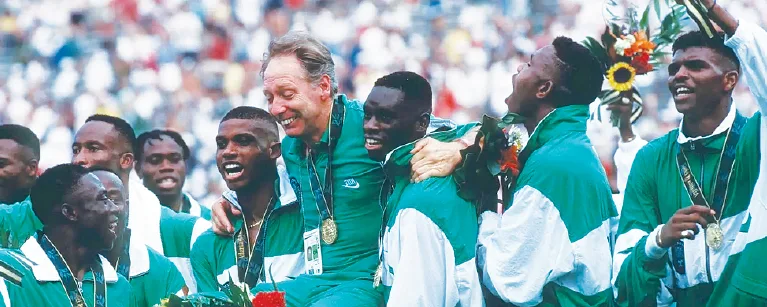
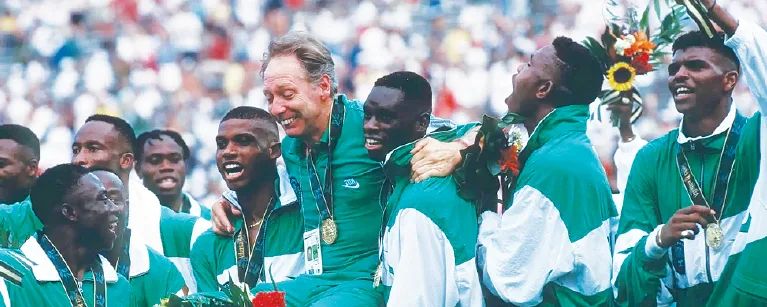
Since Nojeem Maiyegun won bronze at the 1964 Tokyo Olympics, Nigeria has won 27 Olympic medals: three gold, 11 silver, and 13 bronze. A standout moment came at the 1996 Atlanta Games when Chioma Ajunwa won gold in the women’s long jump, becoming Nigeria’s first individual Olympic gold medallist.
In Atlanta, Nigeria’s men’s football team made history by winning Olympic gold. The team, led by Nwankwo Kanu, came from behind to beat Brazil 4-3 in the semi-finals and then defeated Argentina 3-2 in the final, with Emmanuel Amuneke scoring the decisive goal.
At the Tokyo 2020 Olympics, Blessing Oborududu won silver in wrestling, becoming Nigeria’s first Olympic medallist in the sport. Chika Chukwumerije won bronze in taekwondo at the 2008 Beijing Olympics, marking Nigeria’s first medal in that discipline.
Nigerian para-athletes have excelled, winning a total of 80 medals, including 40 gold. Notable athletes include Eniola Bolaji, the first African to win an Olympic medal in badminton, and Folashade Oluwafemiayo.
D’Tigress and Basketball Achievements
Nigeria’s women’s basketball team, D’Tigress, has dominated African basketball, winning the FIBA Women’s AfroBasket five times in a row from 2017 to 2025. They made history at the 2024 Paris Olympics by reaching the quarter-finals, becoming the first African basketball team to achieve this.
Tobi Amusan’s World Record
Tobi Amusan made history at the 2022 World Athletics Championships in Oregon, USA, by setting a world record in the women’s 100m hurdles with a time of 12.12 seconds in the semi-final. She later won gold in the final in 12.06 seconds, though it was wind-assisted and not counted as a world record. Amusan became Nigeria’s first world outdoor athletics champion.
Her record lasted until August 2026, when Masai Russell clocked 12.09 seconds at the Zurich Diamond League. Amusan has won the Diamond League three times, six African Championships gold medals, and four African Games titles, along with two Commonwealth Games gold medals.
Heartbreaking Moments in Sports

Nigeria’s failure to qualify for the 2006 World Cup in Germany was disappointing. The Super Eagles had previously played in three World Cups but missed out due to goal difference against Angola in their qualifying group.
The 2022 World Cup failure was also a major setback. They drew 0-0 with Ghana in Kumasi and 1-1 in Abuja, ending their hopes of reaching Qatar. This also meant they missed the 2026 World Cup, extending their absence to three editions since 1994.
The Super Falcons faced a historic setback in August 2026, failing to qualify for the 2027 FIFA Women’s World Cup in Brazil. They lost 1-0 to Cameroon in the quarter-finals but had another chance in the continental play-off. Unfortunately, they lost 2-1 to South Africa in the play-off on August 13, 2026.
This defeat ended Nigeria’s streak of appearances at every Women’s World Cup since 1991, marking a painful chapter in the nation’s football history.
Close Calls in U-20 and U-17 World Cups
Nigeria’s Flying Eagles came close to winning their first FIFA U-20 World Cup in 2005 but lost 2-1 to Argentina in the final in the Netherlands. Young Lionel Messi scored twice, denying Nigeria the title. The Flying Eagles reached the final after a strong campaign, but a talented group fell short.
Four years later, Nigeria’s Golden Eaglets lost 1-0 to Switzerland in the 2009 FIFA U-17 World Cup final in Abuja. After winning in 2007, they aimed to defend their title, but Haris Seferovic’s header secured Switzerland’s first global football title, leaving Nigeria with silver.
Doping Scandals Affecting Athletes
Nigeria’s sports history has also faced doping scandals that have cost athletes medals and careers. Notable cases include Innocent Asonze, Oludamola Osayomi, and Folashade Abugan, who lost titles due to doping violations.
The most prominent case involved Blessing Okagbare at the Tokyo 2020 Olympics. She was suspended after testing positive for human growth hormone and received an 11-year ban for multiple violations. Promising athlete Divine Oduduru also faced a six-year ban, which affected his career and mental health.
Tragic Events in Nigerian Football
The death of Samuel Okwaraji is one of the darkest moments in Nigerian football. On August 12, 1989, he collapsed during a World Cup qualifying match against Angola in Lagos. He died from cardiac arrest at just 25 years old. Okwaraji continued playing for Nigeria while pursuing a professional career in Europe. His death shocked the nation and symbolized patriotism and sacrifice.
The tragedy was worsened by the deaths of several fans due to overcrowding. Before Okwaraji’s death, seven fans died from the packed stands. Reports say the stadium clinic had only three beds and was overwhelmed with unconscious people.
Years earlier, in 1979, 24 football fans died during a semi-final match between Bendel Insurance and IICC Shooting Stars at the National Stadium due to a crowd surge.
Even today, medical emergency response in Nigerian football is lacking, as more deaths have been reported despite advances in technology.
Painful 2000 AFCON Final Loss
Nigeria’s 2000 AFCON final defeat to Cameroon is one of the most painful moments in football history, especially since it happened at home. Co-hosting with Ghana, Nigeria faced Cameroon in the final at the National Stadium in Lagos on February 13, 2000. The Super Eagles fell behind 2-0 with goals from Samuel Eto’o and Patrick Mboma but fought back to tie 2-2.
The final went to penalties, where Cameroon won 4-3, leaving the home crowd heartbroken. Victor Ikpeba’s missed penalty made the defeat even more painful, as it was a chance to win the title in front of their fans.
Decline of National Stadiums
The National Stadium in Lagos has a rich history, but it is sad to see its current condition. Built in 1972, it hosted the 1973 African Games and the 1980 AFCON, where Nigeria won its first title. Years of neglect have led to its decline, and it stopped hosting Super Eagles matches in 2004.
Other facilities like the Moshood Abiola National Stadium in Abuja also need attention. The Federal Government has announced a plan for a nationwide upgrade of sports infrastructure to improve these facilities.

Drop your comment
No comments yet — be the first to drop the gist 👇