In February 2025, a criminal gang kidnapped Mary Aderemi after she got into a taxi in Abuja, Nigeria's capital.
"Call your boss, call anyone you know to give us money or we will sell or kill you now," a gang member shouted at her.
This incident happened around 1 pm. Ms Aderemi entered an ash-coloured Volkswagen taxi in the Churchgate area. She was rushing to her lecture center to prepare for her accounting certification exam.
The taxi stopped several times to pick up three other passengers. Unknown to her, these passengers were part of the driver’s gang, who would soon put her through hell.
"The glasses were wound up as the last person entered; that was when I knew it was a tinted vehicle and sensed something was wrong," she recalled. "Next minute, one brought out a knife, while another brought out a taser. The third man also had a gun with him."
Ms Aderemi said the man next to her started hitting her, while another used a taser on her. She felt paralyzed.
"Immediately the taser was applied to me, my hands were paralyzed! I couldn’t move them for some time. They tied and blindfolded me, carrying me around Abuja. They said they would take me to the dreadful Kaduna road if I didn’t cooperate with them," she told DUBAWA.
The gang took her phone, withdrew over N100,000 from her bank account, and used her details to borrow money from a loan app. Despite submitting a court affidavit and police report, the loan app continues to harass her for repayment.
In many parts of Nigeria, the lack of laws regulating taser sales and use is creating a public security risk. Criminals are exploiting this gap to easily access these potentially deadly devices.
A taser can incapacitate a person with about 50,000 volts of electric shock. Trained security personnel often use it to subdue aggressive individuals.
In some countries, citizens use tasers for self-defense. This dual-purpose use makes regulating them essential.
DUBAWA's investigation found that tasers are now easy to get in Nigeria. People can buy and carry them without much difficulty. But there are currently no regulations on their use.
A look at the Control of Small Arms and Light Weapons Act (2021) shows that the law does not address tasers. Similarly, the Nigerian Criminal Code does not specifically mention tasers, referring instead to "offensive weapons."
The law defines offensive weapons as any item, other than a firearm, designed to cause injury. Examples include air guns, cutlasses, knives, and other items that can be used to harm.
The law carries a felony charge and a three-year prison term for anyone guilty of using offensive weapons.
DUBAWA reached out to the National Centre for the Control of Small Arms and Light Weapons to ask if they knew about the common availability of tasers, but has not received a response.
In December 2022, Muyiwa Adejobi, then spokesperson of the Nigeria Police Force, responded to a question on X about individual ownership of tasers. He said, "For now, the law of Nigeria doesn’t permit individuals to own these items. It is a matter of law, not an opinion, please."
DUBAWA tried to find out which law he was referring to, but calls and texts to Mr Adejobi and Josephine Adeh, police spokesperson for the Federal Capital Territory, have gone unanswered.
George Anasam, a lawyer in Abuja, noted that Nigerian law doesn’t clearly state the position on tasers. Thus, they can be sold, but using them for crimes is illegal.
"There is no law that prohibits you from possessing tasers in Nigeria as it doesn’t fall under items that are categorically mentioned in the country’s firearms laws," Mr Anasam said. "Tasers can be sold to Nigerians. But what matters is how they are used. That determines if an offense has occurred."
Some Nigerians buy tasers for self-defense. One user, @Sdq_Solution, shared on X how he used a taser to defend himself after a motor park worker tried to damage his car.
He said the incident happened around the overhead bridge in Abule Egba, Lagos. The worker tried to attack him, but he pulled out a taser and defended himself.
"I tased him like 3 times because I was really angry, na the LASTMA wey dey there beg me to go because I don cause traffic, the werey no fit move him body for ground," he wrote in Pidgin English.
Oloye Oloyede, a resident of Mararaba in Nasarawa State, also shared that he bought a taser for self-defense.
He explained that he made this decision in 2023, considering the risks private car owners face in Nigeria without defensive tools.
"I have a taser, but I have not used it before. The attackers always try to catch their victims unaware. Tasers help for self-defense because one can use them against street urchins or touts, but I’ve not used it against anyone," he said.
DUBAWA spoke with five other Nigerians who said they bought tasers for self-defense, but many reported they rarely use them.
In countries like the United States and the United Kingdom, tasers are considered defensive tools against attacks, especially in situations like sexual assault and nighttime robbery. But these countries have strict regulations.
For instance, in the UK, carrying a disguised taser can lead to a five-year prison sentence. If someone owns the original design, it could mean ten years and a hefty fine. Some places even require a license for sales.
These restrictions aim to prevent tasers from falling into the wrong hands.
While buying a taser is not illegal in Nigeria, the lack of regulation makes them a preferred weapon for committing crimes and causing harm. The country allows residents a right to self-defense under Section 33(2) of the 1999 Constitution.
Segun Falade, a journalist, was attacked with a taser during the run-up to local government elections in Lagos State. Security personnel stopped him from entering a meeting he was invited to.
"It was the same party that invited me, yet their security would not allow me or others to enter the crowded venue," he said.
Mr Falade remembered trying to show his press ID when he heard the shocking sounds of the taser.
"Before I knew it, the bouncers at the gate were already using the taser on everybody, and they did use it on me, too. The experience was quite traumatic for me, and I can’t imagine facing such danger while working," he added.
He fled the venue but was unable to work that day because the incident left him unsettled.
"I don’t think tasers should be used indiscriminately on anyone who does not pose a threat. A security official can hold it to control mayhem, but it should be used as a last resort. It’s like a gun, it’s dangerous," the journalist said.
Mr Anasam believes that the use of tasers for self-defense needs regulation to prevent threats and intimidation.
"Nigeria needs to make legal decisions on the use of tasers. While they are lawful if not abused, regulations can help prevent misuse. We live in a society with rising violence, which can cause serious injury if used improperly," the lawyer said.
DUBAWA's findings and interviews show that major hotspots for buying tasers in Nigeria include Bodija market in Ibadan, Computer Village in Ikeja, Lagos, and various areas in Abuja like Wuse and Banex.
We analyzed social media accounts and offline sellers advertising tasers to Nigerians. One account, @AliceandBelleSafetyGadgets, promotes tasers and has over 3,000 followers. It is run by Alishia, a Nigerian-American educator.
The business collaborates with celebrities to market its products. In April, DUBAWA contacted Alishia to buy a taser after visiting Ibadan. After showing us different discreet models, we preferred physical pickup, but she suggested delivery through ride-hailing drivers as her shop was under renovation.
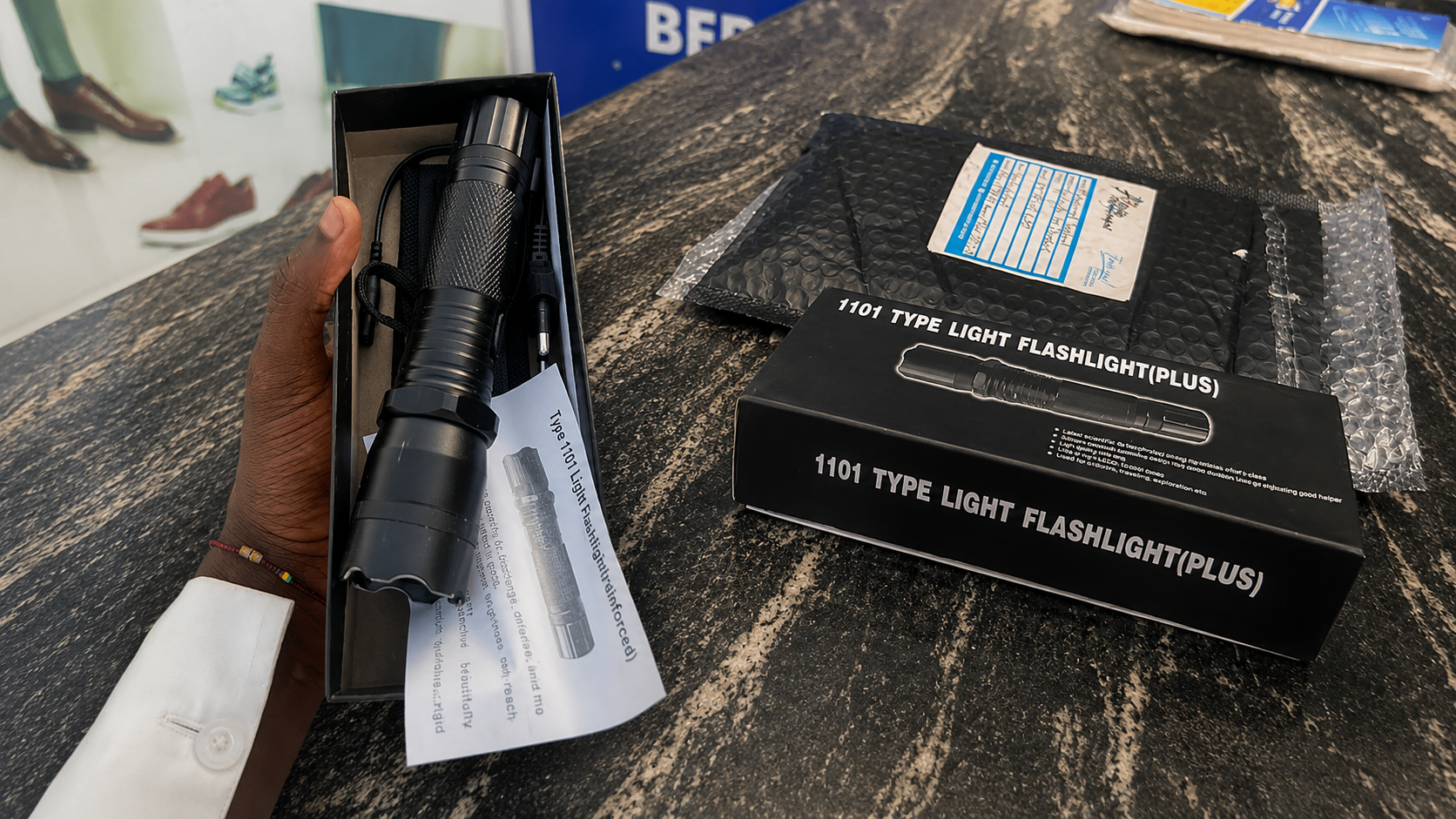
Through WhatsApp, we ordered a phone taser for N20,500. Days later, a delivery person brought the taser in a customized case.
In Ibadan, another seller, Adebiyi Ijoba, offered a taser for N20,000 but only sells online.
"It’s an online business. Call me, and I will meet you anywhere. If the taser is used on anyone, their body will die for some time," he said, adding that he ships the devices in bulk from abroad.
DUBAWA found more offline and online sellers, with many offering immediate delivery after orders. Some even sponsor ads on social media to attract buyers.
In Abuja, Banex Plaza has many taser sellers targeting commuters, especially during traffic jams. These sellers, often teenage boys, would call out to potential buyers.
In July, we met Bil-Yaminu Saadu, who initially priced a taser at N20,000 but sold it for N12,000 after bargaining.
"Come anytime, I dey here. I have plenty. Buy a jackknife too or pepper spray, I’ll reduce your money," he said.
Before this purchase, we approached several other sellers, and none inquired about our reporter's identity or the intended use of the weapon.
Malik Samuel, a researcher at Good Governance Africa, told DUBAWA that the lack of age restrictions at points of sale increases the risk.
"Their sale should be licensed, age-restricted, and tracked, with strict penalties for misuse. For law enforcement and licensed private security, taser use should involve thorough training, mandatory reporting, and medical safeguards to protect the public," he said.
Mr Samuel warned that easy access to tasers through markets and online platforms can lead to political intimidation, street violence, and unlawful crowd control by non-state actors.
"In tense electoral situations, just showing a taser can cause panic and escalate conflicts. The danger is also present in daily life," he added.
Ahmed AbdulBasit, a doctor at the Federal Medical Centre in Lagos, spoke about health risks from tasers. He explained that they affect the muscles and nerves of victims to incapacitate them.
He described tasers as dangerous and offensive. Victims can suffer emotional distress and head injuries that might result in death if they hit their heads hard. "People exposed to taser use can develop post-traumatic stress disorder, anxiety, or fear, and can be fatal if tased near the head," he said.
Moshood Ibrahim, a lawyer in Kwara State, stated that under Section 36(12) of the Constitution, people cannot be prosecuted for owning a taser since it is not clearly defined as a crime.
"Since a taser is not explicitly mentioned under these laws, it cannot be said to be illegal. One cannot be held for possessing it until the law specifically prohibits its sale, possession, or use.
"However, if someone uses it to commit a crime, they can be prosecuted for criminal assault. This is where regulation is needed. The law must define how it should be bought and sold, and penalties for misuse," Mr Ibrahim said.
Drop your comment
No comments yet — be the first to drop the gist 👇