
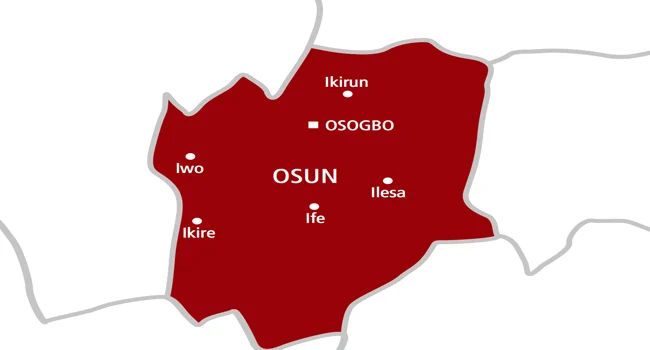
As Osun State gets ready for the governorship election on Saturday, the mood has turned grim. The election season is not just about campaign promises and rallies. It is also filled with fear from killings and attacks that make residents wary of participating.
In recent months, violence linked to politics has surged in parts of the state. This rise in violent incidents shows a troubling pattern that has often marred elections in the South-western state.
The violence involves the ruling Accord Party and the All Progressives Congress (APC). Both sides accuse each other of being the aggressors in these attacks.
Ademola Adeleke, the current governor, is running under the Accord Party banner. His main rival is Bola Oyebamiji, a former Commissioner for Finance and the APC candidate.
Fifteen political parties are in the race. They include the African Democratic Congress (ADC), Action Alliance (AA), African Action Congress (AAC), African Democratic Party (ADP), All Progressives’ Grand Alliance (APGA), Allied Peoples Movement (APM), Action Peoples Party (APP), Boot Party (BP), New Nigeria Peoples Party (NNPP), and Peoples Redemption Party (PRP).
The Young Progressives Party (YPP), Zenith Labour Party (ZLP), and the African Democratic Party (ADP) with a female candidate also join the contest. The APGA candidate withdrew last Saturday but is still on the ballot as the 14th candidate, having pledged support for the APC.
On Wednesday, INEC confirmed the inclusion of the Social Democratic Party (SDP) candidate as the 15th candidate due to a court order.
Tragedy struck in June when 14-year-old Ezekiel Olapade died after being hit by a stray bullet during a shootout involving suspected political thugs near the Irepodun Local Government Area secretariat in Ilobu. He was just a bystander caught in the chaos.
Ezekiel’s father, Gbenga Olapade, claimed that Kareem Saheed, known as Tanfeani, led a group of armed men that attacked his wife’s palm-wine bar across from the local government secretariat. According to Mr. Olapade, the attackers were looking for a man in a yellow cap, thought to be linked to the Accord Party, and shot at random, hitting his son.
The Osun State Police Public Relations Officer, Abiodun Ojelabi, confirmed the incident, stating another person was shot and taken to the hospital.
Saheed has denied any involvement in Ezekiel's death, claiming he was not present during the shooting. Yet, a video of the gunfire raised more questions. Police later arrested him and 23 others connected to political violence and cult activities in the state.
Ezekiel’s death was not alone. It highlighted a series of violent events leading up to the election. Data from the Kimpact Development Initiative (KDI) shows that between October 2025 and June 2026, there were 44 election-related violent incidents recorded in Osun. Out of these, 26 occurred in May and June alone.
KDI reported at least 73 violent incidents linked to the election, resulting in 29 deaths, with Osogbo, the state capital, being the hardest hit. Bukola Idowu, KDI's executive director, told this newspaper that the increase in violence is alarming and needs urgent action.
"Voters need to know that they are safe. When such incidents continue up to the election, they will undermine citizens’ participation and the credibility of the electoral process," he said.
The police also recognized the seriousness of the situation. In July, they revealed that 30 people had lost their lives due to pre-election violence in Osun.
"From the complaints received, we cannot rule out the involvement of some politicians in the killings," said Anietie Iniedu, the police spokesperson, during a morning program on Channel TV.
This surge in violence has stirred memories of Osun’s past electoral conflicts. Civil society groups, security agencies, and political figures have cautioned about the potential dangers as the election nears.
The current wave of violence is rooted in earlier political disputes. Tensions rose among local government chairpersons elected under the former APC governor, Gboyega Oyetola, and the new chairpersons under Governor Adeleke.
In February 2025, conflicts over control of the state’s 30 local governments turned violent. Rival parties, including the APC and Adeleke’s former party, the Peoples Democratic Party (PDP), clashed over who should control council secretariats after a re-run election.
When APC members tried to take control following court rulings, they faced pushback from PDP supporters. This clash resulted in at least five deaths, including the former Irewole Local Government Area council chairman, Remi Abass.
As the fight for local government power continued, it spilled into the governorship race, leading to more violence in the political arena.
Signs of trouble started with vandalism of campaign materials and attacks on political offices. In May, the Imole Campaign Council, supporting Governor Adeleke, accused APC supporters of damaging their campaign billboards in Irewole, Ayedaade, Irepodun, and Osogbo.
The APC denied these claims and countered that their own materials were destroyed by alleged thugs from the state government and the Accord Party. The police confirmed some billboards were damaged and stated they were investigating, but no suspects had been identified.
However, the situation escalated further in May when armed men attacked Governor Adeleke’s campaign office in Osogbo for the second time in two weeks, causing damage and fear among supporters.
On 23 June, another serious incident happened in Esa-Oke, where Ajayi Aderogba, an Accord Party member, was shot dead while preparing for a campaign rally. The Adeleke campaign accused APC federal lawmaker Oluwole Oke of trying to disrupt the rally, which he denied.
Just days later, an APC member, Taofeek Mustapha, was shot in the leg and told reporters his attackers targeted him for wearing an APC cap. The police confirmed the incident and began an investigation.
Around the same time, clashes were reported in Ife, Akoda, Owode-Ede, and Osogbo during an APC campaign in Ife, injuring three people. Tensions were rising, drawing attention from both police and international observers.
On 3 July, Inspector-General of Police, Tunji Disu, visited Governor Adeleke in Osogbo due to the increasing violence. He warned that the election is not a war and called for arrests of those involved in the violence.


"I’ve taken my time to look at what is happening around here, and for a number of months now, we have been able to count the number of deaths and the number of crises and fighting in Osun," Mr Disu said.
Despite the police's efforts, violence persisted. Following Mr Disu’s visit, Governor Adeleke called for visa restrictions and sanctions against the Minister of Marine and Blue Economy, Mr Oyetola, and others for their alleged roles in the violence.
The threat of violence has even reached the election process itself. On 26 July, armed men attacked an Independent National Electoral Commission (INEC) Permanent Voter Card collection center in Okuku, Odo-Otin Local Government Area.
The police reported that about 10 armed men shot into the air and stole three packs of PVCs. INEC condemned the attack and urged security forces to investigate and arrest those responsible.
This incident highlighted how pre-election violence could disrupt the electoral process before voters even reach the polls. In late June, INEC revealed it had identified around 385 hotspots across 11 LGAs in Osun that could disrupt the election.
INEC Chairman Joash Amupitan said these places would receive strong security presence. He noted, "Security forces have been issued strict operational directives to neutralize thuggery, cult activities, and any attempts at ballot disruption."
The police plan to deploy at least 14,692 officers statewide, with at least four officers at each polling unit. The NSCDC will also send 10,210 personnel for the election.
KDI identified 12 LGAs as high-risk areas needing focused security and political actions to prevent violence and ensure a peaceful election.
On 9 June, an APC rally was attacked in Ife, and a convoy returning from Ede was also confronted by Accord supporters. Gunfire was reported around Osogbo, injuring three people.
Earlier in May, gunmen killed Kolade Eluyera, son of the women’s leader of the Accord Party in Ikire, Irewole LGA. This sparked blame between the campaign teams of Adeleke and Oyebamiji.
Pelumi Olajengbesi, spokesperson for Adeleke’s campaign, claimed APC thugs were responsible for the killing. Kola Olabisi, co-chairman of the Oyebamiji campaign, dismissed the claim and called for an unbiased police investigation.
On 15 and 16 July, police confirmed two deaths from separate incidents in Egbatedo and Owode-Igbona in Osogbo. Four others were injured, leading to arrests and recovery of a pistol and ammunition.
Although Governor Adeleke condemned these killings, police attributed them to cult-related violence rather than electoral motives.
The security situation in Osun increasingly blurs the lines between political violence, cult clashes, and regular crime. But for the residents experiencing this violence, the fear is very real.
Some people have stopped wearing party colors or campaign insignia in public to avoid being targeted. AbdulAzeez Adewuyi from Iwo said the fear of the upcoming election has changed how he interacts with politics.
He used to engage actively and accept gifts from supporters. But after witnessing violence near his home in 2022, he chose to distance himself from politicians.
“It has always been brutal. Many people lose their lives or get shot because of their involvement in election politics. Even innocent people can become victims just because they are wearing a party cap or clothing,” Mr Adewuyi said. “Election is a no for me. People will move on after the election, but one family will continue to suffer the loss forever. It is better to stay away.”
Concerned about the tension in Osun, some stakeholders are calling for a peaceful and fair election on Saturday. Titi Adeleke, the governor's wife, led a group of women demanding a violence-free election.
Mrs Adeleke urged an end to the alleged arrests of Accord Party leaders and called on the police to question those involved in the killings.
"We are demanding a free and fair election. All we want is peace and a violence-free exercise in Osun," she said.
IPAC National Chairman, Yusuf Dantalle, emphasized the need to protect democratic values and voters' rights. "The election must be a genuine contest of ideas, policies, programmes and popularity, while the freely expressed will of Osun people determines the outcome," he said.
The fear of political violence is not new in Osun. The state has a history of electoral violence that often spills beyond the ballot box.
Survivors from previous attacks have shared stories of being shot, beaten, or forced to flee their communities because of their political beliefs. Many have lost their lives in past elections.
A study by KDI found that Osun recorded the highest number of election-related violent incidents in Nigeria within a year, contributing to a significant share of the 344 incidents reported nationwide from January 2022 to January 2023.
The Foundation for Investigative Journalism has documented survivors’ accounts of electoral violence, including those who suffered gunshot wounds and had to flee after attacks. Their stories remind us of the serious risks involved when political competition turns violent.
Osun’s political landscape shows that violence often starts months before elections, as parties rally supporters and fight for control. This violence leaves lasting scars long after the votes are counted.
Drop your comment
No comments yet — be the first to drop the gist 👇