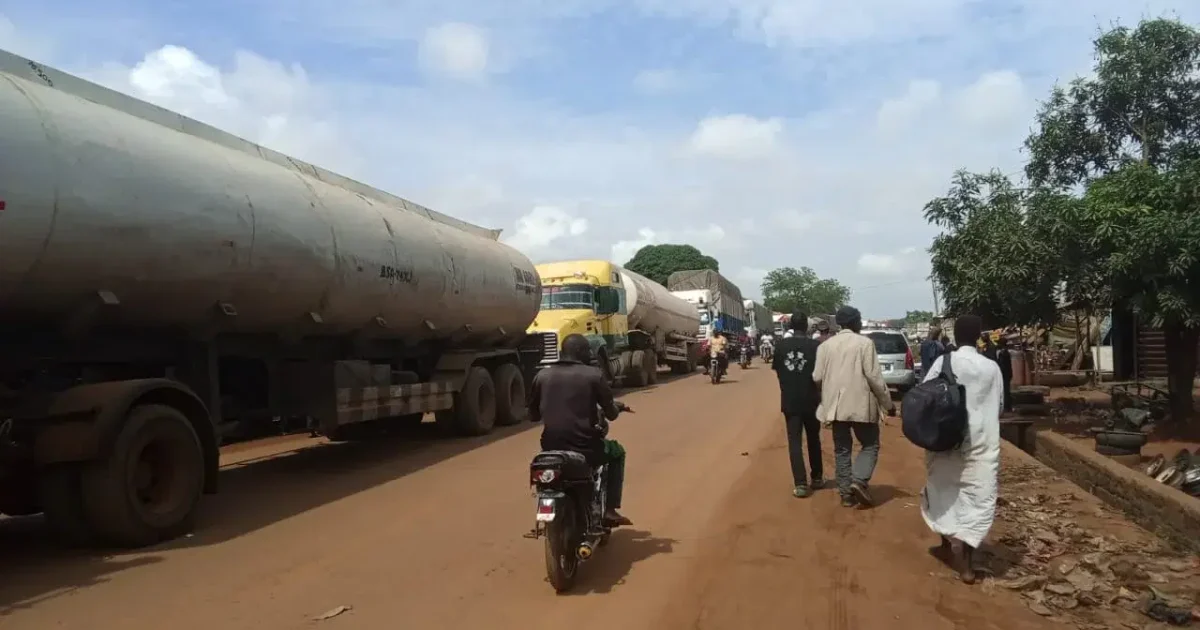
On 31st July 2025, hundreds of protesting IDPs blocked the Makurdi, Lafia expressway in Makurdi. Their message was clear: they are facing hunger, neglect, and unfulfilled promises.

IDP protesting and blocking the Makurdi-Lafia Highway on July 31, 2025
The protest happened shortly after Nigeria’s First Lady, Oluremi Tinubu, visited Benue State. She announced a ₦1 billion donation to help displaced persons after the Yelewata attack that took many lives.
For Mwuese Ugela, one of the protesters, the timing of the donation was suspicious.
“We heard in the news that the First Lady had given the Benue State Government ₦1 billion. And if we don’t protest, that money will never reach us. They have been doing this to us over and over,” she said.
Ms Ugela's concerns are backed by facts. A review of Benue State’s financial statements from 2018, 2024, together with the 2025 Budget Implementation Report, shows serious issues. The documents reveal gaps and inconsistencies in spending decisions that seem to worsen the humanitarian crisis.
History of Donations and Ongoing Issues
For many years, Benue has seen violence under different administrations. From 2015 to 2023, under Samuel Ortom, the state faced waves of violence and displacement. Donations came in, and the state budgeted funds for IDP support. Yet, actual spending was often low or unclear.
On 7 February 2018, the then Governor of Rivers State, Nyesom Wike, reportedly donated ₦200 million to help IDPs in Benue. But a closer look at the financial records shows troubling discrepancies that raise concerns about transparency.
A review of Benue State’s 2018 financial statements shows no record of the ₦200 million donation as capital receipts. This raises doubts about whether the funds were received, documented, or reported accurately.
Yet, in November 2018, Emmanuel Shior, the then Executive Secretary of the Benue State Emergency Management Agency (SEMA), confirmed that the funds had been received and used.
“The ₦200 million donated by Rivers State Governor Nyesom Wike to cater for the IDPs has been judiciously utilised for the purpose it was meant. The money in question has been used in the procurement of food and non-food relief materials meant for their upkeep,” he said.
This statement contradicts the state’s audited financial report. In 2018, the state budgeted ₦50 million for “Rehabilitation of IDPs” but spent only ₦46 million. The spending line for “Welfare Packages” showed only ₦328,000, a tiny amount given the scale of displacement at the time.
This raises a big question: if ₦200 million was used properly, why did official records show only ₦50 million spent? More importantly, what happened to the remaining ₦150 million?
IDP Spending in Recent Years
In 2019, despite ₦80 billion total revenue for the state, only ₦15,000 went to IDP welfare according to the 2019 audited financial statement. Although ₦30 million was approved for IDP rehabilitation, only ₦15,000 was spent, which is just 0.05 percent of the budget.
Despite the ongoing violence, the government showed minimal spending on IDP welfare. Governor Ortom often appealed for help but government spending remained low.
In 2020, the records showed better descriptions of spending. The government reported ₦86.2 million for “COVID-19 protective and relief materials for Internally Displaced Persons.” However, only ₦4.24 million was spent on “Rehabilitation of IDPs” against a budget of ₦8 million.
Lack of Spending in 2021 and 2022
The most alarming pattern appeared in 2021 and 2022. The records showed no actual spending on IDP-related projects in either year. In 2021, there were no reported expenditures linked to IDPs.
In 2022, the state approved ₦800 million for “Welfare Packages,” but actual spending was zero. This was despite the state’s revenue of ₦80.8 billion in 2021 and ₦101.5 billion in 2022.
During this time, violent attacks and displacement continued. Reports showed that about 308 people were killed in 2021 due to violence in various communities. There were also attacks in 2022 leading to more than 335 deaths.
In September 2021, Governor Ortom admitted that the crisis had “overstretched the resources of the state” and sought national support. But reviews of the financial reports for 2021 and 2022 show no clear budget or spending for IDPs.
The lack of spending details raises a key question: if the reports do not show funding for the IDP crisis, how did the government decide that resources were stretched?
Promises and Reality
In February 2022, former Vice President Atiku Abubakar reportedly donated ₦50 million for IDPs in Benue State. A cleric, Apostle Johnson Suleiman, also donated ₦20 million for IDP support. But there was no confirmation that the state received these donations since they were not recorded in the 2022 financial report.
A review of the audited reports for 2021 and 2022 revealed no spending for IDP welfare by SEMA, which is responsible for supporting displaced persons.
In August 2022, SEMA stated that Benue needed about ₦500 million monthly to support nearly two million IDPs. Yet, there were no funds allocated. This contradiction shows that IDPs were not a priority.
By 2023, a new governor, Hyacinth Alia, took office. This may have led to better accounting, with spending on welfare packages increasing.
At the end of 2023, SEMA expenditure rose to ₦559,750,000 under “Welfare Packages,” almost reaching the approved ₦560 million budget.
Questions on IDP Funds
An analysis of Benue State’s 2024 and 2025 budget reports shows a worrying trend in managing IDP funds. While the government clearly noted where billions in humanitarian support came from, they failed to detail how the money was spent.
In 2024, actual IDP-related receipts reached ₦11.6 billion, higher than the budget estimate of ₦10.4 billion. Yet, only ₦4.5 billion was reported spent on IDP activities, leaving a balance of about ₦7.1 billion.
The trend continued in 2025, with receipts of ₈.9 billion, significantly above the approved budget of ₦2.2 billion. But total reported IDP spending was ₦10.3 billion, showing the government spent more than it received.
A review of the 2025 spending profile revealed that ₅.8 billion, more than half, went to administrative costs of the Benue State Emergency Management Agency (BESEMA), while just ₄.4 billion was spent on welfare for IDPs.
Together, the actual IDP receipts totaled about ₜ0 billion over the two years. Of this, ₈.9 billion went to welfare interventions, while ₅.8 billion went to administrative costs. This leaves about ₅.8 billion unaccounted for.
At the end of 2024, the state carried forward around ₈₅ billion in unspent funds into 2025. By the close of 2025, the amount rose to about ₁₂₈ billion. Despite these unspent funds, support for IDPs remained limited.
Vague Spending and Accountability
In 2024, the major spending linked to IDPs was a vague item labeled “Welfare Packages,” where over ₄.5 billion was reportedly spent but with no details on the contents or beneficiaries.
The same pattern followed in 2025, recording ₄.47 billion under “Package Welfare” without providing specific details on how the funds were used.
This lack of detail creates a serious accountability gap. Financial experts say vague classifications like this undermine transparency, especially in humanitarian spending where vulnerable people rely on timely assistance.
Experts like Ternugwa Azende and Timothy Agum noted that calling over ₄.5 billion “welfare packages” without explaining the spending raises big accountability issues. Azende said vague terms make it hard to verify how the funds were used.
The IDP Situation in Camps
Despite rising welfare figures, the 2024 and 2025 reports show no capital projects specifically for IDPs. There are no plans for healthcare facilities or long-term resettlement programs. The IDP crisis seems invisible in capital planning.
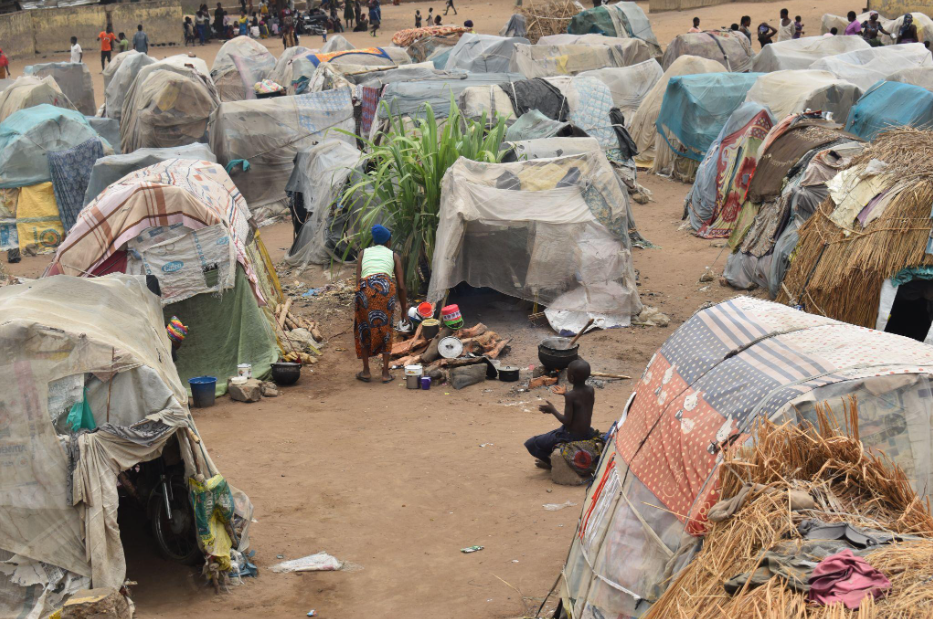
The situation in the camps is dire. The Displacement Tracking Matrix from the International Organisation for Migration shows approximately 480,000 IDPs in Benue.

Map of Benue showing the locations of the IDP camps.
Visits to camps reveal harsh realities. In Makurdi, over 13,000 residents live in a camp without a proper health facility. A clinic once supported by UNICEF is no longer functioning.
Comfort Orban, a mother of two in the camp, said:
“There is no functional clinic here. In 2025, UNICEF set one up, but since the start of this year (2026), it has not been operational.”
Access to safe water is another big issue. Most boreholes were drilled by NGOs. During dry seasons, many become unusable, worsening the situation for displaced families.

The water fetching point with buckets and gallons is queued, waiting for when the water will start to flow in an IDP camp with over 13,000 residents in Benue state
Food distribution is irregular and often insufficient.
“We end up sharing just one mudu of rice, sometimes three at most, and that is after waiting three or four long months,” said Msendoo Tyokaa, frustrated by the situation. “How can that sustain anyone, let alone a family of four?”
The same story plays out in camps across Naka, Ugba, and Daudu. In host communities like Jato Aka in Kwande, displaced residents rely on NGOs or find casual jobs to afford meals.
In Naka IDP camp, Iember Akosu, a mother of three who has lived there for over seven years, said:
“It has been NGOs and humanitarian organisations that come to our aid. We barely get support from the government.”


Drop your comment
No comments yet — be the first to drop the gist 👇