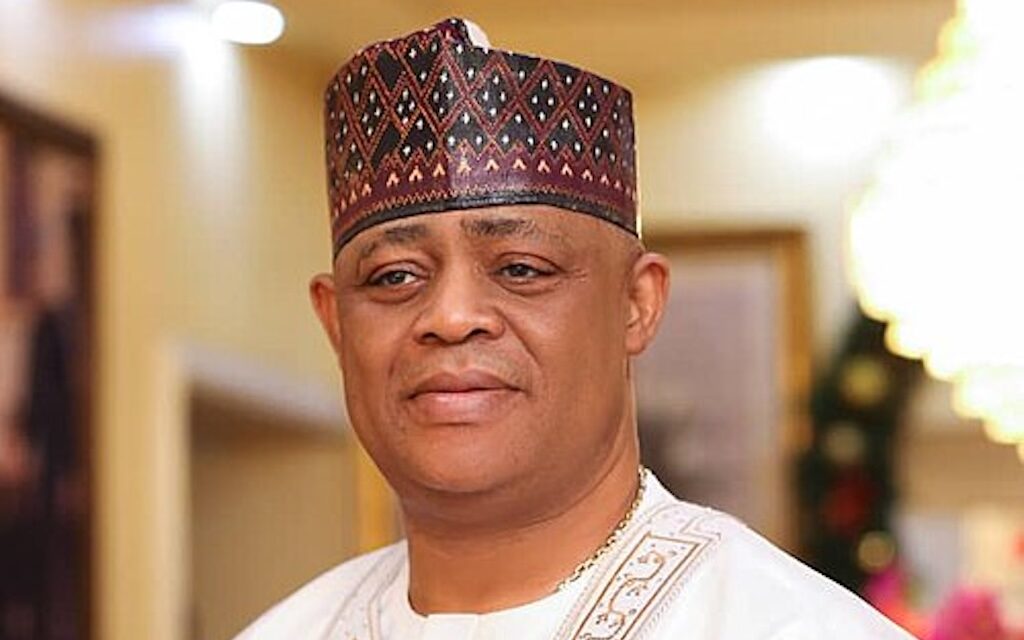
Let me take you back in time.
On 26th November 2006, exactly 20 years ago, Muammar Ghaddafi, the leader of Libya, visited Nigeria for a summit of African and South American heads of state.
As the Minister of Aviation at that time, I had the honor of welcoming him at the airport on behalf of President Olusegun Obasanjo. I was assigned to stay with him for four days, accompanying him wherever he went.
There is no doubt that Ghaddafi’s charm was captivating. After spending those four days with him, I went from being a cautious observer to one of his most enthusiastic supporters.
He was a remarkable man who truly cared for Africa.
But his visit did not start smoothly.
He arrived at the airport with around 200 bodyguards, all armed, and about 100 cars ready to take him to Abuja. The boots of these cars were packed with AK-47s and other weapons.
They took the weapons from one of the three planes he flew in and loaded them into the cars.
When we tried to leave the airport, our security and military personnel blocked us at the gate. They said Ghaddafi and his team could come in, but the high-powered weapons in the cars could not.
I was in the car with Ghaddafi and had to explain this to him through his interpreter. We went back to the airport and tried to leave three more times, but each time we were stopped. Tempers were rising with each attempt.
What happened next was shocking.
Ghaddafi lost his temper, got out of the car, and started walking under the hot sun towards Abuja. He said if the cars could not enter, he would walk. All 200 of his bodyguards and delegation followed him!
I was right next to him, panicking. I feared he would collapse from the heat and exhaustion.
He was already sweating heavily and breathing hard. I was worried about what might happen, even as I pleaded with him not to do this.
My pleas fell on deaf ears.
I called President Obasanjo, and fortunately, he was on his way to the airport to catch a flight to Lagos for an event.
He told me to inform Ghaddafi that he was coming to resolve the issue. I relayed the message to Ghaddafi, and he agreed to go back to the airport, especially after I said the President wanted to talk to him.
When OBJ arrived, he and Ghaddafi greeted each other warmly. After a brief chat, OBJ said he was off to Lagos but would return in time for the conference the next morning.
As he walked past me, he leaned in and whispered that Ghaddafi and his team could not enter unless they removed the AK-47s from their cars and put them back on the plane.
After that, he left me to deal with the situation.
I told Ghaddafi that the weapons had to be taken out. His men reluctantly complied after I had a heated exchange with his Minister of National Security and Head of Protocol, who were rude to our officials.
They had threatened to fly Ghaddafi back to Libya if we didn't allow the weapons in.
The weapons were unloaded and put back on the plane. Our soldiers then surrounded the plane to make sure nothing was smuggled out later.
We then returned to the gate, and the convoy was allowed through.
While we were leaving, my wife Regina called to say that the whole incident was being reported on the BBC, and she hoped everything was okay.
I assured her that we had resolved the matter and were heading to town.
Ghaddafi, still upset, stayed silent in the car until we passed the Central Mosque, where he remarked on its beauty.
That day, I learned a lot about diplomacy. I realized that being firm, showing mutual respect, and sticking to the rules are very important.
Our military and security teams, dedicated to following the President's orders, made me proud. The wisdom, strength, and courage that OBJ showed were impressive.
We stood our ground, and because of that, Ghaddafi and his team respected us from that moment on.
During the next four days of the conference, we became close, and he even invited me to Libya as his personal guest.
His only complaint was that I wore a suit each day. He would have preferred if I had worn an agbada or babariga!
It was a surreal experience.
Ghaddafi was indeed an extraordinary and inspiring man. Over those four days, I learned so much from him.
As for OBJ, he saved lives that day by insisting the heavy weapons must not enter. I learned later that the Libyans had previously left behind weapons that ended up in the hands of terrorists and other dangerous groups in Nigeria.
On 20th October 2011, nearly five years after his visit to Nigeria, Ghaddafi was killed by his own people in his hometown, Sirte.
I watched the footage of his brutal murder on CNN and felt very sad. No one deserves to die like that.
It’s striking how a powerful leader, once adored by his people, can meet such a violent end in an instant.
This serves as a lesson for all of us about the fleeting nature of power and the emptiness that comes with it.
Ironically, the Head of Protocol who was so aggressive during our encounter was one of those condemning him on CNN from Paris the day he was killed.
Such is life!
Drop your comment
No comments yet — be the first to drop the gist 👇