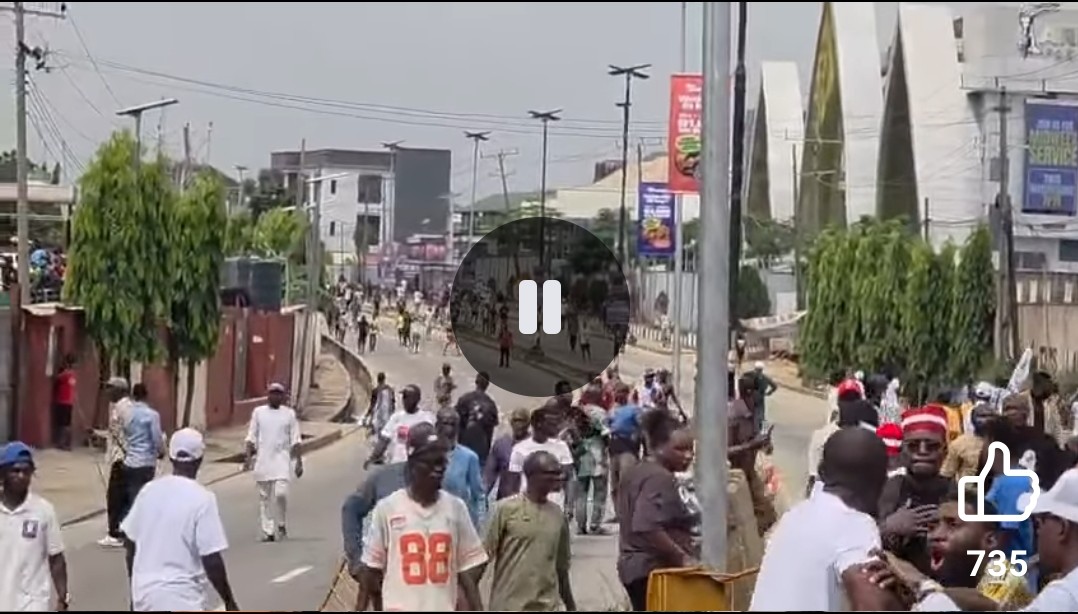
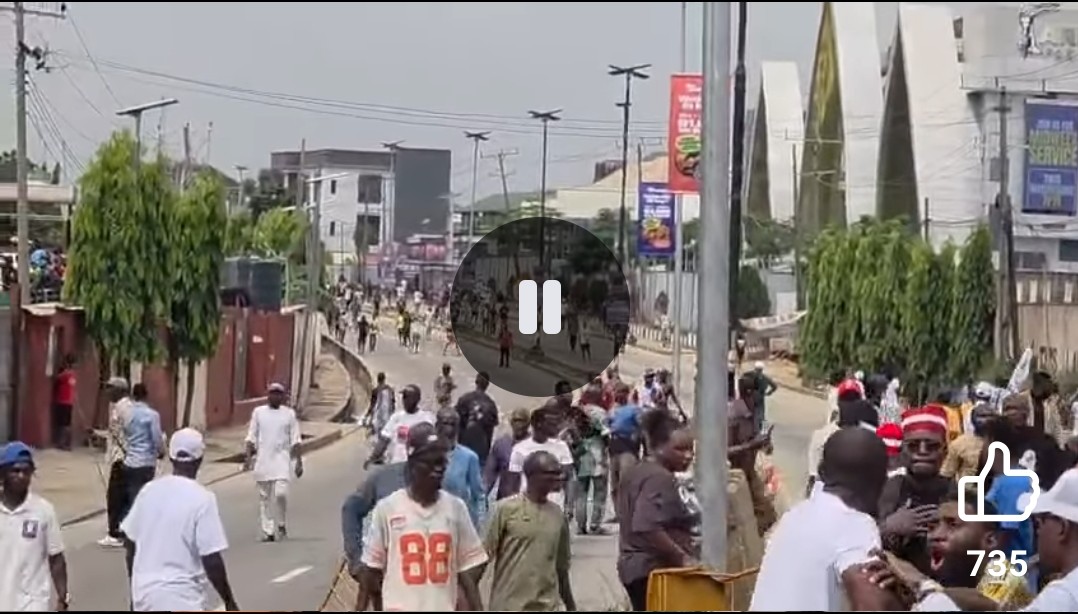
On Thursday, 12 November, thugs attacked supporters of the opposition Nigeria Democratic Congress (NDC) during a town hall meeting in Oregun area of Ikeja, Lagos State. The attack left several people injured and damaged properties, including vehicles owned by party members.
The hoodlums, armed with cutlasses and stones, stormed the meeting, disrupted it, and chased away the party’s supporters.
Before the attack, many supporters, dressed in the party’s colours, were dancing and singing at the event. But when the disruption happened, panic spread, and party supporters ran for safety. Police officers later arrived to restore order and calm the situation.
Peter Obi, the NDC presidential candidate, and his running mate, Rabiu Kwankwaso, a former governor of Kano State, were not present during the attack. Some believe they were the target, but not necessarily to harm them, rather to frustrate their campaign efforts.
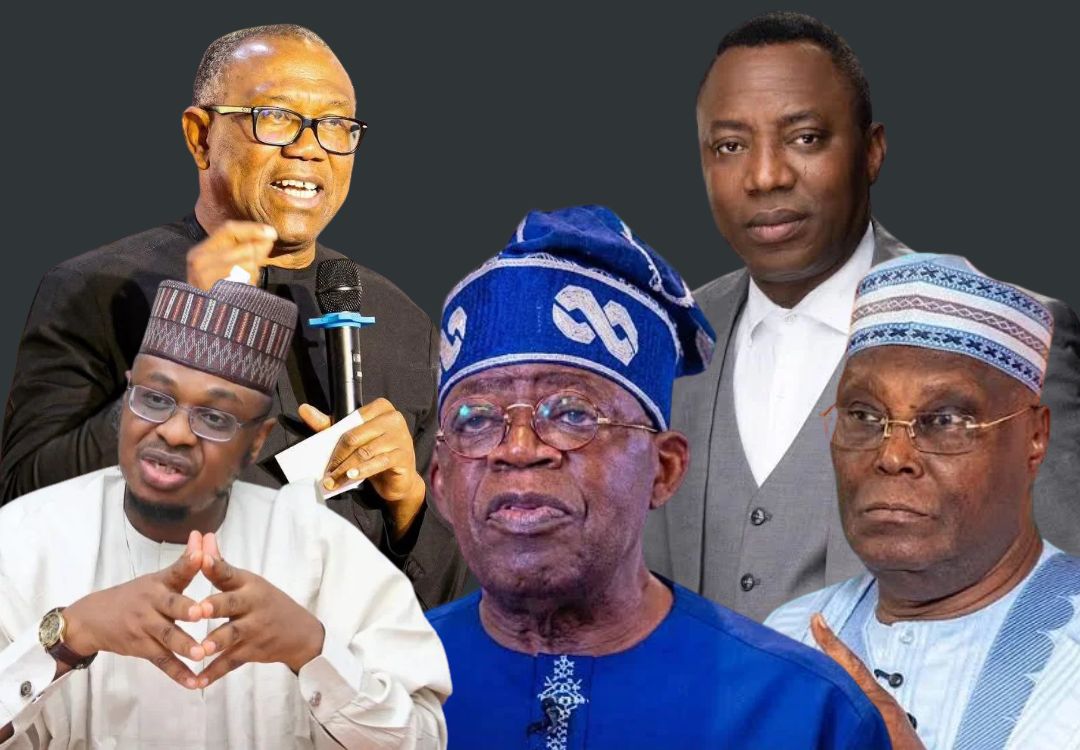
Mr Obi, who was the governor of Anambra State, is running for president again. He first sought the nation’s highest office in 2023 under the Labour Party, finishing third in the election. In that election, he won Lagos State, a stronghold of the All Progressives Congress (APC), with 582,354 votes.
In 2019, he had teamed up with former Vice President Atiku Abubakar on the Peoples Democratic Party (PDP) ticket. Atiku has since moved to the African Democratic Congress (ADC) for the 2027 election, while Obi has switched from the Labour Party to the ADC and then to the NDC.
Both Atiku and Obi are among the 18 candidates cleared by the Independent National Electoral Commission (INEC) for the 16 January 2027 election.
Other presidential hopefuls include President Bola Tinubu of the APC, who is seeking a second term; Oyo State Governor Seyi Makinde of the Allied Peoples Movement (APM); Sandy Onor (PDP); Omoyele Sowore (AAC); former Cross River Governor Donald Duke (PRP); and Adewole Adebayo (SDP).
The commission has also cleared governorship candidates for 28 of the 36 states where elections will take place on 6 February 2027. It also approved candidates for the National Assembly and State Houses of Assembly elections.
As part of the election schedule for 2027, the commission directed candidates for the elections to begin their campaigns.
Presidential and National Assembly candidates started their campaigns on 19 August, while those for governorship and State Houses of Assembly began a month later.
Since the campaigns began, there have been violent attacks on rallies, town hall meetings, and other political events organized by parties seeking the people's mandate.
In the lead-up to the polls, political activities across the country have increasingly seen reports of violence, intimidation, and threats.
Campaign activities involving presidential candidates and opposition parties have faced security challenges in various parts of the country. This includes attacks on convoys, disruptions of political gatherings, and confrontations between party supporters.
In some cases, presidential candidates have claimed their lives or those of their supporters were endangered. Political gatherings have been disrupted, vehicles damaged, and people injured or killed.
Other incidents
On 13 September, unknown gunmen attacked and disrupted a state-wide monthly ward meeting of the NDC in Ihuani Awkunanaw, Enugu State, the hometown of the party’s governorship candidate, Christian Ohaa. At least eight party members were injured, and several party materials, canopies, and plastic chairs were destroyed.
Sampson Ukwu, media aide to the NDC governorship candidate, named the victims as Onovo Donald Ekene, Ngene Godwin Madueke, Ogbodo Gloria, Onovo Victor, Maduabuchi Ugwu, Nnaemeka Nelson, Chinonso Nwagbara, and Obinna Daniel Owo.
On 18 September, suspected political thugs disrupted a rally for supporters of Obi and Kwankwaso in Warri, Delta State.
Esther Umoh, a photographer with Obi, alleged that the attackers fired at members of the campaign team, including the party’s Delta State governorship candidate's entourage.
The police did not deny that an attack occurred but did not provide further details about the incident.
This incident raised concerns about the security arrangements for opposition campaign activities and whether political candidates can move freely during their campaigns.
On 10 October, gunmen invaded an NDC gathering in Afa, Enugu State, killing a young man named Ifeanyi Nwolie.
Following the incident, Obi pledged financial support to the mother of the slain supporter.
On 30 October, Omoyele Sowore, the AAC presidential candidate, claimed he and his team were attacked in Ado-Ekiti, Ekiti State.
The attack happened at Tawakalitu Restaurant in Dalimore area after Sowore attended an interview at MIDAS FM. He alleged that armed men attacked him and his team with sticks and machetes. He also reported that communication devices were stolen, vehicle tyres were slashed, and property was damaged.
Sowore called the incident an assassination attempt and demanded an independent investigation. The police called it an altercation and announced the arrest of 11 suspects.
Sowore questioned the police’s version and asked that relevant evidence, like CCTV footage, be preserved. The suspects were arraigned on several charges, including conspiracy and assault. They were granted bail, and the case was adjourned until 4 December.
The disagreement between Sowore and the police over what happened raises concerns about the transparency of investigations into attacks on political figures.
While arrests are a step in the investigation, the evidence presented in court and the outcome will be key to finding out what happened and who is responsible.
In Sokoto State, another violent incident occurred on 31 October. The ADC governorship candidate, Manir Dan’iya, was attacked near the city’s airport.
His party claimed that personnel from the Sokoto Marshal and the state Community Guard blocked his convoy, fired gunshots, and damaged vehicles.
They also alleged that two State Security Service (SSS) operatives with the candidate were detained during the incident.
However, the Sokoto State APC chairman, Haruna Adiya, denied the attack, calling it false claims aimed at discrediting the state government.
According to Adiya, the security presence was for a traditional title ceremony, not to disrupt the ADC’s political activities.
The state police confirmed they were aware of the incident and had started investigations. The SSS also stated it evacuated Dan’iya to safety and that two of its personnel were injured while protecting him.
Atiku, the ADC’s presidential candidate, condemned the incident, calling it troubling.
This incident is serious because it involves allegations against state-linked security personnel. It raises questions about security officials' neutrality during campaigns and the state's responsibility to protect candidates, regardless of their political affiliations.
On 4 November, Obi’s convoy was attacked near Watt Market Roundabout in Calabar, Cross River State.
The attack happened as he was returning from the Obong of Calabar’s palace to the Metropolitan Hotel, where a presidential town hall meeting was set to take place.
Suspected hoodlums attacked vehicles in the convoy with sticks and machetes, smashing some windscreens.
Reports say the attackers came from the Calabar Road and Clerks Alley areas, damaging the convoy's windscreens.
The Cross River State Police Command confirmed the incident and announced the arrest of a 27-year-old suspect named Victor Duke. However, they cautioned that the arrest did not prove the suspect’s guilt, adding that investigations were ongoing.
Obi accused APC supporters of the attack. But the police said they had not determined the attackers' political affiliations or if any political organization sponsored them.
A separate clash also happened between NDC and APC supporters near the Metropolitan Hotel. The police described it as a confrontation between two groups but had not confirmed if it was linked to the convoy attack.
On 7 November, a political procession by NDC and Obidient Movement supporters along Nnebisi Road in Asaba, Delta State, turned violent, resulting in one death and five injuries.
The Delta State Police Command confirmed the attack and said they had earlier warned the party and the Obidient Movement against holding an open-road rally due to intelligence suggesting violence might occur.
The police advised the organizers to hold the rally at a designated venue instead. However, the organizers rejected the advice and moved forward with the procession, which later turned violent. The police later criticized the party and movement for ignoring their warning.
On 11 November, armed thugs attacked the campaign convoy of PDP’s governorship candidate in Gombe State, Isa Pantami, along Jekadafari Road in Gombe town.
The attackers blocked the highway with tyres, set them on fire, and smashed several vehicles' windscreens, causing traffic to come to a standstill.
Human rights group Amnesty International condemned the attack, saying its findings suggested the attackers were working for the ruling APC. This allegation has not been independently verified.
The National Peace Committee, led by former Head of State Abdulsalami Abubakar, recently reported 109 breaches of the National Peace Accord across 26 states and the Federal Capital Territory between 19 August and 27 October.
The report identified political violence and thuggery as the largest category of violations, accounting for 33 incidents.
The Armed Conflict Location and Event Data project (ACLED), which tracks political violence, reported over 30 attacks targeting political campaigns, candidates, supporters, convoys, and gatherings since the campaigns began on 19 August.
ACLED stated that these incidents led to over 10 deaths and many injuries.
The African Centre for Security, Governance and Development (CentreSGD) reported 70 election-related attacks across 19 states and the Federal Capital Territory between 1 January and 27 October 2026. They noted that 27 people died in 20 of the incidents.
Hate, divisive outbursts
Beyond physical attacks, comments from some political leaders and party officials have raised concerns about the environment in which Nigerians will exercise their democratic rights.
Some politicians have made divisive statements that make people wonder if politics and governance are about service.
For example, in Edo State, the ruling APC Chairman, Jarrett Tenebe, was quoted as invoking ‘AK-47 fire’ against anyone obstructing the party's goal of getting 2.5 million votes for President Tinubu in 2027.
In the Federal Capital Territory, Kuje Area Council Chairman Samuel Shekwolo was seen in a viral video telling residents they must support the APC or leave the area.
In Borno State, Commissioner for Youth and Sports Development, Sainna Buba, was seen in another viral video threatening that anyone who doesn't support the APC in 2027 would be flogged. He made this statement during a campaign organized by the Tinubu City Boy Movement in Maiduguri.
Although the commissioner later apologized, the incident shows the blurred line between political mobilization and coercion by public officials.
These threats followed a controversial one by Osun East Senator Francis Fadahunsi before the state off-cycle governorship election in August. He was heard in a viral video threatening members of the opposition Accord Party.
He later clarified that his comments meant to defeat the opposition politically, not to harm them.
In Edo State, Esan West Local Government Area Chairman Blessing Ebhodaghe was reported to have directed commercial drivers to wear APC caps or risk being removed from motor parks.
Global Rights also highlighted a threat by the chairman of Ibi Local Government Area in Taraba State, an APC member, against civil servants who might vote for candidates other than his preferred choice.
These incidents happen amid worries from election observers about the safety of political campaigns and the risk that intimidation could harm citizens’ participation in the electoral process.
They also raise questions about whether political parties can campaign freely, if security agencies protect political actors adequately, and whether Nigerians can support candidates of their choice without fear.
Security agencies and accountability
The responses of security agencies to the reported incidents will be key to knowing if the government is protecting political activities and holding offenders accountable.
In Calabar, where Obi’s convoy was attacked, the police made an arrest and said investigations are ongoing.
The police also arrested 11 suspects in Ekiti following Sowore’s claims. However, the AAC candidate doubted the police’s account and called for an independent inquiry.
In Sokoto, the SSS stated its personnel protected the ADC governorship candidate, and two officials were injured in the attack. The police confirmed they are investigating the incident.
In Delta, where the Asaba violence resulted in one death and five injuries, the police said they are investigating the clash.
These actions show that security agencies have taken some steps in the investigation. However, arrests and promises of investigations do not guarantee accountability.
Legal framework
Nigeria’s electoral laws forbid violence and threats to force citizens to support or reject a political party or candidate.
Section 97(1) of the Electoral Act 2026 bars a political party, candidate, or individual from threatening anyone with force or violence to compel political support.
This provision is crucial concerning threats against citizens regarding their political preferences.
Global Rights has pointed out this provision while monitoring the 2027 electoral environment.
Section 40 of the Nigerian Constitution guarantees citizens the right to assemble freely and associate with others, including forming or joining political parties. Section 39 protects freedom of expression, while Section 14(2)(b) highlights the government’s primary purpose as ensuring the security and welfare of the people.
Concerns and condemnations
The rise in attacks and hate speech has drawn criticism from various groups and individuals worried that it could harm the nation’s democratic progress.
The Presidential Campaign Council of the APC, whose supporters have been accused of some attacks, condemned the violence targeting political gatherings. In a recent statement, spokesperson Dele Alake urged security agencies to identify, arrest, and prosecute those behind the attacks, regardless of their political affiliations.
Nigerian lawmakers are also concerned about the rising violence. Last Thursday, the House of Representatives resolved to investigate violence during political campaigns across Nigeria, following reports of attacks, injuries, deaths, and disruptions of political gatherings in several states.
President Tinubu has also expressed concern over the rise in violence. A statement from his media aide, Bayo Onanuga, said the president warned politicians and their supporters against violence. He said his administration will not tolerate actions that could disrupt public order during the election period.
“As the leader of this country, I commit myself to a peaceful, free, and fair election, and I urge political leaders and supporters across party lines to act responsibly.
“I have said that being in different political parties or pursuing different ambitions does not make us enemies,” he said.
President Tinubu ordered security agencies to take strong action against thugs and other anti-democratic actions.
“Security agencies are therefore authorized to confront thuggery and other anti-social and anti-democratic activities with full force,” he stated.
But Human Rights lawyer Femi Falana says the government must go beyond arresting suspected political thugs and hold accountable those who recruit, fund, and arm them.
“I suggest INEC should have a prosecution unit to gather reports from police and other security agencies about electoral offences and take them to court,” he said.
He also criticized the National Assembly for not implementing the recommendation for an Electoral Offences Commission, saying the lack of a good prosecution system has allowed politicians involved in electoral violence to escape justice.
Speaking on these issues, Ifeanyi Odili, President of the Campaign for Democracy (CD), suggested security authorities should find out who organized the attacks, if political actors were involved, if weapons were used, and if anyone provided financial or logistical support.
Odili also argued that investigations should check if enough security measures were in place for political gatherings and if warnings from security agencies were followed.
Kazeem Odekunle, spokesperson for the Campaign for Peace, a non-governmental organization promoting peaceful coexistence among political parties, said political parties must ensure their supporters do not engage in violence or intimidation.
“Political parties also have a duty to ensure that their supporters do not resort to violence or intimidation. The APC, being the ruling party, should clarify what measures it has taken to address threats from its officials and members.
“The opposition parties should also clarify whether their supporters have been involved in violence or intimidation against rival political activities. This is necessary to ensure investigations look at political violence across party lines rather than assigning blame without evidence,” he told PREMIUM TIMES.
What Nigerians may lose
Beyond political rivalry, these incidents have serious implications for ordinary citizens and the credibility of the electoral process.
Political campaigns offer some of the most visible chances for citizens to engage with candidates, hear their programs, question their records, and show support for their preferred parties.
When violence interrupts these activities, the effects go beyond just candidates and party officials.
Supporters may hesitate to attend rallies, residents may avoid political events, and community members may fear to publicly identify with opposition parties. This atmosphere of fear can weaken citizen participation in the electoral process, especially in areas where political intimidation is common.
It can also limit candidates, especially those from opposition parties, in reaching voters, sharing their policies, and competing fairly.
Ultimately, an election cannot be called genuinely free and competitive if citizens are scared into silence or blocked from supporting candidates of their choice.
The responsibility for avoiding this situation rests not only with security agencies but also with political parties, candidates, and public officials, whose actions can either boost democratic participation or weaken it.

Drop your comment
No comments yet — be the first to drop the gist 👇