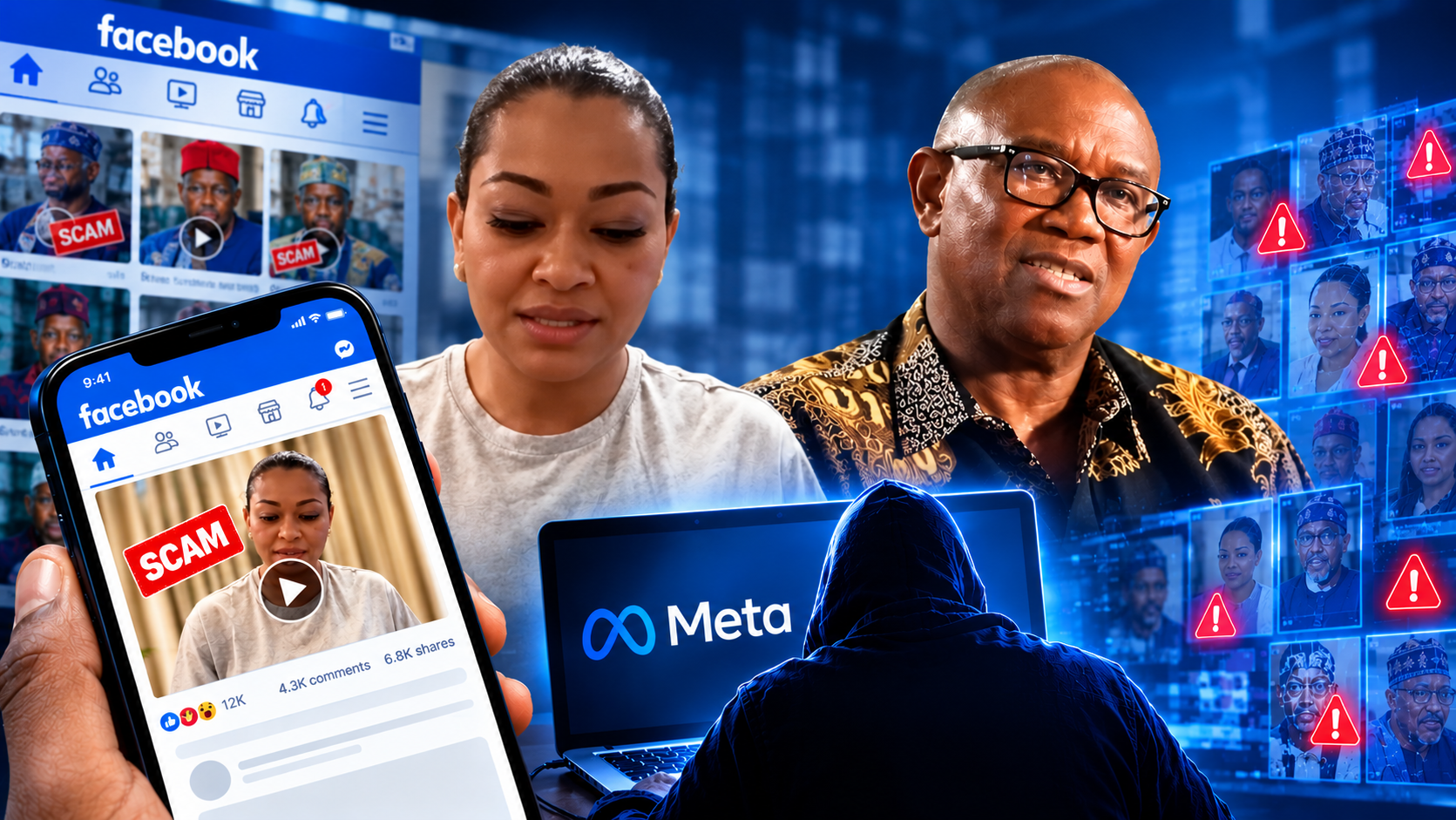
In mid-April, a sponsored video popped up on the Nigeria Daily Report Facebook page. The video featured a figure resembling Natasha Akpoti-Uduaghan, the senator for Kogi Central at the National Assembly. She introduced viewers to a supposed "lucrative" investment scheme.
"I am going to reveal a secret to you…today is your lucky day," she supposedly said in the video, which is a deepfake now seen and liked by over a thousand users on Facebook.
The figure of Mrs Akpoti-Uduaghan in the video claimed that viewers could invest a one-time N430,000 to earn N14 million monthly. This is a staggering 3,000 percent return on investment.
"It is important to understand one thing, opportunities like this can’t be opened up to everyone at once," her figure said in the video.
But the senator didn’t make the video. She has also publicly disclaimed any endorsement of investment platforms before this video appeared.
"Although the video looks like me and even sounds like me, it is not real," she stated about a similar video a month earlier. "It is fabricated and misleading content created to scam unsuspecting members of the public."
The creators of the video used deepfake technology to mimic the senator's likeness and voice, then uploaded it. They also paid to promote the video to reach more Facebook users.
Through Meta, Facebook's parent company, anyone can pay to promote posts to specific audiences. The scammers behind this video paid for ads, and the platform unintentionally helped them reach more potential victims.
As traditional advertising declines due to the rise of social media, tech companies are making billions from digital ads. But these loosely regulated ads have also allowed fraudsters to find new victims.
Meta claims it is always taking steps to tackle scam ads. But critics say it has been slow to act because these fraudulent ads keep bringing in revenue for the company.
Meta's internal documents show that the company earns money from scam ads. Reuters reported last year that Meta projected it would earn $16 billion in 2024, about 10 percent of its total annual revenue, from ads promoting scams and banned goods.
These documents also revealed that Meta charges higher rates for ads than rejecting them when it suspects the advertiser could be a scammer.
While Meta's ad policies say it doesn't allow fraudulent or misleading ads, such ads are still flooding the platform, with many targeting Nigerians.
"We don’t allow advertisers to run ads that promote products, services, schemes or offers that use identified deceptive or misleading practices, including scams to take money from people or access personal information," part of Meta's advertising policy states.
But more deepfake videos impersonating well-known Nigerians have appeared on Facebook and stayed up for months after being fact-checked.
In May, a deepfake video appeared on Nigeria Daily Bulletin's Facebook page, featuring presidential candidate Peter Obi. He appeared to ask social media users to invest N350,000 to earn N4.5 million.
"This is not just about making money for some people; it means achieving financial independence earlier than expected," Mr Obi supposedly said in the video. "For others, it creates a chance to rebuild savings, support their families and plan for the future with confidence."
The video's caption urged social media users to hurry and register as "Registration Is Closing, Only Limited Access Still Available."
But the link in the video leads to a fake website, ‘welceastming.website.’ This site clones Channels Television’s website, featuring false stories about investment platforms.
The site also has a fake interview supposedly conducted by the TV station's Seun Okinbaloye and Mr Obi. In that interview, the page attributed various comments about the ‘AfriQuantumX’ investment scheme to Mr Obi. The hyperlink on the page leads to a form asking for users’ names, emails, and phone numbers.
Meanwhile, the deepfake video of Mrs Akpoti-Uduaghan is linked to another suspicious site, ‘springbunnhopes.online.’
A check on a website analysis page, WHOIS, showed that key details about the webpage were hidden through a privacy service from a company called ‘Withheld for Privacy ehf.’
Meta confirmed to PREMIUM TIMES that the ads and deepfake videos broke its policy. But these posts stayed up for months. They were only removed in July after this newspaper asked the social media company if they violated its policies.
"We have reviewed the material shared with us and are taking action on content that violates our policies," a Meta spokesperson told our reporter in an email.
"It’s against our policies to run ads that deceptively use public figures to try to scam people, and we remove these ads when we detect them."
The tech giant also shared that it is investing heavily in "trained review teams" to find and eliminate such ads.
"This problem isn’t new," it added. "Scammers use every platform available to them and constantly adapt to evade enforcement. That is why Meta has specialized systems to detect celebrity bait, invests heavily in trained review teams, shares tips on avoiding scams, and offers tools to report potential violations."
Deepfake videos of influential Nigerians have flooded Facebook, often used to promote fake investment scams and sometimes to direct traffic to gambling websites.
Facebook first announced plans to remove deepfake videos in 2020, but six years later, such videos are still common on the platform.
In another deepfake video, Ngozi Okonjo-Iweala, Director-General of the World Trade Organisation (WTO), appeared in her signature Ankara, delivering a speech. The video, which cloned her voice, introduced viewers to an investment scheme where they could invest N380,000 to earn N2,660,000 daily.
"It is real, verifiable and backed by a system designed for your success...I personally assure the safety of your funds and complete confidentiality," it claimed.
But Mrs Okonjo-Iweala took to her X handle to warn Nigerians against that video and other investment platforms using AI and deepfakes to impersonate her.
"As I repeatedly said, I never post anything on Instagram, Facebook or WhatsApp," she wrote. "Anything from these sources with my image is not from me. I only post on Twitter/X. I just don’t want people to be duped."
The page that posted the video, Moonbeam Meadows, is still active on Facebook but looks inactive. It has only a few posts and pictures of gardens. It has fewer than 10 posts in total.
It is similar to the page that shared the deepfake of Mrs Akpoti-Udughan. The page, Nigeria Daily Report, is still on Facebook, but has no visible activity. Even though it ran the video as an ad in April, a search of the page's ad history on Meta Ads Library shows empty results. The Ads Library should have details of the ads, including the target, how long they ran, and who paid for them.
Meta said it removed over 159 million scam ads on Facebook last year alone and took down 10.9 million accounts on Facebook and Instagram tied to criminal scam centers.
But the pages with the deepfake of Mrs Akpoti-Udughan and Mrs Okonjo-Iweala have stayed on the platform for months. Although hidden from the page’s profile, you can still visit it with the link, showing it has not been taken down. The post was only removed in the first week of July after PREMIUM TIMES contacted Meta.
"What they (scammers) do is to hide the post from the public profile of the page, but you can see it as a sponsored ad if you fit the target audience," said Nurudeen Akewushola, a fact-checker at FactCheckHub.
Mr Akewushola explained that users who click on scam ads are likely to see more because of Meta’s ad-personalisation system, which tries to deliver ads based on a user’s interests.
The platform also said in March that it has deployed Artificial Intelligence to analyze and remove celebrity-bait and brand impersonation ads.
"Scammers use subtle tricks and deceptive framing that are hard to catch with traditional detection systems," it said. "Our experts and specialists in combating scams built advanced AI systems that can analyze multiple signals, such as text, images, and the surrounding context to spot a broader range of more sophisticated scam patterns faster and at scale."
Despite this, the videos keep thriving on Facebook, and many prominent Nigerians continue to be victims of these deepfakes. Tony Elumelu, Chairman of the United Bank for Africa (UBA), Jim Ovia, Group Chairman of Zenith Bank, and Africa’s richest man, Aliko Dangote, have all been featured in deepfakes promoting fake investment schemes on Facebook.
Popular journalists like Channel TV’s Seun Okinbaloye and RadioNow’s Kadaria Ahmed have also fallen victim to these deepfakes.
Each of these individuals has distanced themselves from any investment platforms. Yet, new videos promoting new platforms keep appearing, with little action from the social media company to stop them.
"It looked and sounded remarkably real, but it was completely fake," Mr Elumelu said in a statement distancing himself from a deepfake featuring him used to promote an investment scheme. "This incident highlights a growing and serious threat to digital trust."
Nigerian fact-checkers have already checked many of these videos. "(But) it has become very difficult to even fact-check all these videos," said Mr Akewushola.
Mr Akewushola, who has checked several similar videos, noted that the sheer volume of such ads overwhelms the fact-checkers who work on them frequently.
He added that the practice has become more sophisticated as the scammers discover new ways to hide their identities.
Meta told PREMIUM TIMES that the scammers have constantly adapted to avoid its scrutiny, but it will keep working to find and remove them and provide tools for users to report potential violations.


Drop your comment
No comments yet — be the first to drop the gist 👇