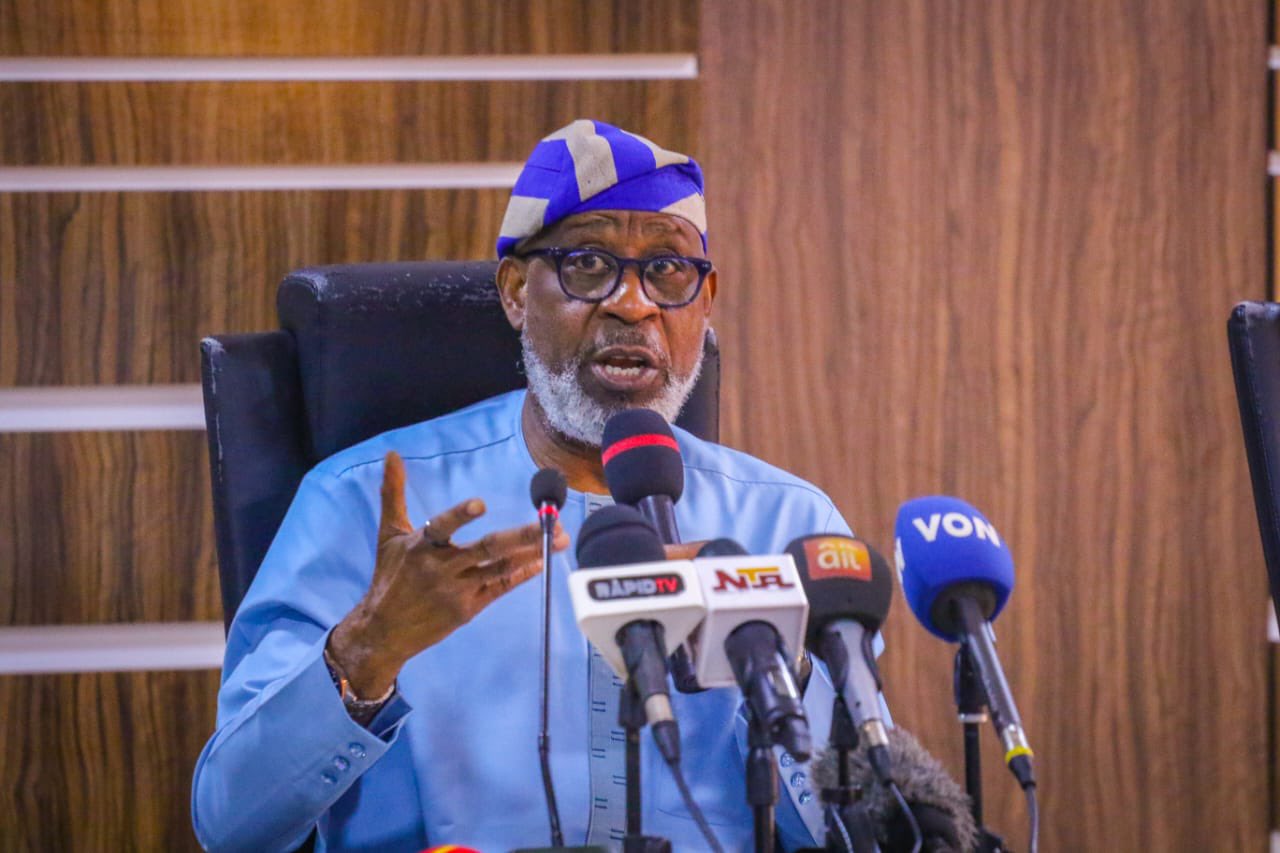
The Director of Electioneering Planning for the All Progressives Congress 2027 Presidential Campaign Council in the South-West, Prof Sola Adeyeye, spoke with Ismaeel Uthman about President Bola Tinubu’s federalism record, his coalition approach, and the drive to reconcile Tinubu with former Osun State governor, Ogbeni Rauf Aregbesola.
In 2022, you disagreed with President Bola Tinubu’s bid for the presidency, but now you are leading his re-election campaign in the South-West. What has changed?
In terms that matter, nothing has changed. I did not oppose Tinubu as a candidate. That’s where many misunderstand. I only opposed him as an aspirant during the primary of my party, APC. I used my right as a party member and a citizen to back whom I believed was the best candidate, Yemi Osinbajo. Once ‘aspirant Tinubu’ became the party's candidate, I never spoke against him. The primary contest is like sibling rivalry; members should choose whoever they want.
Tinubu and I have things in common. I know some things about Tinubu that I cannot betray. He also knows some things about me that must remain confidential. When I supported Osinbajo, some of Tinubu's supporters attacked him in ways that I found offensive and unfair. They compared him to Akintola, the former premier of the Western Region, Samuel Ladoke Akintola. I didn’t see any real similarity between Osinbajo and Akintola.
What kind of similarity do you mean?
Akintola and Awolowo, the first premier of the Western Region, never ran for the same position. While Awolowo was premier, Akintola was in the House of Representatives, supporting Awolowo’s party. When Awolowo aimed to be Prime Minister, Akintola did not block him. They switched roles, and Awolowo did not prevent Akintola from being a premier.
Normally, at that time, either Anthony Enahoro, then deputy leader of the Action Group, should have led the party in the Western Region. The Midwest was part of that region back then. Yet, because Enahoro and Awolowo were both in the House of Representatives, it was unlikely for Enahoro to lead. They worried that, in Nigeria's ethnocentric society, it would be tough for Enahoro to maintain the Western Region against opposition from the NCNC.
Yes, Awolowo and Akintola had their issues, but it wasn’t the same with Osinbajo. The comparisons suggesting Osinbajo was like Judas Iscariot were offensive. Judas took money to betray his leader. Nobody has shown that Osinbajo took money to betray. So, when they kept on, I felt we should respond. I said some things I might not have needed to say.
What has changed? The man won the primary and became the President. That is what changed.
Are you proud to have him as President?
I will tell you what Tinubu has done that I admire. Anyone who follows my political journey knows I’m a strong supporter of federalism in Nigeria. Tinubu has done what no president has done since 1999 to lay the groundwork for a federal system. Most presidents want to keep as much money as they can for the federal government due to what they see as heavy responsibilities. But Tinubu has slightly increased the money shared with the states, helping them become more economically viable. Without that, no government can succeed.
Tinubu started the process of giving states policing rights. This right existed at independence but was taken away by military governments. If he does nothing else but restore real federalism in Nigeria, he will be remembered as a significant President.
There are about 195 countries worldwide, and only roughly 25 operate a federal system. The 25 are often large, complex, and diverse. Nineteen of those have state or regional police.
Does that make Nigeria abnormal?
Of all federal countries, Nigeria has the worst case of security centralization. By far the worst. In England, not a federal system, there are territorial police across the UK. But in Nigeria, we have an unusual scenario.
When I was the Chairman of Ifedayo Local Government in Osun, the police officer in charge was from Otukpo in Benue State. He didn’t speak Igbomina, our local dialect. How could he adequately police a community whose language he didn’t know? That’s the nonsense we have. In the name of national unity, people who didn’t even speak Yoruba have led police in Osun State, and it’s similar in other states.
These are the issues I believe Tinubu will help resolve. When you say power belongs to the people but deny them the means to enforce it, you create chaos. That is what happens from centralizing a federal system. I am pleased Tinubu is taking steps to give us a federal system. I was a strong advocate for state police in the Senate, pushing for police powers for states.
Is state police the only thing you admire about Tinubu’s administration?
Another thing that impresses me about Tinubu is his commitment to the ideals we fought for during our struggle for democracy. We held a congress in Maryland, USA, with Chief Anthony Enahoro as chairman, and I led one of the committees. One decision was that if any of us became president, they must work hard to restore federalism and remove the military's imposed anthem.
I never imagined it would be easy, but I’m amazed at how quickly Tinubu removed that anthem. The military also manipulated our constitution and published a white paper. They removed parts they disliked. So, the constitution was not ‘we the people.’ It was the military pretending to represent the people. Tinubu’s retention of our pro-democracy movement’s key ideas makes me respect him.
Many Nigerians are asking why, considering the country's economic situation, they should trust Tinubu for another four years.
What’s the economic situation?
Some complain of hunger, insecurity, inflation, and less purchasing power...
(Cuts in, then smiles.)
You know, Jesus said, “the poor you will always have among you.” We hope for a Nigeria where we can reduce the number of poor people. Our people are not just poor; they have been extremely poor for a long time. People often glorify the past, thinking it was better.
People discuss purchasing power: since 1999, if you divide Nigeria’s budget by the population, you’ll find that there hasn’t been a year when the Federal Government allocated a dollar for each Nigerian per day. We have always been poor. Look at the 2025 budget, and you’ll see the Federal Government plans to spend less than $150 on each Nigerian in a year. That’s around 45 cents daily.
Let’s address our external reserve; it is now at $57 billion, which is commendable. But it’s still a small amount. The endowment of Harvard University, which has about 8,000 students, equals Nigeria's entire external reserve. That’s a university in the US. This shows how poor Nigeria is. When we hear N31 trillion, we think we are wealthy. Nigeria should be rich if managed properly.
Norway, a country similar to Ondo or Oyo in population, has a budget that’s on another level compared to Nigeria’s. Norway has around $32,000 to spend on each citizen this year. In Nigeria, regardless of who is in power, be it Tinubu, Atiku Abubakar, or Peter Obi, the government spends less than $200 on each citizen in a year. Under either Yar’Adua or Jonathan, it came close to $268.
The reality is we are very poor, and we must face that. We need to find ways to grow our economy and tailor our spending to what we have.
The APC formed from a merger of different political parties. It has always presented itself as progressive, drawing on the legacies of Chief Obafemi Awolowo and other progressive leaders. Do you think the party has stayed true to its founding principles?
We misuse terms in Nigeria. To be progressive means to seek the well-being and progress of individuals as the main goal of governance. If that's the case, how do you achieve that? Will you, just because you are progressive, buy petrol from France without paying? The reality is, if we focus only on ideological labels, we will fail. We must do what Awolowo did. When he introduced free education in Western Nigeria, he taxed for three years. That led to him losing a federal election in the 1950s. His government was the only one to lose an election in this region in a free and fair contest because people complained about taxes without seeing benefits. But when free education started three years later in 1955, the Eastern Region, led by Dr. Nnamdi Azikiwe, tried to emulate him. Free education collapsed in the East within two years because they hadn’t prepared like the West.
Growth is often painful.
Awolowo always insisted that progressive politicians should maintain ideological clarity and distinguish themselves from conservative politics. Does Tinubu’s rainbow coalition, which includes politicians from different backgrounds, mean he strays from that tradition?
No, because running a government is not the same as winning an election. No matter how nice your ideology is, you cannot implement it until you gain power. First, you must take power.
It was no surprise that Awolowo’s party formed a coalition with the NCNC in 1964, along with the United Progressive Grand Alliance. However, they made the mistake of boycotting that election. People forget that when Awolowo was alive, there was a coalition called the Progressive Party Alliance in 1980. They were called progressive in name only. While you could argue that the PRP and UPN were progressive, the GNPP and MPP were not ideologically aligned. But they realized they had a bigger enemy in the NPN to confront.
The PPA, as a coalition, was in the majority. Had they acted smartly, they could have beaten Shehu Shagari in 1983. So, I understand anyone who says, to prevent a greater evil, let me form whatever alliance is needed to stop it.
Would you say Awolowo would be pleased with Tinubu’s political style?
I cannot speak for Awolowo. The last time I spoke with him was in 1980. Anything I say is just speculation.
Awolowo respected data. His opponents often said he only quoted figures. But part of Nigeria's issue is our disdain for figures. We don’t consider the numbers necessary for running our country, leading us to propose unsustainable ideas.
People are unhappy about petrol prices now. Is there any item in the world that can have a competitive price if the supplier is a monopoly? In Nigeria, petrol supply is a monopoly. We have only Dangote Refinery. That company borrowed to set up. We call Alhaji Aliko Dangote Africa’s richest man, which he is. But he owes billions of naira and other currencies. So, do people expect him to borrow and not repay? Do people expect him not to profit from his loans? The reason petrol is expensive is that the last refinery built in Nigeria was during Muhammadu Buhari's first tenure. We haven’t built any new refinery in over 40 years. The existing government-owned refineries are not operational.
I hope that when Tinubu wins, he will prioritize building a new refinery. Why should a country with nearly 250 million people have just one refinery? I pray that Tinubu will prioritize energy and electricity. If we have affordable petrol and electricity, our people are not lazy. Their creativity will thrive. Companies leaving Nigeria aren’t doing so due to laziness. They are leaving because they cannot run factories on diesel. That’s the problem.
You have kept close ties with both Tinubu and former Osun governor, Ogbeni Rauf Aregbesola, who are now on opposite sides politically. What do you think went wrong between them?
Honestly, I don’t know. They both liked each other. I just hope that one day they will reconcile. That is my prayer.
Naturally?
Well, some people need to help make it happen.
What have you done to unite them?
I have done all I can, but I won’t say more than that. My prayer is that they reunite.
Is there any conspiracy blocking your efforts to bring them together?
I don’t believe so. Even if there is, it doesn’t trouble me. I know some enjoy disputes. But ultimately, both must take responsibility for their friendship that has now turned sour. I trust that God will mend it. By God’s grace, they will reunite.
How soon will that be?
I can’t say. It’s not up to me. It depends on them.
Have they met since the rift began?
I know they’ve met about three times since their disagreement started. When people have strong feelings for each other and feel betrayed, the hurt runs deep. But time can heal, and I believe healing is already happening.
Drop your comment
No comments yet — be the first to drop the gist 👇