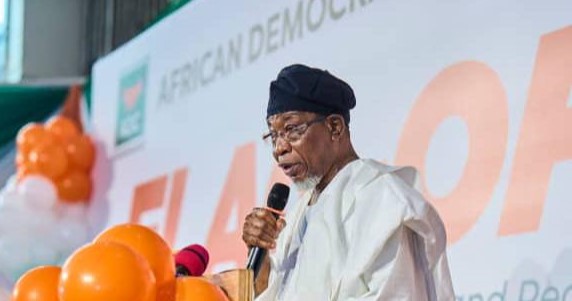
Rauf Aregbesola has filed a separate appeal against the ruling that invalidated the leadership of the African Democratic Congress (ADC). This became public on Sunday and adds to the legal troubles that also affected Atiku Abubakar’s presidential nomination.
The Independent National Electoral Commission (INEC) stated that it would get a certified copy of the judgment and review it before deciding its next steps.
This legal fight could impact more than just Atiku’s name on the ballot. INEC needs national party chairmen to have access codes for submitting polling agents. The portal for this will close on December 10.
In other news, the Delta State Government is calling for an investigation into a deadly opposition procession in Asaba that happened on Saturday. A group backing President Bola Tinubu claimed it had shared over 500 campaign vehicles.
On Sunday, there was also a new debate regarding the Ibom Deep Sea Port. The Nigeria Democratic Congress (NDC) questioned if the president’s latest approval is a step forward or just a repeat of an earlier decision by the federal government.
These developments are raising issues around party authority, campaign security, political funding, and government commitments as the election approaches.
Justice Peter Lifu of the Federal High Court in Abuja ruled on November 5 that the ADC leadership, led by former Senate President David Mark, was unlawfully formed.
The court annulled decisions from the party’s controversial 99th National Executive Committee meeting, which included how Atiku was chosen as the presidential candidate.
The case, noted in court documents as FHC/ABJ/CS/1819/2025, was brought by Nafiu Bala Gombe, a former deputy national chairman of the ADC. He challenged the leadership changes that followed Ralph Nwosu’s exit.
The ADC has filed an appeal against the ruling and has asked for a stay of execution.
On Sunday, more details came out about a separate appeal from Mr Aregbesola, the party’s national secretary. His lawyer, Mohammed Sheriff, a senior advocate, filed the appeal.
Mr Aregbesola is challenging the trial court’s authority and its interpretation of the party’s constitution. His legal team argued that the court did not make a clear distinction between filling a leadership vacancy and a temporary appointment allowed by the ADC constitution.
The notice of appeal was submitted on Friday, November 6, and a separate application to halt some of the orders was filed the next day.
An appeal or application for a stay does not automatically mean the judgment is on hold.
INEC National Commissioner Mohammed Haruna told Sunday that the commission would look over the judgment and discuss its effects in their upcoming meeting.
One key issue is about the party’s polling agents.
INEC’s electronic system says that access codes go to national party chairmen, who then pass them to authorized officials for uploading agents’ details.
The deadline for submissions is December 10 at 11:59 p.m. West Africa Time, as the presidential election is set for January 16. The disputed ADC leadership could create confusion about which officials INEC recognizes for this task.
There is no proof that INEC has blocked the party’s access or rejected its polling-agent submissions.
Similar issues are happening in the Peoples Democratic Party (PDP).
On November 4, the Court of Appeal upheld a decision that denied INEC from recognizing the interim leadership led by Kabiru Turaki.
INEC’s directory shows Abdulrahman Mohammed as the national chairman of the rival faction, supported by Federal Capital Territory Minister Nyesom Wike.
At a Sunday briefing, Mr Turaki accused the ruling All Progressives Congress (APC) of gaining from court decisions against opposition groups.
He also criticized Mr Wike’s Rainbow Coalition, whose members back Mr Tinubu even though they belong to different political parties.
The claims of political meddling have not been proven. The APC denied any role in the ADC's internal leadership issue.
INEC names Sandy Onor as the PDP presidential candidate, showing a difference between a party’s official nomination and the presidential choices of important politicians in the party.
The Delta State Government is calling for an investigation into violence that happened during an opposition procession in Asaba on Saturday, which left one person dead and five others injured.
The event was organized by the Obidient/OK Movement to rally support for NDC presidential candidate Peter Obi and his running mate, Rabiu Kwankwaso.
The violence occurred along Nnebisi Road. Mr Obi condemned the violence on Saturday night and demanded that those responsible be found and punished.
The state government’s response comes amid different accounts of the security arrangements.
Delta’s Commissioner for Works, Rural Roads and Public Information, Charles Aniagwu, said the organizers should have listened to police advice to use a designated venue.
Police mentioned they had warned of potential violence and responded to a distress call, taking injured people to the hospital.
The movement’s state coordinator, Favour Emerure, disagreed with the idea that organizers ignored police instructions.
He stated that the police were informed and that the procession avoided Inter-Bua Junction as directed. He also questioned the lack of officers when the violence started.
These conflicting accounts leave questions about whether security arrangements were adequate, what led to the confrontation, and who was responsible for the attack.
The police-reported casualty numbers do not clarify who the attackers were or their political ties.
This incident raises more concerns about campaign security as political activities ramp up ahead of the January presidential election.
The PBAT Door-to-Door Movement, linked to Government Ekpemupolo, also known as Tompolo, announced on Sunday that it had given out over 500 vehicles for grassroots mobilization in about 20 states.
Its national coordinator, Sunday Asuku, revealed plans for another tour of Enugu, Cross River, Bayelsa, Zamfara, Jigawa, Anambra, Kebbi, and Abia from November 9 to 14.
The claimed number of vehicles has not been independently verified.
The movement has not shared a complete list showing the costs, ownership, funding sources, or who received these vehicles.
These details are important to see if the contributions or spending meet the rules for political parties and campaigns.
Section 93 of the Electoral Act 2026 requires political parties to file audited election-expense returns within six months after an election. These returns must show money spent on behalf of the party and the value of relevant goods and services received.
Whether the claimed vehicles count as reportable APC spending will depend on how they were financed, used, and their connection to the party’s campaign.
This announcement comes as the APC ramps up its activities in the North-West.
In Kebbi, Governor Nasir Idris kicked off the party’s state campaign council on Sunday, just days after Atiku campaigned in Birnin Kebbi.
Kebbi is politically important because Atiku beat Mr Tinubu there in the 2023 election, getting 285,175 votes against 248,088.
In Jigawa, Governor Umar Namadi said the APC aims to deliver two million votes for Mr Tinubu in 2027.
That goal is more than double the 954,805 votes cast in Jigawa in 2023, when Mr Tinubu won with 421,390 votes.
This comparison shows how ambitious the governor’s target is compared to past turnout; it does not predict how many people will vote in 2027.
Mr Kwankwaso, campaigning separately in Dutse for the NDC, also reflected on his failure to form an alliance with Mr Obi before the 2023 election.
The two politicians, who ran separately that year, now share the NDC presidential ticket.
Their partnership shows one way of opposition collaboration, even as Mr Atiku keeps chasing the presidency under the ADC.
The NDC has questioned President Tinubu’s recent announcement about the Ibom Deep Sea Port, saying the project had already been approved under former President Muhammadu Buhari.
At an APC rally in Uyo on Friday, Mr Tinubu approved a request from Akwa Ibom Governor Umo Eno.
On Sunday, NDC spokesperson Osa Director asked what the new approval brought to the table that the earlier federal government decisions did not.
The Infrastructure Concession Regulatory Commission’s 2020 report confirms that the project’s full business case was approved by the Federal Executive Council on December 16, 2020.
But that approval does not mean that the project was fully funded or built.
The regulator pointed out that finalizing contracts and financing were the next steps.
At that time, Akwa Ibom officials estimated the first phase would cost about $2 billion, with the state expected to cover 40 percent and a preferred private bidder taking care of the rest.
Mr Eno described the latest presidential decision as approval of financing plans.
This explanation raises questions that the previous approval did not: how much financing has been committed, on what terms, by which institutions, and what the construction timetable is.
The NDC’s claim that the president recycled an earlier promise is a political statement. To find out if the new decision is meaningful, we need to see the financing and project documents.
Drop your comment
No comments yet — be the first to drop the gist 👇