As Nigeria gets ready for the general elections in January 2027, the fight for power among key groups and candidates shows how political cartels are taking over in Nigeria’s Fourth Republic.
On January 26, Governor Abba Yusuf of Kano, Nigeria’s most populated state, left the New Nigeria People’s Party (NNPP) to join the All Progressives Congress (APC). He switched parties with 22 members of the State House of Assembly, eight federal lawmakers, and 44 local government chairmen. Yusuf said he joined the ruling party “to strategically align Kano State with the centre of national governance to accelerate development.” This move came after the ruling party tried but failed to win over his political mentor, Rabiu Kwakwanso, founder of the NNPP.
With this change, Yusuf became the 29th governor from the ruling party. Now, only seven governors in Nigeria are from four opposition parties. His defection highlights a trend where governors and lawmakers are leaving opposition parties to join the ruling APC as the 2027 elections approach. The next month, the Adamawa State Governor Ahmadu Fintiri also defected from the Peoples Democratic Party (PDP) to the APC, saying he did so to “align the state with (the) federal government for the interest of the state’s development.” Fintiri became the ruling party’s 30th governor.
Fintiri explained his decision by saying that “in ideal democracies, alignments that confer mutual advantages are constant normals,” adding that “Our alignment with the APC reflects a pragmatic approach to politics, conferring electoral value while delivering democratic dividends to the people.”
The following month, PDP’s Governor Dauda Lawal from Zamfara State became the 31st governor on the APC platform. He also left due to “prolonged internal crises, leadership disagreements, and unresolved structural challenges” in the PDP.
Before these three governors switched parties, others like Sheriff Oborevwori (Delta), Umo Eno (Akwa Ibom), Douye Diri (Bayelsa), Peter Mbah (Enugu), Siminalayi Fubara (Rivers), and Caleb Mutfwang (Plateau) had already joined the APC. While each of these governors gave different reasons for their moves, the mass shift to the APC shows fears of a one-party state as Nigeria heads toward the crucial elections in early 2027.
But Vice President Kashim Shettima disagrees. He argued that “the growing influx of political actors into the APC reflects increasing public confidence in the party’s structure, vision, and capacity to manage national challenges.” After a meeting at the Presidential Villa in Abuja with President Bola Tinubu and the 31 governors in late August 2026, Hope Uzodimma, governor of Imo State and chairman of the Progressive Governors Forum, stated, “All 31 of us are in total agreement, and we are united. We are supporting Mr. President’s re-election.”
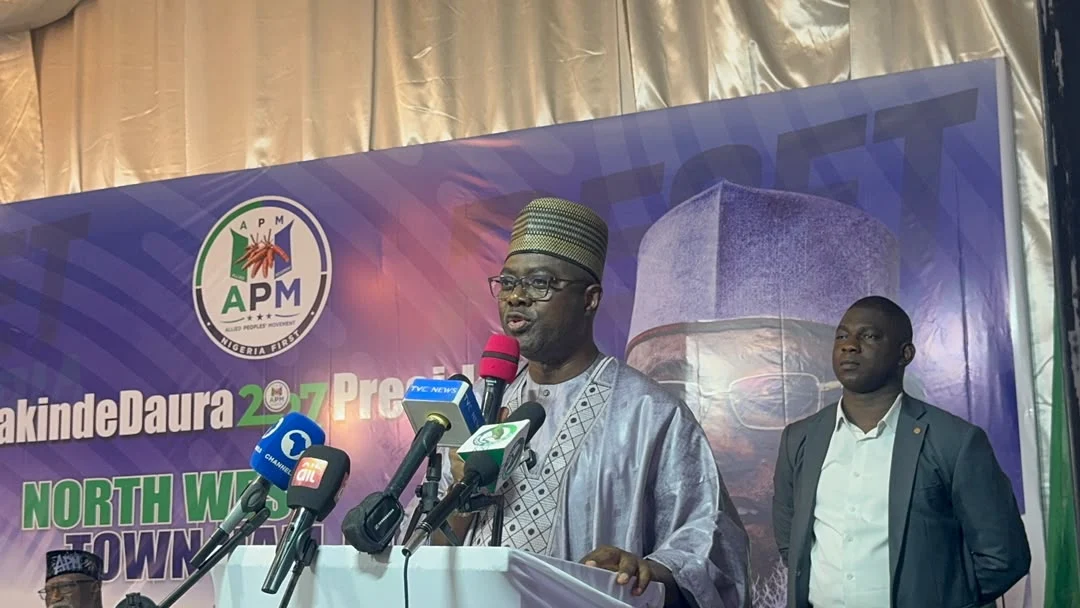
President Tinubu is counting on more than just the 31 APC governors for his re-election bid next year. Three other governors, Charles Soludo from Anambra, Ademola Adeleke from Osun, and Alex Otti from Abia, who represent the All Progressives Grand Alliance (APGA), Accord Party, and Labour Party (LP) respectively, have also offered their support. In fact, Soludo and Adeleke were present at the APC campaign council inauguration in Abuja on October 14. This gives Tinubu support from 34 of Nigeria’s 36 governors, leaving only two PDP governors, Bala Muhammed from Bauchi and Seyi Makinde from Oyo. Interestingly, Muhammed considered joining the APC before talks fell apart, while Makinde supported Tinubu in 2023 but resisted joining the ruling party ahead of the 2027 elections. Makinde is now the presidential candidate of the Allied People’s Movement (APM) and frequently criticizes Tinubu during his campaigns.
In Nigeria’s democratic history, no president has had as much backing (94 percent) from the governors as President Tinubu. Olusegun Obasanjo came close in 2003, when he had the support of 21 governors from his party and five from the Alliance for Democracy (AD), totaling 72 percent.
One-Party-Dominant State
Though the support from 34 governors does not guarantee Tinubu’s win in the 2027 elections, the situation is complicated by the Rainbow Coalition formed by Nyesom Wike, the Minister of Federal Capital Territory and leader of a faction of the PDP. Wike has pledged to support Tinubu but aims to strengthen the PDP against the APC in the elections. There is no doubt that Tinubu’s possible re-election is boosted by these defections as these governors control a significant number of Senate and House of Representatives seats, alongside most state assembly seats.
These numbers have led The Guardian newspaper to suggest that “Despite [the constitutional] safeguards, political dynamics suggest that Nigeria’s system has been coerced into functioning more like a de facto one-party state, raising questions about competitiveness and democratic resilience.”
The newspaper fails to see that due to Nigeria’s diverse ethnic, regional, religious, and cultural backgrounds, the country cannot become a sustainable one-party state. Even though it has been a one-party-dominant state, as Onyedikachi Madueke describes, this is more about ‘rotating hegemonies rather than genuine electoral competition.’ This was the case in previous elections like in 2003 and 2007 when the PDP’s chairman Vincent Ogbulafor claimed the party would rule for 60 years. Just seven years later, many left the party after it lost the presidency in 2015, and Ogbulafor himself sought to join the APC, congratulating them for ‘a job well done.’
The reasons behind political leaders joining the ruling party (previously the PDP, now the APC) are not just about fearing one-party rule. It is also because many of these politicians belong to groups that are not real political parties but are political cartels. As members of these cartels, they lack any ideological or visionary ties that could keep them together in one organization for long. What drives them is the access to power and resources. They move to where they can get what they want.
A Different Past/Path
The recent ‘decampees’ have switched parties multiple times during their political careers in the 27 years of Nigeria’s Fourth Republic. Some have even changed three parties within one election cycle. This trend is seen not just among governors. In the past year, Peter Obi was part of the Labour Party, then the African Democratic Congress (ADC), and is now the presidential candidate of the Nigeria Democratic Congress (NDC). Obasanjo, after leaving the presidency on the PDP platform, has backed candidates from four different parties in the last four elections: Goodluck Jonathan (PDP) in 2011, Muhammadu Buhari (APC) in 2015, Atiku Abubakar (PDP) in 2019, and Peter Obi (Labour Party) in 2023. He is now supporting Obi of the NDC for the 2027 election.
Politicians switch parties because the parties often lack substance beyond the pursuit of personal power and resources. This is sometimes hidden behind claims of ethnic or religious interests. The funding for political parties also reflects this. Since 1999, whether or not the incumbent wins, the same wealthy retired generals and business tycoons have financed most successful presidential campaigns.
Despite the messy history of Nigerian politics, cartel politics has not always been the norm. It started in 1923 with the Herbert Macaulay-led Nigerian National Democratic Party (NNDP), marking a shift towards ideologically driven party formation in Nigeria. Other parties followed, like the National Council of Nigeria and the Cameroons, and later the National Convention of Nigerian Citizens (NCNC) in 1944. They had clear ideological orientations and were distinct political parties. Despite their limitations, party-switching in the First Republic (1960-1966) represented significant political events since it meant abandoning one ideology for another.
Even in the Second Republic (1979-1983), there was some ideological basis for party organization. The four major parties mirrored those from the First Republic: the National Party of Nigeria (NPN), Unity Party of Nigeria (UPN), Nigerian People’s Party (NPP), and People’s Redemption Party (PRP).
But during the transition to the Third Republic, military president Ibrahim Babangida disrupted this by dissolving political parties and imposing two government-sponsored bureaucracies, the Social Democratic Party and the National Republican Convention. This forced politicians to pick between these two government-funded parties.
While some see this as a step towards a two-party system, the annulment of the June 12, 1993 election won by Moshood Abiola and the resulting national crisis revealed the weaknesses of government-created parties. The victorious party abandoned its mandate and its winning candidate while accepting the interim government offered by the military.
The transition to the Third Republic, described by Richard Joseph as ‘the most sustained exercise in political chicanery ever visited on a people,’ showed that political parties not rooted in society cannot truly represent the interests of the people. They cannot be a sustainable force for change in building a developmental state.
By the time the Third Republic collapsed into a brutal regime under General Sani Abacha, the trend of state-directed political parties had drained the ideological energy from Nigerian politics. It became clear that genuine political parties could not form as platforms for shared visions of society. Under Abacha, the five political parties that emerged were all aligned with the dictator, reflecting a worrying similarity to the current situation where Tinubu enjoys support from non-ruling party governors and federal legislators.
Militarised Politics and Political Parties
Three key issues arose from the Babangida and Abacha regimes that weakened party politics. First, many of the so-called political parties that emerged since then have been mere vehicles for a few powerful individuals to gain power and resources. They rarely show ideological clarity or purpose, despite the grand statements in their ‘policy papers’ and constitutions. Second, those who enter politics today are not the same as politicians from the First and Second Republics. The military era created ‘militricians’ who rely on various forms of violence to gain power. This led to the dominance of retired military figures in politics, and it is no surprise that two retired soldiers, Olusegun Obasanjo and Muhammadu Buhari, have become presidents in the Fourth Republic. Third, corruption became rampant, influencing how parties operate and how elections are conducted. This trend destroyed the essence of party politics.
The Reign of Political Cartels
In the Fourth Republic, political cartels or cartel parties became the norm. Although cartels existed before, they were not the mainstay of party politics. The retired military did not dominate political formations in earlier republics. Now, political cartels, often led by retired generals, are in control. The five most significant political figures in Nigeria since 1999 have been retired military generals who influence the nature of these cartels.
Political cartels are formed by powerful individuals with shared interests, seeking power mainly to protect their interests. They aim to present their interests as those of the party and the country. After nearly three decades of Nigeria’s Fourth Republic, it is clear that these so-called political parties behave in a cartel-like manner.
In Nigeria’s political cartel system, five patterns are observable: (i) each cartel is not a true representation of any specific segment of society, which is why party switching is common; (ii) internal democracy is unimportant; (iii) these cartels do not represent the electoral majority; (iv) elections are not about competing ideologies but about serving the interests of powerful individuals; (v) social forces do not drive party formation, those who form and fund these cartels have a narrow view of benefits.
Ultimately, the idea of democracy as ‘government of the people, by the people, and for the people’ is replaced by cartel politics. This means a politician could wake up in one ‘party’ for breakfast, flirt with another for brunch, and switch again for lunch, as described by Nobel laureate Wole Soyinka about a particular leader during military rule. Since political parties should unite citizens based on shared principles, the implications of cartel politics for democracy in Nigeria are serious and far-reaching.
Nothing highlights this better than the fact that two of the leading candidates for the 2027 elections, Bola Ahmed Tinubu and Atiku Abubakar, have been members of the same political parties at different times. They have also been running mates in one election or considered joining forces in another.
Consolidation of Cartel Politics and the Future of Democracy
The ruling APC under President Tinubu reflects the deepening cartelization of politics. When a faction within the APC tried to block him from becoming the presidential candidate in 2022 and later from winning the election in 2023, Tinubu showed he understood cartel politics. He won both the party primaries and the general elections despite the challenges.
As Tinubu faces the elections in January 2027, his influence over political officeholders is not a guarantee of victory. His opponents have warned of the potential collapse of democracy or even civil unrest if he wins through illegitimate means. The historical power that the North holds in Nigerian politics is being leveraged against him alongside the dissatisfaction in the country.
If there is no significant disruption before or after the elections, cartel politics will likely influence not just who wins but also the direction Nigeria takes.

Drop your comment
No comments yet — be the first to drop the gist 👇