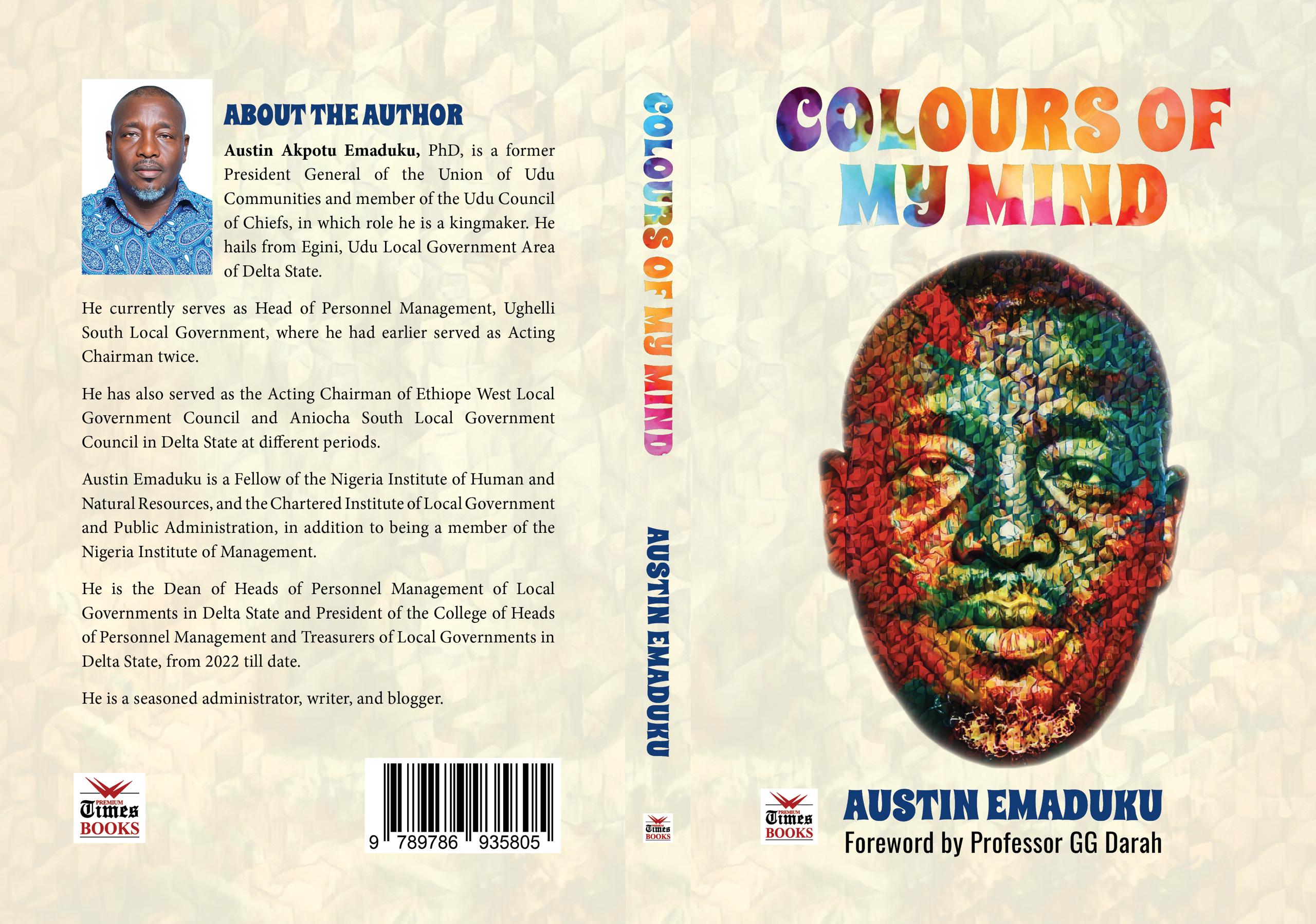
In the foreword to A Nigerian’s Thoughts, Professor Godini G. Darah places Austin Emaduku among notable Nigerian thinkers like Nnamdi Azikiwe and Anthony Enahoro. These individuals used their writing to question power and hold leaders accountable.
This comparison is ambitious for a collection of 69 articles. But it is not entirely out of place.
A Nigerian’s Thoughts is perhaps less grand, but in some ways more compelling. It is a record of how an active Nigerian citizen viewed his country in real time, especially from the Niger Delta. Its strength lies not in deep political analysis but in the immediacy of its observations and the author’s strong beliefs, along with his willingness to reflect critically on his own community.
The pieces, mostly written between 2016 and 2017, with some up to 2023, touch on politics, governance, religion, culture, social values, and local issues. They began as social media posts, and the book keeps much of that immediacy.
This is not your typical political philosophy book. It mixes political commentary, local history, and moral arguments, making it an archive of thoughts.
What Type of Book Is This?
Emaduku offers the key to understanding his work. In his introduction, he shares that "a bulk of these articles were written between 2016 and 2017, a trying period in my life that turned out to be my most productive and creative years thus far." He says he gathered these writings "to record my thoughts for posterity."
That’s fair enough. It sets a clear purpose.
Readers should avoid judging each piece as if it were part of a well-structured political essay. These are responses to specific moments and events. Some pieces show anger, others reflect on deeper issues, and some provoke thought. Some are stronger than others.
Together, they paint a picture of a Nigerian trying to understand his country during tough times.
That’s the real focus of the book.
The Niger Delta Perspective
Emaduku’s unique contribution is his grounded perspective.
He writes from Udu Kingdom in Delta State, a place that produces a large part of Nigeria’s wealth but also faces many challenges from oil extraction. His views offer a perspective often missing in national discussions.
In a keynote speech on youth restiveness and militancy from October 2016, he recalls Warri in his youth:
"I can recall the mid-80s to the early 90s when Warri, the economic hub of Delta State was home to hundreds of oil companies. Oil production was at its peak and many of our young men and women were engaged in one form of employment or the other. Technicians, fitters, welders, caterers, security guards, etc."
This passage is valuable because it is not just nostalgia. It highlights what happened later. Emaduku writes:
"We created the state of insecurity that chased away the companies that would have provided employment for our teeming unemployed youths."
The importance lies in where he directs his criticism. He points out government failures and the injustices in the Niger Delta, but he also addresses harmful choices made within his own community.
This willingness to reflect inward appears often in the book.
His description of the local economy's collapse, including the uncomfortable truth about "club girls" who once turned down African customers for lacking “dollar power,” is not polished analysis. It is vivid observation, showing the mindset that arose around oil wealth, foreign workers, local poverty, and unrealistic expectations from a booming economy.
He does not simply see the Niger Delta as a victim. He tries to understand how victimhood, anger, opportunism, militancy, and community responsibility are intertwined.
The Community Thinker
The book also shows Emaduku as a community thinker.
His involvement in local politics, the Union of Udu Communities, the BEDC electricity crisis, and the Aladja-Ogbe-Ijoh conflict may seem local to those outside Delta State. Yet they reveal something key about citizenship.
To Emaduku, politics is not just something happening in Abuja. It’s about electricity not reaching communities, failing institutions, contested traditional authorities, neighbors turned enemies, and local leaders whose actions impact everyday people.
His letter to the Aladja and Ogbe-Ijoh communities in August 2017 is particularly striking. He recalls a time when these communities shared a close bond, writing:
"I recall with clarity and fond memories the peaceful brotherly relationship that existed between your two communities. I recall my first visit as a student of Aladja Grammar School to the then sleepy community of Ogbe-Ijoh."
Then he asks:
"What or who brought this calamity upon you?"
This simple question carries weight because of who is asking. He is not an outsider judging a conflict he doesn't understand. He is someone invoking a shared past to challenge a situation he finds unacceptable.
In moments like this, A Nigerian’s Thoughts becomes more than political commentary. It becomes a reflection on shared memories.
The Courage to Critique One’s Own
One of the most admirable traits in the collection is Emaduku’s readiness to critique his own side.
He questions Niger Delta militancy, critiques Urhobo political culture, and challenges Igbo nationalism. His targets include governments, political parties, ethnic communities, religious groups, and ordinary citizens.
His critique of Niger Delta militancy is particularly harsh:
"You are like the mad man who in an attempt to solve the problem of rats in his house, set the house on fire only to sleep out in the rain."
He goes further, stating that militants are in a worse moral position than Boko Haram because, unlike the latter’s twisted religious reasoning, the militants have no excuse for their actions.
The language is tough. But its significance lies in its direction. Emaduku is not just condemning an enemy far away. He speaks directly to his own community.


He also applies this approach to his criticism of Urhobo social media users. After celebrating the Olu of Warri’s English speech while criticizing another Urhobo leader for speaking English, he questions:
"‘You well?’ ‘Them, do you?’"
The humor is distinctly Nigerian, but the core message is serious. Emaduku criticizes what he sees as selective standards based on ethnic and political convenience.
This readiness to hold his community to high standards gives the book much of its moral weight.
Interesting Contradictions
Emaduku’s arguments also show tensions the book does not always resolve.
In “Where Did Our Values Go?”, he criticizes Pentecostal Christianity for "demonising those traditional beliefs that helped maintain the right values in our communities." At one point he claims:
"Christianity is our greatest problem."
Yet elsewhere, his writing reflects Christian moral views, and he criticizes failures of Christian institutions from within a Christian perspective.
A fascinating discussion could develop here: is Christianity itself the problem or is it how it has been practiced?
The same applies to his thoughts on restructuring. Emaduku calls for greater autonomy while blaming local leaders for misusing resources and failing their communities.
To be fair, these are not necessarily conflicting ideas. More decentralization can go hand in hand with stronger accountability. But the argument needs more careful reasoning than the book provides.
These contradictions should not just be criticized. They should have been explored further.
The Missed Reflection on His Past Self
Perhaps the biggest missed chance in the book is the lack of reflection on his past thoughts.
Emaduku tells us he gathered these writings "to record my thoughts for posterity." But now that posterity has arrived, there are questions.
What does he think of his earlier views now? Which predictions were accurate? Which political figures surprised him? Did later events change his views on restructuring, ethnic politics, militancy, religion, or protest? How does he view the Buhari years from today’s perspective?
A concluding essay would have added depth to the book. It would let the author reflect on whether he was right, where he was wrong, and what he learned from subsequent events.
That would have turned a collection of opinions into a journey of personal growth.
The Audience Challenge
The book also faces an audience challenge.
Its local content could interest readers from Delta State and the Urhobo community but may confuse those unfamiliar with it. Its national essays sometimes lack the depth to stand out from the many Nigerian political discussions already out there.
The solution is not to remove local content but to provide context. A glossary of local terms, brief notes, and a short introduction to Udu’s political history would help national readers see why these local matters are important.
The local can connect to the national with the right framing.
Indeed, one of the book’s biggest contributions could be showing how the Nigerian experience is felt not through constitutional theories but through electricity, traditional institutions, community conflicts, jobs, political representation, and local leadership.
A Book Worth Keeping
A Nigerian’s Thoughts is a valuable book.
Its importance lies in Emaduku’s effort to preserve something that can easily fade in the digital world: a record of civic engagement.
Social media is full of opinions, but fewer people keep those opinions in a way that others can look back on them later. Emaduku has done that.
His collection shows what Nigeria looked like from the eyes of one engaged citizen at key moments in its recent past. It captures anger, disappointment, humor, moral conviction, ethnic concerns, community pride, and the ongoing quest to understand a complicated country.
Emaduku represents the tradition of citizens who believe public affairs matter too much to be left only to politicians. He is also a community thinker who chose to document his thoughts.
That is valuable on its own.
Conclusion
The main contribution of A Nigerian’s Thoughts may be its demonstration that citizenship is more than just voting, paying taxes, or complaining about government. Citizenship also means thinking, debating, remembering, and holding oneself and one’s community accountable.
That is what Emaduku aims for throughout these pages.




Drop your comment
No comments yet — be the first to drop the gist 👇