Months after communities in Katsina State made peace deals with armed groups, new attacks, kidnappings, and displacements are testing these agreements and the security meant to protect rural folks.
In southern Katsina and nearby Sokoto State, many people have died, been kidnapped, or forced out of their homes recently. Farmers in some areas fear going to their farms, and livestock are being stolen.
Security agencies have responded by sending more troops, conducting rescue operations, and raiding suspected bandit hideouts.
The results vary by location. Some communities say they have seen improvements after local talks and security actions. Troops have rescued some kidnapped people and claim to have disrupted planned attacks. But in other areas, families are still displaced, and the attacks continue.
Numbers for casualties and displacements change often and rely on local reports that are hard to confirm. There is no clear evidence that fighters pushed out by military actions in Zamfara are causing the new violence elsewhere.
Attack After Troops Block Bandits’ Path
The situation is worst in the Rabah Local Government Area of Sokoto State.
In the early hours of 7 September, suspected bandits attacked Tofa, killing residents, kidnapping others, and stealing livestock. Reports say between seven and 10 people died, and about 35 to 40 were taken.
Sokoto police spokesperson Ahmad Rufai confirmed the attack to PREMIUM TIMES but had not shared final numbers at the time of reporting.
The Tofa attack happened a week after troops said they stopped armed men heading towards Ghandi, a community in Rabah. On 30 August, eight farmers were killed, and five were hurt in an attack in Ghandi, according to police numbers. Days later, Operation FANSAN YAMMA said troops stopped another group of armed men heading towards the community.
This interception did not stop the later attack on Tofa. There is no evidence linking the stopped men near Ghandi to those who attacked Tofa.
When PREMIUM TIMES reached out to army spokesperson Olaniyi Osoba, he refused to discuss military operations over the phone and invited the reporter to the 8 Division headquarters in Sokoto.
Repeated Attacks Empty Sokoto Communities
Further south in Kebbe Local Government Area, the impact is clearer.
On 4 September, police confirmed that five people were killed and three injured in an attack on Girkau and nearby communities the previous day.
This attack followed reports that suspected bandits demanded ₦40 million from residents of Kebbe town. Mr Rufai confirmed that police were aware of the demand and said the Anti-Kidnapping Unit was investigating.
Girkau faced another attack later on.
By mid-September, the Kebbe Local Government Council said it was giving food and cash support to 150 households displaced from Ungushi, Girkau, Margai, Kebbe East, Kebbe West, and other affected areas.
Council chairman Musa Garba Kuchi said displaced families are taking shelter in Kebbe. The district head of the town, Lawal Margai, also confirmed that insecurity had forced residents from their homes.
Mr Kuchi said improved security operations have encouraged some residents to come back, but the council did not mention which communities or how many households returned. At least 150 households still remain displaced in Kebbe town.
Displacement Without Camps
A similar situation is happening in southern Katsina, but counting the displaced is more difficult.
Residents fleeing attacks in Bakori, Funtua, Faskari, and Dandume mostly moved in with family instead of gathering in camps. Many families have relocated to Dandume town, Funtua, Yan-Kara, Mairuwa, Katsina, Zaria, and Kano.
This scattered movement makes it hard to see the full picture.
Reports that as many as 15 communities around Dandume have been abandoned are disputed. Dandume council chairman Bishir Sabiu said no community between Dandume and Funtua has been completely deserted, while acknowledging the insecurity.
Mr Sabiu confirmed a recent attack on Takalamawa where three residents died, and three were injured. He also mentioned that vigilantes and community patrol members killed three suspected attackers.
IOM Data
An assessment by the International Organisation for Migration of attacks from 9 to 14 August in Bakori, Dandume, and Jibia showed 2,723 people affected across 629 households. Out of these, 1,535 people from 218 households were displaced, including 697 children, 495 women, and 343 men.
The affected communities included Labo Kankia in Bakori; Magaji Wondo Dansuda, Gyazamar, Bokolo, and Unguwar Rimin Jiruwa in Dandume; and Daddara in Jibia.
The assessment does not break down the figures by local government area, so the 1,535 cannot be linked to Dandume alone.
Peace Agreements Face Test
Several communities had earlier joined local peace agreements.
On 20 September 2025, representatives from Sabuwa and Dandume reportedly entered a ceasefire with armed groups.
Weeks later, representatives from Bakori, Funtua, Kafur, Malumfashi, and Kankara met with armed-group leaders at Kakumi in Bakori Local Government Area.
Community representatives included Abdurrahman Kandarawa of Bakori and Audu Goya of Funtua. Armed group representatives included Ado Aleru of Yankuzo in Zamfara, Isiya Kwashen Garwa of Guga Ward in Bakori, Babaro of Gidan Gamji, and Iliya Zango Dan Sabau.
This meeting reportedly ended with promises to stop hostilities, restore order, and pursue peaceful living.
The Katsina State Government insists these deals should not be seen as negotiations between the government and armed groups.
Governor Dikko Radda described the approach as community-driven peace agreements, started by the communities themselves. He said the government supports efforts to bring back peace but still carries out security operations against groups that remain active.
There were early signs of progress. In November 2025, the Funtua council chairman said five captives had been freed without ransom after the agreement.
By December, however, residents in some rural areas told PREMIUM TIMES they were already doubting whether the agreements could provide lasting safety as attacks continued.
Reports in early September described killings, kidnappings, and livestock theft across Bakori, Funtua, Faskari, and Dandume. In Bakori, residents reported attacks on Gidan Na Kaura, Yar Tukunya, Unguwar Gambo, and Gidan Sarkin.
In Faskari, community leader Abubakar Aliyu said security improved after local talks, with some residents returning home and farming and business activities starting again.
The agreements were made with specific communities and leaders, meaning they did not necessarily bind every armed group in the areas. So, figuring out if the recent attacks break the agreements requires identifying the attackers and seeing if they or their leaders were part of the agreements.
The link between local agreements and ongoing security operations adds another layer of difficulty.
In September, police reported that air and ground operations in Katsina killed seven suspected associates of Ado Aleru, one of the bandits said to have attended the Kakumi meeting.
This shows how the two approaches can happen at the same time: communities may make agreements with specific armed-group leaders while security forces continue operations against people they allege are linked to those leaders.
More Troops, But Attacks Continue
The Katsina State Government has reacted by reviewing security plans in the southern part of the state.
On 9 September, senior security officials met in Funtua to look at conditions across Funtua, Faskari, Sabuwa, and Dandume.
Police later sent more personnel and an armoured vehicle to the area and announced intensified joint operations, intelligence sharing, rapid response, and community policing.
On 14 September, armed men kidnapped residents from Unguwan Daudu and Unguwan Chibauna in Funtua.
Operation FANSAN YAMMA said troops chased the attackers, fought them, and rescued 10 captives, which included three men and seven women, one of whom was an infant.
On 17 September, another kidnapping happened along the Dandume-Damari route. Troops responded to an emergency call, engaged the attackers, and rescued three men, recovering their vehicle.
The military did not name the attackers or connect them to the earlier Funtua kidnapping.
On 15 September, troops based on intelligence about a planned attack on communities in Matazu and Kankara raided a suspected hideout.
The military said two suspected fighters were killed, including Abbah Alhassan, whom they called a known terrorist leader.
Two other suspects were arrested around Yantumaki in Dan Musa. The military said early questioning linked them to a commander known as Mannori.
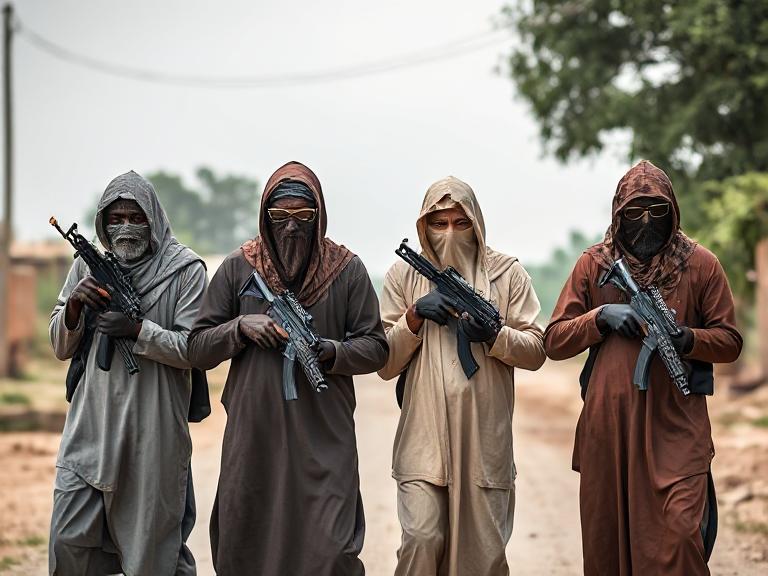


The same military statement said 21 kidnapped residents were rescued in a different operation around Fafala and Dandikwa in Kebbi State. Together with the 10 from Funtua, this gave the widely reported number of 31 rescued captives, though the rescues happened in separate operations.
Displacement Crosses State Boundaries
The impact of the violence does not stop when families flee an attack.
Three residents, who wished to remain anonymous for fear of retaliation, told PREMIUM TIMES that people displaced from communities in Tureta Local Government Area of Sokoto State have moved into neighbouring Zamfara, especially Gummi, while others have settled in Tureta town and other areas.
The sources requested anonymity for security reasons.
Their reports back up findings by Daily Trust, which spoke to displaced residents from affected communities.
Umar Abubakar, a trader from Dan Gulbi, told Daily Trust he fled to Gummi in Zamfara after an attack on his community about three months ago.
His brother was killed, his shop was burned, and he sold some of his livestock to raise ₦250,000 for six months’ rent for a two-bedroom house in Gummi.
Another displaced resident, Muhd Dan Gulbi, estimated that around 1,000 people from the area are living in Gummi, some in rented homes and others in primary schools and an Eid ground.
In another part of Tureta, a resident of Gidan Kare told the newspaper that most residents fled into Tureta town after months of attacks. He estimated that 97 percent of the village has been displaced.
The account mentioned Lofa, Tsamiya, and Doma among the affected communities.
These places also seem to be among the origins of families helped by the Centre for Peoples Health, Peace and Progress (3Ps). The organization said it assisted 106 displaced households, including 397 children, from Doma, Rafin Gero, Tsamiya, Lofa, Dabegi, Jurga, Dakku, Damri, and Kuruwa.
The Daily Trust accounts and the 3Ps data cover some of the same communities, making it hard to know how much overlap there is. Both, however, show displacement from communities around Tureta, including movement across the Sokoto-Zamfara border.
Farmers Count Cost
Displaced residents and community sources who spoke to PREMIUM TIMES said attacks have separated families from their farms, livestock, businesses, and local markets, forcing some to rely on casual work after fleeing.
The sources, who asked for anonymity because they fear retaliation, described abandoned farms and businesses, livestock losses, and difficulties returning to places where attacks are still a threat.
Their accounts match those of displaced residents interviewed by Daily Trust.
In Sabon Birni, Abubakar Usman, who fled Tsamaye with his wife and four children, told Daily Trust that he left five farms, two plots of land, and a phone-accessories business after an attack on his community.
Another displaced resident, Isa Mai Yadi, said his family left behind 11 farms.
In Goronyo, a displaced veterinarian said livestock theft made it impossible for him to return to his former job.
Other displaced residents talked about turning to masonry, gathering firewood and grass, or casual farm work to feed their families.
Housing costs have become another burden.
Displaced residents interviewed in Gummi reported paying between ₦250,000 for six months and ₦500,000 yearly for rent. In Tureta town, one resident said rising demand has pushed the price of a three-room house to about ₦100,000 a month.
These numbers reflect individual experiences rather than average rental costs in the affected communities.
There are also claims of direct interference with farming.
Mr Mai Yadi alleged that an armed-group leader known as Jamu Baki has controlled his community for years and forced residents to farm and sell seeds and fertilizer to him.
PREMIUM TIMES has not independently verified the claim against Mr Baki.
Elsewhere in the North-west, residents reported that armed groups impose taxes to access farmland. Different groups operate in different areas; there is no proof that the levy requests recorded in Sokoto and Zamfara come from the same network.
Years Away from Home
PREMIUM TIMES also confirmed through community sources that some families displaced by violence in parts of Sokoto have been away from their homes for several years.
The sources, who wanted to remain anonymous for security reasons, said ongoing insecurity and fears of new attacks have kept some residents from returning for good.
Daily Trust separately spoke to residents of a displacement camp in Goronyo who said some families had been away from their communities for four to eight years.
The chairman of the 200-housing camp, Yakubu Adamu, said it housed 5,764 residents as of 12 March 2026 and included people from 19 villages.
Recent attacks are causing new displacements in parts of Sokoto, but they add to a population that has been unable to return home for years.
Any assessment of improving security must consider not just fewer attacks but also whether people displaced for years can return safely and rebuild their lives.
Are Armed Groups Moving Between States?
Military operations in Zamfara and nearby areas raise questions about whether pressure in one location is pushing fighters into neighboring states.
Security agencies have reported intercepting suspected suppliers of fuel and ammunition and other support networks along routes linking parts of Zamfara, Katsina, and Kaduna. This shows that at least some support networks operate across state borders.
Security analyst Yahuza Getso told Daily Trust he believes pressure from operations in Katsina and Zamfara has caused some armed groups to move into Sokoto.
He said agencies in neighboring states have stepped up operations at the hideouts of these groups and argued that the resulting pressure has led to movement towards Sokoto.
Mr Getso's view offers one explanation for the changing violence pattern, but PREMIUM TIMES found no clear evidence linking the attackers in the recent Rabah or Kebbe incidents to fighters displaced from Katsina or Zamfara.
Recent attacks in Zamfara also complicate the theory of displacement.
On 12 September, six Islamic clerics were kidnapped along the Dakko-Damri road in Bakura while heading towards Talata Mafara, according to the Zamfara State Police Command.
The military dismissed early reports that the victims were taken from the home of former governor Abdul’aziz Yari.
Between 16 and 17 September, communities around Dansadau in Maru faced attacks.
Published reports put the death toll at between 13 and 15; another report said as many as 33 people were feared dead. Residents also reported significant displacement into Dansadau town.
There is no evidence connecting the attackers in the Dansadau incidents to the recent violence in Sokoto or southern Katsina.
Reports that some communities around Dansadau have struggled to use farmland for a long time suggest an ongoing local security crisis rather than just evidence of newly arrived fighters.
Tactical Gains, Unresolved Insecurity
Security forces have carried out rescues, arrests, and successful operations across the affected states. Local agreements have brought some calm to certain communities. But recent attacks and displacements show the limits of those gains.
In Tofa, some residents were killed and kidnapped days after troops reported stopping armed men moving towards nearby Ghandi. In Kebbe, local authorities are supporting 150 displaced households even as they report that some residents are beginning to return.
In southern Katsina, more personnel and an armoured vehicle have been sent while troops continue responding to kidnappings, including rescues in Funtua and along the Dandume-Damari route.
In Tureta, displaced residents talked about their struggles after fleeing attacks: finding shelter, feeding their families, and surviving without access to their farms, livestock, and businesses they left behind.
The repeated rescues show that security forces can pursue kidnappers. But the repeated kidnappings in the same areas raise another question: whether more troops are stopping attacks or just improving the ability of security forces to respond after attacks happen.
The evidence does not show one bandit group sweeping across the North-west. It instead points to connected security situations where armed groups and their support networks can operate across borders, while local truces and security operations have different outcomes from one community to another.
For residents, the key measure of progress is practical: whether attacks are stopped rather than just answered, if displaced families can come back for good, whether farmers can work without risking kidnapping or forced payments, and if communities can rebuild the lives they left behind because of the violence.


Drop your comment
No comments yet — be the first to drop the gist 👇