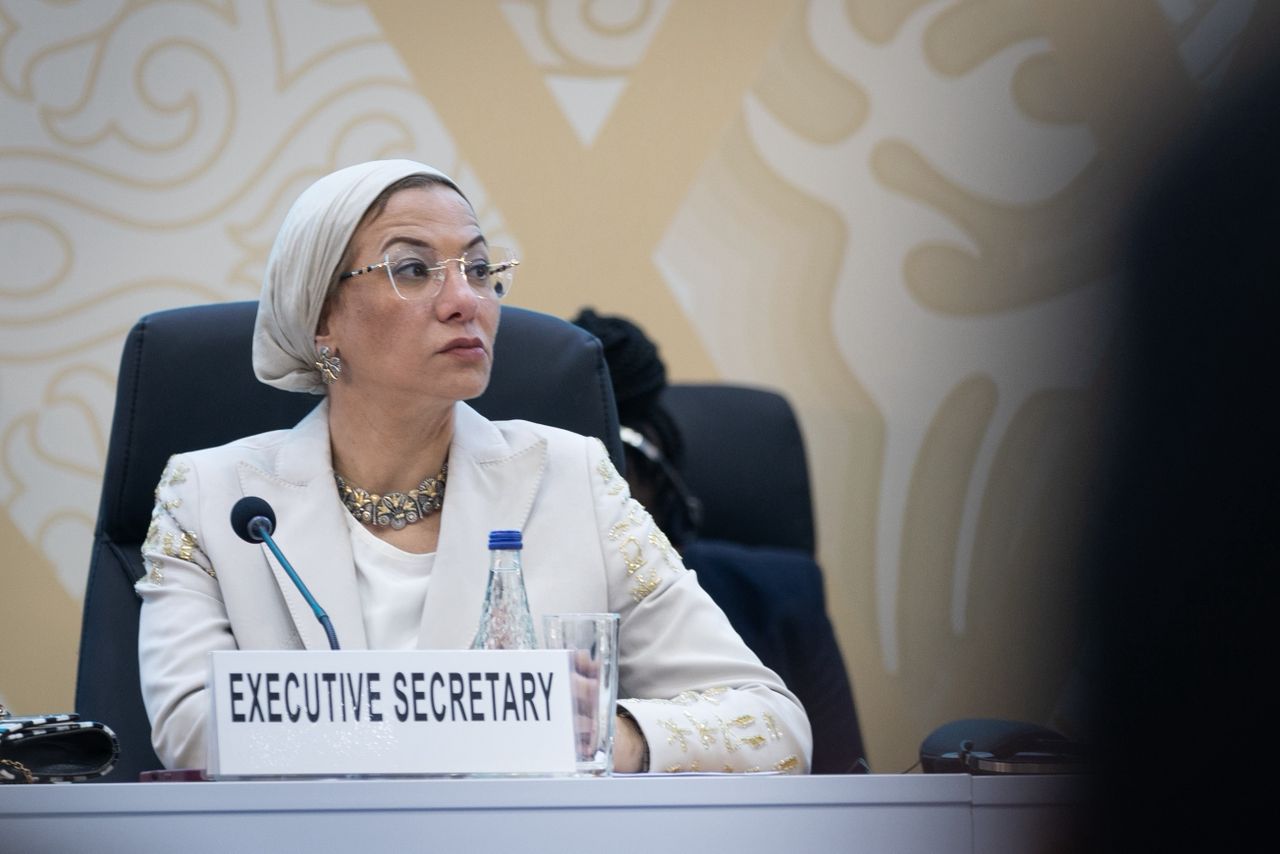
As delegates wait for the final text and resolutions from the two-week COP17 talks in Mongolia, Yasmine Fouad, the Executive Secretary of the United Nations Convention to Combat Desertification (UNCCD), said the conference must turn promises into real action.
Ms Fouad spoke to six media fellows from the UNCCD on the sidelines of the conference in Ulaanbaatar on Friday. She called COP17 the “COP of implementation,” saying the true success will depend on whether decisions made here actually lead to actions on the ground.
“Rest assured that COP17 is the COP of implementation. And here, implementation can mean one of two things: either what we put on paper to implement, or simply putting things on paper while remaining far away from actual implementation,” she stated.
She pointed out that the conference is happening amidst growing geopolitical and environmental challenges, like rising heatwaves and drought. “One thing I want you to remember when you go back home is that this is the first COP in a real ‘trio,’ in a year full of geopolitical challenges. El Niño has proved that there will be more heatwaves and more drought. It is real; it is happening,” she noted.
Ms Fouad mentioned that the UNCCD Secretariat came to Ulaanbaatar with a strong focus on food security, the land-water connection, and financing for land restoration and drought resilience. “One thing we wanted to change at this COP was to show that land is central to everyone and that people matter,” she added.
COP17
The 17th session of the UNCCD Conference of the Parties began in Ulaanbaatar on 17 August and is set to finish on 28 August, depending on party agreements. The conference theme is “Restoring Land. Restoring Hope,” and it aligns with the UN-designated International Year of Rangelands and Pastoralists.
Negotiations have been focused on fighting land degradation and drought, boosting land restoration, and getting funds to support vulnerable countries and communities. As the conference nears its end, delegates are still working out how to improve global efforts on land degradation, drought, and sustainable financing.
Nigeria and the African bloc are advocating for sustainable financing mechanisms to tackle rangeland issues and for a legally binding framework for drought management. In the early hours of Friday, a 15-page initial draft text was released and is still being reviewed ahead of the final plenary later today.
Disagreements came up during the opening plenary over procedural and substantive matters concerning several agenda items. Indigenous peoples, civil society groups, and young people have also expressed concerns about their inclusion in the formal process, insisting that their voices need to be heard in decisions affecting their communities and livelihoods.
Some key issues at COP17 include the planned drought framework, finance and investment, rangelands and pastoralists, and the involvement of Indigenous Peoples and local communities.
‘People Matter’
Reflecting on her experiences at the conference, Ms Fouad said the human aspect of land degradation has been central to her work. “So, we had the Silk Road Caravan, we had the pastoralists, and I was very keen, as the Executive Secretary of the Convention, to attend the Global Pastoralists Gathering that Mongolia organised, with participants from more than 100 countries,” she explained.
She stated that her interactions with Indigenous Peoples, local communities, young people, women, and small island developing states emphasized the need for a people-centered approach to land restoration. “The conference’s message from all the events I have attended, including those involving Indigenous Peoples, local communities, the youth caucus, and the gender caucus, as well as when I sat with the SIDS and listened to their needs, is that this is a human-centered convention. It will continue to go down to the grassroots,” she added.
One of her main goals was to ensure COP17 produced real commitments on rangelands and land degradation. “I was keen to ensure that there were real pledges on rangelands and land degradation, and that there was something new,” she stated.
She highlighted financing commitments made during the conference’s high-level opening, including $1.29 billion for rangelands through the coalition and an additional $2 billion from the Asian Development Bank for Asia and the Pacific.


Drought Finance
Ms Fouad also noted that the Secretariat was focused on ensuring that drought financing keeps moving forward, regardless of whether an agreement on a legally binding drought protocol is reached at COP17. “We moved on to drought because we knew that, even if a decision on a protocol or otherwise was not reached at this COP, I wanted to make sure that this would not hinder me, as Executive Secretary, from getting the money needed to ensure that countries that had developed their drought management plans would have access to funding,” she explained.
She mentioned two facilities, the Reversing the Flow (RTF) facility and the Drought Resilience Investment Facility (DRIF), as part of the mechanisms being used to support drought resilience. According to her, the DRIF is particularly aimed at encouraging private-sector investment by helping to reduce risks in drought-affected areas. “I am saying these words because these are the elements of implementation for me. The elements are not only the decisions,” she said.
Ms Fouad pointed out that parties had already accepted a decision on the Intergovernmental Working Group (IWG), while discussions on drought have made progress and will continue at the next COP. She recognized that some decisions might take longer to finalize. “Maybe it will be a bit late until we gavel them, but that is the COP,” she said.
‘We May Not Have the Whole Package’
The UNCCD leader said the presence of 197 parties at the convention shows the ongoing importance of working together, despite the challenges in reaching a consensus. “We are happy that the 197 Parties are represented at this Convention. We know it is not easy to get them to agree, but that is the beauty of both the COP and the UNCCD, that it has still gathered all 197 Parties,” she said.
She mentioned that the negotiations have highlighted the importance of land as “natural infrastructure” and the need for continued international cooperation. “This makes land much more important as natural infrastructure, but it also makes the multilateral system much more important, particularly at a time when many say the system may be too fragmented and distracted,” she noted.
She added, “We are working very hard to make this COP progress. We may not have the whole package, but definitely, we will have progress towards COP18.”
UNCCD Chief Sets One-Year Drought Target
When asked by a PREMIUM TIMES reporter what she would hold countries accountable for one year after COP17 and what would be a major failure before the next conference, Ms Fouad highlighted progress on drought as a key measure. “After one year, I will want to see more progress on drought because we will keep pushing, as a Secretariat, on that topic,” she said.
She expressed hope that, before the next session of the Committee for the Review of the Implementation of the Convention, expected by the end of 2027, countries would have developed a pipeline of fundable drought projects. “As for how Parties are acting, this is always the case. We are a Convention built on a Party-driven process. We are facilitating, supporting, and convening, but we will continue to push. That is perhaps different from other multilateral processes,” she explained.
Migration Agenda
On the delay in the decision regarding migration, Ms Fouad said this issue will remain part of the UNCCD’s work programme. “First of all, it will still be part of the work programme. We are still relying on the decision that came out of COP16, so the postponement did not stop our mandate to work on the issue,” she said.
She noted that the Secretariat will work to broaden the political conversation by involving ministers and institutions whose work touches on security, finance, and human rights. “The strategy is to engage more with those who are relevant to security, such as ministers of finance and ministers of defence. We will go to forums such as the Munich Security Council and engage with Geneva, because that is also part of the human rights dimension,” she said.
“So, we need to continue elevating the issue politically.
Drop your comment
No comments yet — be the first to drop the gist 👇