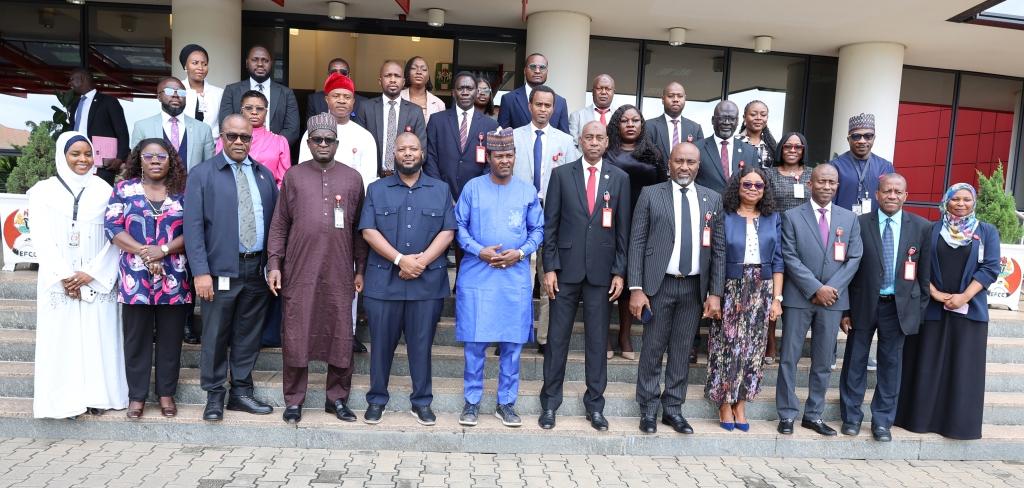
The Economic and Financial Crimes Commission (EFCC) and the Nigerian Financial Intelligence Unit (NFIU) have started a three-day review to check Nigeria's readiness for the 2027 Mutual Evaluation of the Financial Action Task Force (FATF).
This review looks at how well Nigeria is fighting money laundering and terrorist financing. It will also highlight any gaps that need fixing before international assessors come to check Nigeria's performance.
The review started on Tuesday at the EFCC headquarters in Abuja. Its goal is to "review progress, identify gaps and strengthen inter-agency cooperation ahead of the mutual evaluation."
The review will continue on 30 September and 2 October. Officials from both agencies and other important stakeholders will take part, according to a statement from the EFCC Head of Media and Publicity, Dele Oyewale, on Tuesday.
Nigeria's FATF Grey List History
Last year, Nigeria was taken off the FATF grey list. This list includes countries under close watch for having weak measures against money laundering and terrorist financing.
Countries on the grey list often see less money coming in from global financial institutions. This can slow down economic growth and raise transaction costs.
On 24 October 2025, FATF announced Nigeria's removal from the list. They said Nigeria had made "significant progress" in improving its anti-money laundering and counter-terrorist financing efforts. They pointed out better risk assessments, international cooperation, supervision, ownership information, and the use of financial intelligence.
FATF also noted an increase in money laundering investigations and prosecutions. There was also better detection of currency declaration violations and asset recovery, as well as stronger cooperation on terrorist financing investigations.
The latest review comes just as Nigeria prepares to mark almost a year since it was removed from the grey list. The country is also getting ready for another evaluation in 2027.
In FATF's assessment method, mutual evaluations check both how well countries follow the rules and how effective their measures are. The process looks closely at whether countries are actually putting their laws and policies into action and if they are getting the right results.
Shared Commitment to Compliance
EFCC chairperson Ola Olukoyede described the review as showing Nigeria's commitment to meeting international standards on anti-money laundering and counter-terrorist financing.
Mr Olukoyede, who was represented by the EFCC Secretary, Muhammad Hammajoda, said the review reflects a "shared commitment to achieving full compliance" with FATF requirements.
He mentioned key issues under review like financial intelligence, asset tracing, recovery and management, as well as money laundering investigations and prosecutions.
"It is unimaginable that Nigeria returns to the Grey List," Mr Olukoyede warned.
He explained that the review would help Nigeria show the progress made since leaving the grey list and strengthen those gains before the evaluation.
He also said the review is a chance to check what is working well and where resources may need to go.


Mr Olukoyede highlighted the EFCC's activities since Nigeria left the grey list. This includes recovering proceeds of crime under the Recovery and Management Act 2022.
"Since Nigeria was removed from the FATF Grey List, we have scaled up our Anti Money Laundering enforcement activities, recovering proceeds of crimes," he added.
At the event, NFIU CEO Hafsat Abubakar Bakari talked about how important this review is for the relationship between the two agencies and Nigeria's fight against financial crimes.
Mrs Bakari was represented by NFIU Chief Operating Officer, Law Enforcement Agencies, Emmanuel Sotande. She said the review is "not about addressing a crisis" but about finding ways both agencies can improve their work before the evaluation.
"We gathered here not because there is a problem to solve, but because there is a standard to uphold," Mrs Bakari insisted.
She explained that this review would help the agencies reflect on what is going well, spot challenges, and agree on actions to boost Nigeria's readiness.
But she added that the evaluation will look beyond Nigeria's laws and structures. It will check how well the country is actually putting them into practice.
"The reality is that international assessors will not only look at our laws, frameworks and structure," she noted. "They will look for evidence that we are able to produce desirable outcomes," she said.
She pointed out that assessors will look for proof of effective investigations, successful prosecutions, asset recovery, inter-agency teamwork, and the use of intelligence to disrupt crime.
Mrs Bakari emphasized the EFCC's role in these areas. She said they have been central to Nigeria's progress over the past year.
In his talk, Mrs Bakari’s Chief of Staff, Mohammed Shahid Ahmed, highlighted key areas Nigeria must work on before the 2027 FATF evaluation.
Mr Ahmed recalled that Nigeria's 2019 Mutual Evaluation report, published in 2021, found weaknesses that led to Nigeria being placed on the FATF grey list.
He said Nigeria has since taken steps to fix those weaknesses, especially in financial investigations, recovering proceeds of crime, and international cooperation.
But he expressed worry that Nigeria has "just little time to consolidate on the gains" made since being taken off the grey list. Preparations for the next evaluation have begun barely a year after Nigeria was removed.
He explained that the 2027 evaluation will focus not just on following FATF's rules but also on how effective they are.
"Including whether agencies use financial intelligence, prioritize investigations based on identified risks, and show that enforcement efforts are producing decisive results."


Drop your comment
No comments yet — be the first to drop the gist 👇