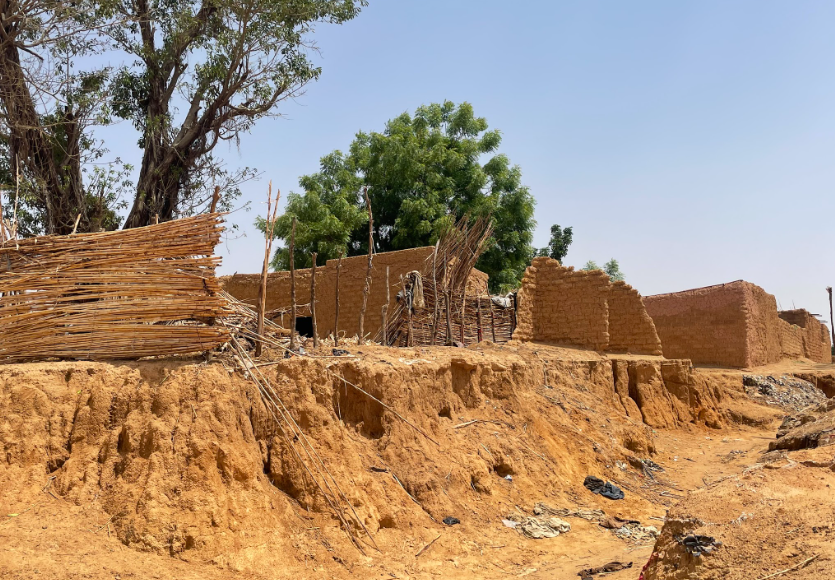
In Mesar Tudu, a farming village in Gezawa Local Government Area of Kano State, every rainfall is a warning.
When it rains, water rushes from nearby villages into homes, creating deeper gullies, collapsing mud walls, and swallowing up homes and farmland that have fed families for years. What should be normal rain has turned into a constant threat to lives, property, and livelihoods.
As the clouds gather, residents do not think about harvests or relief from the heat. They worry about homes collapsing, farmland disappearing, and whether the next rain will take away whatever is left of their community.
For Yusuf Abdulwahab, a 72-year-old man with two wives and 15 children who has lived in Mesar Tudu all his life, erosion has taken almost everything he relied on. A farm he cultivated since he was 18 years old vanished after years of flooding and erosion.
Mesar Tudu is about 40 kilometers from Kano city and is on low ground that collects runoff from nearby villages like Bujawa and Kaurawa Yan’Hudu. When it rains, water pools, stagnates, and rushes through the community’s sandy soil with more force.
What looks like a peaceful rural village today is slowly falling apart.
Residents say that when it rains, the community becomes nearly impossible to access. During a visit on June 7, I walked through dried flood channels and deep paths that become unusable during heavy rains.
The farms have disappeared, replaced by flat erosion channels filled with sand washed in by floodwater.
“I lost my farm completely,” Mr Abdulwahab said quietly, sitting in front of a house that erosion is now threatening.
“It began with a heavy rain. I used to farm during both rainy and dry seasons because my farm was large, about four acres. I planted maize, millet, guinea corn, and groundnuts.
“First, half of my farm was swallowed. I managed to keep the rest for over 10 years, producing just enough food for my family. But the flooding kept happening until erosion took the rest, five years ago. Many others in the community faced the same fate.”
He paused and gazed at the crumbling edges of his home.
“Now it is eating at my house. I am old and have no way to relocate. I have a large family to care for.”
He mentioned that he once filled sacks with sand around his house to slow the erosion.
“The rain washed everything away,” he said.
Now, he rents farmland in a nearby community to survive.
“I am old now. I do not know what will happen to my family after I die.”
Across the community, similar stories are common.
Mansir Bello, a 35-year-old farmer, said his family lost a two-hectare farm.
“We pooled money to build embankments with blocks and cement, but it did not stop the water,” he said.
Some people have had to leave entirely.
“My house had four rooms. The erosion took them one after the other until everything collapsed,” said Yahaya Sa’adu, a 70-year-old father of nine.
“I had to move my family to a single rented room in another community.”
Hassan Ahmed, a teacher, said he left the community after his house fell apart.
“It was only three months after my wedding when my house collapsed,” he said.
“I had to move to Gezawa and rent an apartment. It was a painful experience for me and my wife. I have not gotten over it.”
Ramatu Muhammad, a 25-year-old mother of two, said she lost her house and farmland five years ago.
“My husband also lost his farm. We now live in a relative’s house and struggle to feed our children,” she said.
“During each rainy season, we live in fear because the destruction keeps getting worse.”
She remembered how floodwater uprooted a giant tree near the community last year.
“We could do nothing except grab our children and run. It happens every year. It is frightening.”
Her request to the government was simple.
“Please come and see our situation. If nothing is done, we may lose everything.”
Erosion Crisis Since 2003
Residents say the erosion problem started more than twenty years ago.
“It began with one heavy rain in 2003. After that, everything changed,” said Tijjani Bello, a 60-year-old lifelong resident.
He explained that Mesar Tudu is on sloping land below Bujawa and Kaurawa Yan’Hudu villages.
“There is no drainage system. When it rains, water from those villages flows down and gathers here. Sometimes it stays for hours or even a full day before moving.”
What followed was a cycle of destruction.
“Since that first incident, it has never stopped.”
Mesar Tudu used to be flat land.
“This place was not like this before. It was level ground. What you see today started after that first incident.”
He mentioned that a small dam used to exist but failed, removing the little protection the community had against floods.
Since then, erosion has worsened.
He estimated that over 16 farms have been lost, while many animals have been swept away in floods.
“We cannot even count the animals anymore,” he said.
To check residents’ claims, I visited Bujawa and Kaurawa Yan’Hudu and saw where runoff from both villages meets before flowing into Mesar Tudu. There were no drainage systems along the way.
Women and Children in Danger
For women in Mesar Tudu, erosion is not just an environmental issue but also a daily safety risk.
Hafsatu Ado, a mother of five, talked about a deep erosion pit in front of her house.
“As women, we are usually at home while our husbands are away. I have small children, and whenever it rains, I become scared,” she said.
“It doesn’t matter if the rain is heavy or not. Once it rains, we are in trouble. If I am in the kitchen and my children go outside, they can fall into the hole.”
She remembered that her sister once fell into the pit and needed help from neighbors.
Hafsatu also said the erosion has hurt her business.
“I used to sell kunu, but during the rainy season, nobody comes because water fills the holes in front of our house.”
For Sahura Adamu, the crisis became personal in a tragic way.
She said her brother died after falling into an erosion-created hole while visiting her.
“Since losing my brother, I no longer have peace of mind when it rains,” she said.
“I also have small children. Sometimes it is tough to control them. I am always scared they may wander outside.”


The impact goes beyond individual homes.
Economic activity slows during the rainy season as roads become hard to use and residents find it hard to move around safely.
Homes and Farms Collapsing, Families Displaced
In Mesar Tudu, residents say erosion has displaced over 50 households and many farmland plots.
Abdullahi Yusuf, the community leader, described the destruction as heartbreaking.
“More than 50 households have been affected, and many have moved to Gezawa town and are now renting homes,” he said.
“For farms, we can’t even count them anymore. The erosion is eating away at our community, and we fear it may eventually take the whole place.”
He said community members tried to protect themselves.
“We raised money, bought cement, and built embankments. It slowed it for a while, but the water returned stronger,” he said.
He added that the small dam, which once helped control runoff, collapsed.
“Now there is nothing to stop the water.”
The community leader said residents have reported the situation to the authorities many times.
“We have written letters. Government officials have come to see the place. But nothing has been done.”
A visit to the community showed deep erosion channels cutting through homes and farmland. Some houses are now dangerously close to collapsing.
Residents said erosion has uprooted trees and damaged others. I saw exposed tree roots in several places, showing significant soil loss.
Some houses have lost their entrances completely, forcing neighbors to share access through each other’s compounds.
“In some areas, you have to enter one house to reach another,” said Mr Bello.
He added that motorcycles and cars can no longer reach most parts of the community.
“Only one narrow road remains in the community.”
Reporting to Authorities, But No Help
Tijjani Muhammad, chairman of the Mesar Tudu Community Development Association, said the community first wrote to the Gezawa Local Government chairman on December 5, 2024, and then sent another letter to the Kano State Watershed, Erosion and Climate Change Management Agency (KN-WECCMA) on March 16, 2026, seeking help.
The community showed me copies of both letters.
But the copies I saw did not have any official acknowledgment stamp.
Mr Muhammad added that residents also tried to tackle the problem themselves.
“We raised money and bought cement, blocks, and sand to build embankments, but it still did not stop the erosion.”
Government Response
PREMIUM TIMES tried to reach the Chairman of Gezawa Local Government Area, Muqadas Bala, but he did not respond to our questions.
Also, when I visited the Kano State Watershed, Erosion and Climate Change Management Agency (KN-WECCMA), officials said they were not aware of the erosion issue in Mesar Tudu.
The agency’s director of Environment and Climate Change, Hamisu Binyamin, stated that communities facing erosion must formally report such cases before the agency can step in.
“Communities must submit complaints through recognized groups,” he said.
“The agency will assess the site and decide the right intervention or refer serious cases to larger programs like the World Bank-supported ACReSAL project.”
But he insisted that the agency had no record of Mesar Tudu’s complaint and said the community must resubmit their petition.
The gap between the community’s story and official records shows weaknesses in documentation and coordination for disaster response.
Budget Allocations and Unanswered Questions
The agency’s stance comes as Kano State has set aside significant funds for environmental management and climate resilience.
Budget documents released by the state show that the Ministry of Environment and Climate Change received ₦18.4 billion in the 2026 fiscal year for environmental and climate-related programs.
The Kano State Watershed, Erosion and Climate Change Management Agency (KN-WECCMA) got ₦2.69 billion, while an extra ₦500 million was approved for erosion work across the state.
Yet, residents of Mesar Tudu say they have not seen any help in their community despite years of complaints and clear destruction.
A lot of erosion-control work in Kano is linked to donor-supported projects, like the World Bank’s Agro-Climatic Resilience in Semi-Arid Landscapes (ACReSAL) program, which has funded actions in several areas of Kano State.
In 2025, the state awarded an ₦8.5 billion contract for the Bulbula and Gayawa gully erosion control project in Ungogo and Nassarawa local government areas.
While such projects continue in other places, Mesar Tudu remains without any help.
Climate studies show that extreme rainfall events are becoming more common, while poor drainage makes their effects worse in vulnerable communities.
At the federal level, both the Nigerian Meteorological Agency (NiMet) and the National Emergency Management Agency (NEMA) have repeatedly identified Kano State, including Gezawa LGA, as a high flood-risk area.
Residents say these warnings have not turned into local protection.
“We hear alerts every year, but when the rain comes, it still destroys everything,” says Mansir, a farmer.
Experts say this gap between forecasting and action leaves communities exposed despite known risks.
Experts Warn of Worsening Erosion
An environmental scientist at the Federal University Dutse, Nurudeen Muhammed Shehu, said the situation in places like Mesar Tudu reflects a more extensive pattern of increasing erosion risks due to heavy rainfall, poor drainage, and changes in land use.
He explained that the area is experiencing more short, intense rainfall events that create large amounts of runoff and speed up soil erosion.
“When you mix heavy rain with sandy soil and no drainage system, erosion is unavoidable,” he said.
He added that changes in land use upstream, like loss of vegetation and farming, may also be increasing runoff downstream, concentrating destructive water flow in low-lying communities.
“The lack of proper drainage systems is what turns vulnerability into disaster, but basic engineering measures can prevent this.”
A Community Waiting for Help
In Mesar Tudu, erosion is no longer an occasional disaster. It is a continuous threat reshaping land, homes, and lives.
For a community that has faced this crisis for over twenty years, hope now rests on whether the government response will finally match the visible destruction.
For residents, the fear is not only about what they have lost but also about what the next rain will take.
“We are not safe anymore. Every rainy season, we wait to see what will disappear next,” the 72-year-old Mr Abdulwahab says.
Drop your comment
No comments yet — be the first to drop the gist 👇