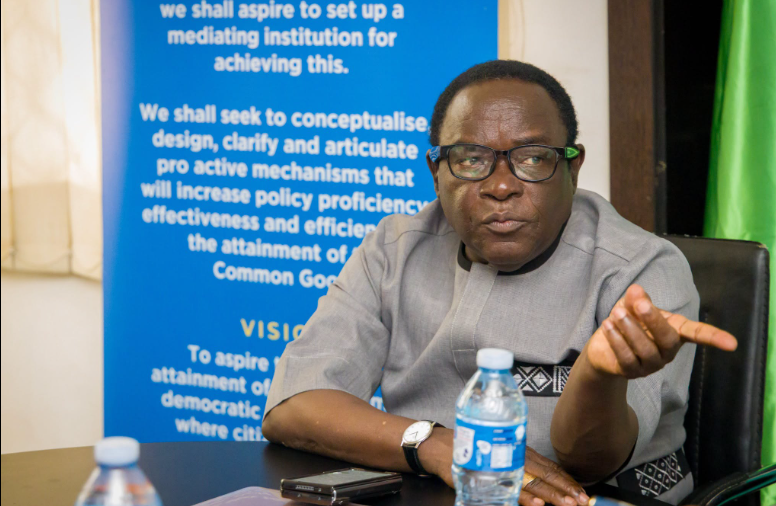
Convocation Lecture delivered at Augustine University, Epe, By Bishop Matthew Hassan Kukah, Bishop, Catholic Diocese of Sokoto on October 29, 2026.
Your Grace, Archbishop Adewale Martins, Archbishop of Lagos, Vice President of the CBCN and Visitor of the University, Distinguished Pro Chancellor, Dame Winifred Akpani, other members of the Governing Council, the Vice Chancellor, Rev. Professor Anthony Akinwale, OP, Deputy Vice Chancellor, Deans of Faculties, Registrar, other principal officers, and key staff, please accept my heartfelt congratulations on this great occasion. Thank you for inviting me. Parents, guardians, family members, friends of the university, and all the students here today.
People of my generation grew up with what we called The Penny Catechism, a small booklet covering the basic teachings of the Catholic Church. Knowing it well was a must for baptism. We did not grasp all the deeper issues but recited the answers with enthusiasm. The first question in that booklet was: Who made you? The answer was, God made me. The second question was, Why did God make you? The answer was, God made me to love him, to serve him, and to be happy with him in heaven.
Heaven is seen as a place of ultimate happiness, rest, bliss, and peace with God forever. This is, of course, if we keep His commandments and do His will. So, when people die, we often say and pray that they rest in peace with the Lord. St. Paul tells us that with thoughts like these, we should comfort each other [1 Thes.4:18]. But we are still here on earth, living in two worlds. A musician once warned, You make your heaven or hell here on earth. In moments of joy, people often say they felt like they were in heaven on their wedding day. When suffering comes, some say they feel like they are living in hell. Yet, on the final judgment day, Jesus teaches that where we end up is based on our actions here on earth [Matt. 25:31ff].
So much happens between our lives on earth and what comes after, and much of it relies on the choices we make. Living well here or reaching heaven depends on following both God’s laws and civil laws. Many argue that obeying God’s laws makes it easier to live under civil authority. This is why St. Augustine is known for saying, Love God and do whatever you will. This does not give anyone a free pass to act irresponsibly. It simply echoes John’s words that if we are truly of God, we cannot sin [1 Jn 3:9]. I want to draw your attention to the challenges of what those in the famous American Declaration of Independence called the pursuit of happiness. As graduates from a respected Catholic university named after Africa’s greatest theologian, I hope you have gained solid moral tools to guide you through life. As I have grown older, I have realized that how we define happiness shapes what we pursue, love, and build.
So, Augustine University Class of 2026, let me join the voices of your parents, teachers, and everyone who worked hard to bring you to this point. Many of you began your journey here as young, inexperienced people, strangers to each other. I hope you are now better people, more mature, and ready to take on the next phase of your lives. Today, you will celebrate, thinking you are free from exams. In many top universities worldwide, students have faced serious harm or even lost their lives during these celebrations. I urge you to take it easy and listen to your senior brother, Kiss Daniel. If you want to be rich until you die, please wear a face mask! The real challenges of your lives are just beginning.
Some years ago, Michelle Obama shared a story with students at an American university. She often asked her children what sports they liked or disliked. She would tell them to learn to play the sport they did not like. The lesson was: Life will not give you only what you want. You will meet people you dislike in school or work. The world will not change for your needs. So, while you can, make new friends, learn new languages, taste new foods, and try new things. Do not look down on the food, language, or culture of those around you. Life will embrace you if you open yourself to new ideas.
Before I came to Lagos, I thought eating snails was disgusting. Over time, after visiting families and friends, I gave in. The late Archbishops Ganaka, Jatau, Bishops Aje, and Abba joked that I was embarrassing the north in Lagos. They said I had been influenced by the Yorubas. Now, I have successfully introduced some bishops from the north to the delicacy of snails! I hope Archbishop Martins can help me introduce his friends, Archbishop Ndagoso and Archbishop Kaigama, to it too. Snails might just be a matter of taste, but there are important choices in life that go beyond taste.
The pursuit of happiness is a personal journey, but it is best lived in connection with others, many of whom may be strangers. I have seen young men and women in different parts of Nigeria eating foods they never imagined. I have seen those who once held others in contempt now living among them. University life takes you away from family and ethnic comforts. Many have fallen in love and married people from groups they once looked down on. I hope many of you have made friends from different parts of Nigeria and social classes. Keep these friendships and expand your networks. You never know who you might meet tomorrow. For your teachers, remember that one of these young people could be your future President, Senator, or Governor. He or she could be your son-in-law or daughter-in-law.
As young people, it is easy to feel frustrated and hopeless in Nigeria due to the moral chaos around us. Our society is in a moral decline. From the top down, we are a nation unwilling to obey laws. Those we look up to for leadership often do worse. If you ask an average Nigerian how to gain admission to university or get a first class, you will often hear, it all depends. Many believe opportunities come not from merit but from connections. From breaking laws without facing consequences to living with a prison sentence, everything can be negotiated. This is moral relativism at work. A compass that changes direction based on who holds it cannot guide anyone home.
This backdrop gave rise to the japa syndrome as a solution. It became a trend and a flood. Young people were sold the dream of paradise abroad, everywhere but Nigeria was said to be heaven. For the last ten years, the Atlantic Ocean and the Sahara Desert have become graves for thousands of our young people. Many have found new lives abroad, and we thank God for that. Migration is part of human history. I was pleased when Pope Leo spoke to university students in Cameroon about the understandable desire of young Africans to migrate for a better future. He urged them to have an ardent desire to serve their country and to use their knowledge for the benefit of their fellow citizens. Some of you will leave Nigeria. Some will stay. Wherever you go, be builders. But do not think too quickly that nothing can be built here.
Class of 2026, this is a time for you to make crucial decisions in your lives. The choices you make now will affect you forever. Now is the time to think about the type of life you want to live, whether single or married, the children you might have, the career you will choose, the dreams you will chase. Prepare well for your pursuit of happiness. So, think, pray, and choose wisely. Your pursuit of happiness is a legitimate goal that you cannot hand over to someone else. It is the basis for living well and taking charge of your life.
The conditions for taking on this responsibility depend on the society we live in. When the Americans wrote the Declaration of Independence in 1776, they stated: We hold these truths to be self-evident, that all men are created equal and are given certain rights by their creator, including life, liberty, and the pursuit of happiness. This document stated that governments exist to enhance citizens' chances of pursuing happiness. The legitimacy of every government is based on its ability to create the right conditions for citizens to pursue happiness. What happiness means, and who sacrifices what for someone else’s happiness, are key issues of governance. Constitutions and state laws are often designed to ensure everyone has a fair chance at these rights. These rights are called inalienable because they do not come from a kind ruler but are inherent to all people. This is why fair elections allow citizens to choose who can best help secure their happiness.
When Rev. Martin Luther King delivered his I Have a Dream Speech on August 28, 1963, he highlighted the gap between the promises of equality in both the Declaration of Independence and the Constitution and the realities faced by black people in America. He used powerful images to make his point. He said black people had gathered to highlight the shameful conditions imposed on them and that they had come to the nation’s capital to cash a cheque. He described both documents as promissory notes guaranteeing the inalienable rights of life, liberty, and the pursuit of happiness for all. However, when black people tried to cash this cheque, they were told the banks had insufficient funds! He firmly stated: We refuse to accept that the bank can have insufficient funds and repeated, We cannot be satisfied. Government can build the road, but the citizen must walk it. We cannot blame people for failing to arrive where no road was built.
What does this mean for us? It means that the fight for our dignity and the pursuit of happiness is a moral obligation. It cannot be left to the government or future generations. The struggle to create conditions for pursuing happiness must start with understanding that it is about reclaiming our dignity and self-worth. This is where faith and understanding God’s will are essential. The Church can help guide us in this journey. What does the Church teach us about happiness? How does it help us pursue happiness? The Church provides us with moral tools for making those choices.
If we return to the penny catechism mentioned earlier, we remember that God created us to love and serve Him. He has given us sacred Scripture, His word to guide our choices. In reality, we often focus on temporary definitions of happiness. The human chase for happiness can lead to exhausting pursuits. Just when we think we have found it, it slips away, leaving us wanting more. The best definition of this frustrating search for happiness comes from your patron saint, St. Augustine, who searched for it in the wrong places. When he finally discovered what true happiness is, he said: You have made us for yourself, O Lord, and our hearts are restless until they find rest in you. Another saying from St. Augustine I cherish is: Pondus meum amor meus. My weight is my love. What we love directs our lives. What we love shapes our choices and, over time, those choices become what we build. For a Christian believer, there is no real happiness outside God. This is why Jesus said at the start of His ministry: I have come to bring good news to the poor, sight to the blind [Lk. 4:18]. He explained the meaning of life, saying: My kingdom is not of this world [Jn. 18:36]. He called Himself the bread of life, stating that whoever comes to Him will never be hungry [Jn. 6:35].
The Catholic Church has provided us with valuable teachings that can help us. From sacred scriptures, the Ten Commandments, the Beatitudes, the Corporal Works of Mercy, the Gifts of the Holy Spirit, and many other forms of guidance, these reflections are meant to answer the many questions we face. Building a good society is essential for helping people pursue happiness by making the right moral choices. St. Augustine beautifully stated: Pax omnium rerum tranquillitas ordinis. A good society, according to St. Augustine, is founded on peace, which he defined as the tranquility of order. This peace creates conditions for healthy relationships and helps manage conflicts. Thus, peace is not merely the absence of war.
St. Paul warned us about times when people would not tolerate sound teaching. Instead, to satisfy their desires, they would gather many teachers to tell them what they want to hear [2 Tim:4:3]. These are the times when people claim the Church is conservative and outdated. They accuse church leaders of being out of touch with reality and unable to adapt to changing times, believing that only change is constant. This is the echo chamber of moral relativism. In our pursuit of happiness, our vision can be clouded by ignorance and lack of moral clarity. In this echo chamber, the options of moral relativism distort our understanding. Pope St. John Paul established the groundwork for what Pope Benedict XVI later called the dictatorship of relativism, which values personal ego and desires, treating moral choices like a menu to choose from. Pope Francis and Leo have continued to address this, stating that moral relativism is harmful because it rejects natural law, blurs good and evil, and ignores objective truth. To tackle these challenges, young people must embrace new ideas and deepen their knowledge of the faith. Pope Francis encouraged us in Fratelli Tutti to create new friendships. Now, Pope Leo has placed this responsibility squarely on your generation. In Magnifica Humanitas, he said: Each generation inherits the task of shaping its own era. Class of 2026, this is your moment.
The era you are called to shape is changing rapidly, especially with artificial intelligence. I have been trying to grasp what AI means for your generation. Education, medicine, banking, agriculture, law, engineering, business, and government are all being transformed. It reminds me of cement while it is still being mixed. When it is wet, you can help shape what will be built with it. Your generation has arrived while the cement is still soft. The IMF estimates that AI will impact about four out of ten jobs globally. Some of these jobs are in the fields you are preparing to enter.

These changes are also providing you with new tools. The gap between an idea and its execution has narrowed significantly. One person can now do what previously required an office, staff, and a lot of capital. People now have incredible new abilities for knowledge, production, and organization. When I compare the tools you have with those of my generation at your age, the difference is astonishing. Scripture reminds us that to whom much is given, much is expected. What is technology for, and what kind of society are we building with it?
The Church’s view on development helps us answer these questions. I have been privileged to serve in the Vatican Dicastery for Promoting Integral Human Development. The Church uses this term to remind us that development should benefit everyone and every person. This belief is also why I agreed to lead Veritas Enterprise, where we are joining universities, technology, enterprise, and capital to tackle poverty and development challenges. At the heart of this work is the goal to eliminate extreme poverty through AI and enterprise. Augustine University is well-placed for this work, and some of you in this room may play a key role in what we build.
This focus on the whole person helps us understand the role of material things in pursuing happiness. Material and temporary things can bring happiness, but true happiness is different from joy. The rich young man who ran to Jesus, asking what he needed to inherit eternal life, was sincere in his request. Yet, three contradictions arise in the story. First, he was young and rich, so he should not have been running or kneeling in public. He revealed his true self by seeking the kingdom like an inheritance, just as he had acquired his wealth! Not everything can be inherited. A good life must still be lived. He thought his riches guaranteed happiness. But when Jesus asked him to sell everything and give to the poor, he turned away. Misused riches can become barriers to the pursuit of true happiness.
Class of 2026, we must also think about what we want to inherit as a generation. We all recognize these are tough times, but they also hold promise. We are not seeking finished products to inherit. Nation-building requires each generation to contribute. Recently at St. Finbarr’s College here in Lagos, I recalled St. Augustine’s words: Pondus meum amor meus. My weight is my love. I said that every institution reflects what it loves by what it builds. I believe this applies to a generation as well. If corruption is what we build, it reveals something about our values. If we create good schools, functioning hospitals, reliable energy, and honest businesses, these too reflect our values. If we build a Nigeria free of poverty, that will also show what we cherish.
This raises a concern. Nigeria has the second-largest Catholic population in Africa. Yet, the World Bank reports that 123 million Nigerians, more than half our population, lived in extreme poverty in 2025. Nigeria also had the most people living in extreme poverty worldwide in 2025. Each of these facts should worry us. Put together, they should disturb us even more. I find it hard to believe that a faith nurturing millions of us produces so little impact on the lives of so many. Helping to end extreme poverty must become part of our mission. We all know what these numbers mean. It is the mother in the village who cannot access proper healthcare when her child falls sick. It is the family living without steady electricity. It is the child whose education may end because parents cannot afford it. It is the young person with ideas and ambition but no resources to start a business. These are the real stories behind the statistics.
UNICEF reported in 2024 that 18.3 million Nigerian children of primary and junior secondary school age were out of school. How many future doctors, engineers, teachers, and entrepreneurs are among them? How many will never discover their talents? Universities exist to expand knowledge and help solve societal problems. A medical degree does not heal anyone until it is applied to treat the sick. A degree in agriculture does not feed anyone until someone uses it on the farm. What should we expect from your education?
Nigeria’s Energy Transition Plan estimates that 86 million Nigerians lack access to electricity. We all know that even those counted as having electricity often cannot rely on it. Some are fortunate to get four hours of electricity in a day. Imagine a young woman who must sew fifty school uniforms. She has the skills, the sewing machine, and customers, but cannot finish because of power outages. This presents a problem to solve and an opportunity for a business. Imagine ten of you starting ten such businesses, each employing five others. That would create fifty new jobs. A thousand graduates could generate five thousand jobs. If these businesses address issues in electricity, food, healthcare, or education, your success will also aid others.
When faced with such vast needs, Scripture directs us to what we already have. I find God’s encounter with Moses very insightful. When Moses worried about what lay ahead, God asked him: What is in your hand? Moses had a staff. The widow had a little oil. The disciples had five loaves and two fish. In the parable of the talents, everyone received something. Augustine University Class of 2026, what do you have in your hands? You have an education, youth, friendships, networks, and ideas. You are entering a world where technology has greatly expanded what one person can achieve with these resources.
We must also recognize what is in the hands of those we aim to serve. Years of working with ordinary people have shown me that the poor are not empty-handed. They have skills, knowledge, relationships, land, and ambitions. We often speak about poverty as if the poor are just waiting for help. We must create systems where people can produce, own, earn, and participate. The moral and economic purposes can work together.
Often, the resources we need are already around us. Picture a man searching his entire house for his glasses while they sit on his head. He looks everywhere, yet what he needs is right there. Similar to Santiago, the young shepherd in Paulo Coelho’s The Alchemist, who traveled far seeking treasure only to find it where his journey started. How often do we look far for solutions while ignoring the abilities of those before us? Imagine building a staircase for someone in a wheelchair and then wondering why they cannot enter the building. The failure began with the design. The same goes for institutions meant to aid the poor. We must consider their circumstances, abilities, and potential. Only then can we create institutions that help them thrive.
We have seen what happens when people recognize opportunities others miss. When Nigeria was about to introduce mobile phones in 2001, major Western telecom companies examined the market but decided against investing. They could not see how ordinary Nigerians would pay for the service. African companies recognized what they missed. They invested, built networks, and opened the market. Before the revolution, Nigeria had about 450,000 telephone lines. According to the Nigerian Communications Commission, by the end of 2025, we had nearly 180 million active phone subscriptions. The sector now contributes more to our economy than crude oil and gas. What some of the world’s biggest companies overlooked became one of Nigeria’s great industries. The demand was already there. Someone saw it, believed in it, invested, and built.
The missionaries offer us a model for recognizing needs, believing in people, and building. They saw a child in a village classroom and believed that child could become a doctor, teacher, priest, or leader. Because they believed, they built schools. They saw the sick and believed their lives were worth saving. Because they believed, they built hospitals. I have spent time reflecting on what the missionaries achieved in this country. They did not look for communities already filled with schools and hospitals. They went where there was most to build. Your generation has tools they could never have imagined. Where, then, should the best builders go? Surely, where there is still much to build. Nigeria is waiting.
This tradition of building institutions around the needs of the poor is centuries old. In 1462, Franciscan friars established the Monte di Pietà in Perugia, Italy. It was the world’s first microfinance bank and the foundation of what we now call development finance. It lent to poor widows, laborers, and artisans that conventional lenders overlooked. While some moneylenders charged fifty percent, these institutions could lend at about five percent. By the eighteenth century, historical records show around seven hundred Monti di Pietà across Italy. The Catholic Church recognized the productive abilities of the poor and built institutions to serve them.
Fast forward five centuries to 1956, in my own lifetime, another Catholic priest, Father José María Arizmendiarrieta, inspired by Catholic social teaching, including Pope Pius XI’s encyclical Quadragesimo Anno, helped five former students establish a small industrial cooperative in northern Spain. Students like you. That enterprise grew into Mondragon, the largest worker cooperative federation in the world. The London School of Economics calls it the largest company in the Basque Country. According to Mondragon’s records, it is the largest employer in the Basque Country and Spain’s fifth-largest private employer. In 2025, it reported over €11 billion in sales, more than 71,000 employees, and nearly €619 million in profits. A priest and five students laid the groundwork for an enterprise that now employs over seventy thousand people. What might you create?
This brings me back to Veritas Enterprise, which I co-chair with Professor Bart Nnaji. Just as the social teaching in Quadragesimo Anno inspired Mondragon, Pope Leo XIV’s Magnifica Humanitas inspires us to bring together universities, AI, enterprise, and capital to combat energy poverty, primary healthcare poverty, and extreme economic poverty across Africa. We aim to build institutions where millions of Africans can express their potential. If a priest and five students could start one of Spain’s largest enterprises, imagine what our universities and young people could build throughout Africa. Perhaps the foundations of one of Africa’s greatest enterprises are waiting to be established by someone in this room today.
Let us stop complaining about office holders and their shortcomings and ask how we can all help renew the world. Leadership is about ideas, not just holding office. Each group of politicians may leave us worse off than before. Yet, the value of our education lies in facing the challenges ahead and seizing opportunities. Keep yourself open to being used by God. Follow your inspiration and pursue your dreams.
We have come to take flying for granted. But how many of us remember how it all began? We got here through the dreams of two brothers who envisioned what the world had not yet considered possible. Wilbur Wright was born near Millville.



Drop your comment
No comments yet — be the first to drop the gist 👇