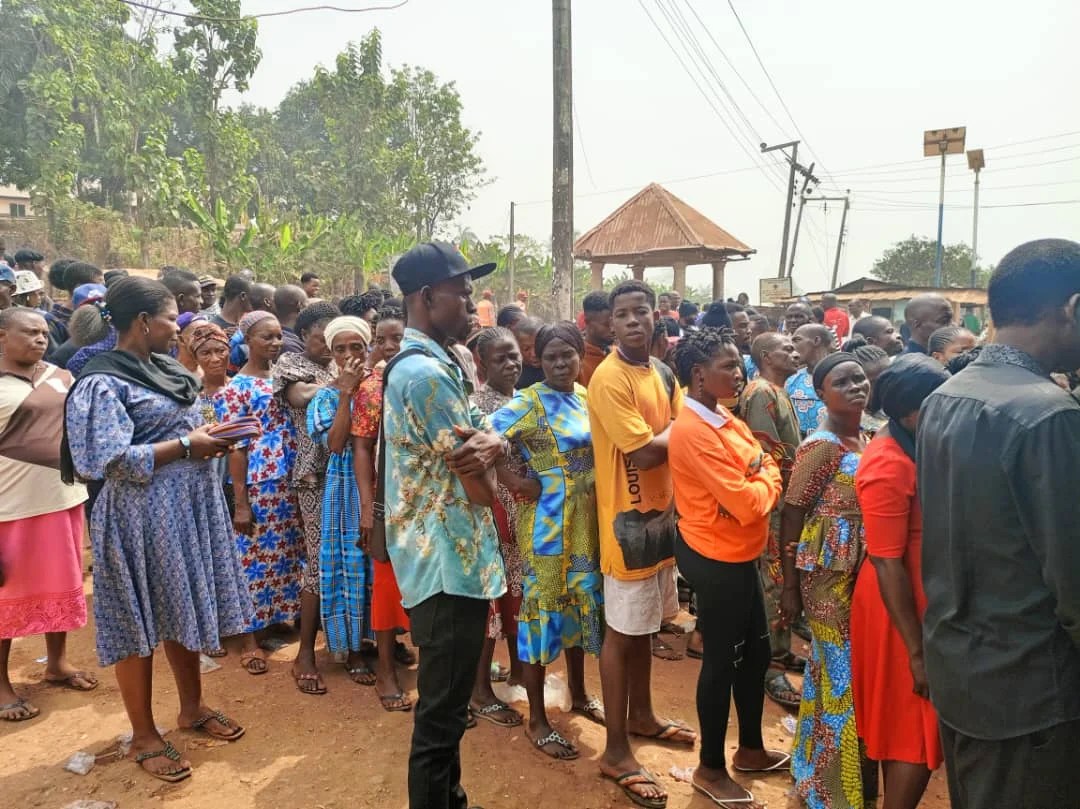
Before the 2023 General Election, Nigeria's way of tracking results was mostly manual. Results from polling units were written on paper and moved up through different collation centres.
After voting, the presiding officer counted the votes, wrote the results on Form EC8A, had party agents and officials sign off, announced the results, and took the materials to the collation centre.
Collation officers collected results at the ward, local government area (LGA), and state levels, after which the returning officer announced the winner. Proper counting, transport, collation, and announcement of results showed transparency in the process.
But there were often issues with the collation process, leading to distortions and manipulations at different stages.
IReV Launch
Many Nigerians have seen the electoral process as a ‘black box’. There is a strong feeling that votes do not always count, causing many young people to lose trust and refrain from voting.
The launch of INEC's Result Viewing Portal (IReV) in August 2020 was a big step towards transparency. It allowed citizens to see polling-unit result sheets (Form EC8A) online for the first time.
IReV was made to let polling-unit results be uploaded online, so the public could view them as the collation was happening. It created a digital record of results, making independent checks easier, but it did not replace the manual process.
In February, the Senate changed its earlier decision on electronic result transmission, allowing polling-unit results to be sent electronically to INEC's IReV.
Form EC8A is still the main document for collation, especially where there are internet issues. However, this does not mean Nigeria has solved its election credibility problems. Instead, it shifts the focus to what happens before and during voting.
IReV Challenges
Still, relying on IReV data comes with limits that might affect transparency during result collation in Nigeria.
For example, there were controversies in Rivers State during the 2023 General Election. Claims arose that INEC's announced results did not match those recorded at polling units.
After the presidential election on February 25, 2023, PREMIUM TIMES looked into polling-unit results uploaded to INEC's IReV in Obio/Akpor Local Government Area. INEC declared Bola Tinubu of the All Progressives Congress (APC) the winner with 80,239 votes against Peter Obi of the Labour Party's 3,829 votes.
However, the investigation, published in April 2023, found big differences between INEC's declared figures and what was recorded on many polling-unit forms.
PREMIUM TIMES checked 1,116 of the 1,211 polling units in Obio/Akpor, which is about 94.13 percent of the area's polling units. Their tally gave the APC 17,158 votes and the LP 73,311 votes. The review also found changes and damages on some result sheets.
These findings were crucial because the results from Obio/Akpor changed the outcome in Rivers State. Before the announcement of results from Obio/Akpor and Degema, Mr. Obi was leading Mr. Tinubu in 21 out of 23 local government areas. After INEC announced 80,239 votes for Mr. Tinubu and 3,829 for Mr. Obi in Obio/Akpor, Mr. Tinubu took the lead and was declared the winner.
This showed the challenges IReV poses for ordinary citizens and election watchers. Even though the information is out there, gathering and comparing figures from thousands of result sheets by hand takes a lot of time.
Civic Technology
Civic technology can change how people access, understand, and track election results while the electoral body is still collating them.
IReV has truly improved transparency and made results more available. But these results are mostly uploaded as photos of handwritten forms, not as structured data.
Even with public access, making sense of thousands of result sheets in real time is very hard for the average person. Downloading, reading, and adding results from thousands of polling units could take days or weeks.
Instead of waiting for INEC to finish the collation and announce the results, data companies and election stakeholders like Dataphyte and Mundx Analytics use civic tech to provide results with infographics as they are announced at polling stations.
This technology helps compile, analyze, and publish results quickly, something that was previously only for INEC.
These tools offer a safeguard against election manipulation, especially claims of altered results.
Mundx and Dataphyte
Martin Uwakwe, founder of Mundx Analytics, shared that the company monitored and reported on about 97.7 percent of the Osun governorship election. He said they built a technology layer on IReV.
“As polling-unit result sheets become available, our system identifies the polling unit, uses AI to read and organize the information, runs validation checks, flags errors, and compiles results,” Mr. Uwakwe said.
This sounds simple: INEC publishes the result sheets, and the tech organizes thousands of those sheets quickly. But the technology still depends on what INEC uploads, although it allows for checking individual polling units’ results.
“Our results stay linked to the original polling-unit records, so people can check the source instead of just trusting our numbers,” he added. “We do not get election results from social media, party agents, or unofficial reports. Our main source is the polling-unit result sheet on INEC's IReV portal.”
In another interview, Joshua Olufemi, founder of Dataphyte, explained that they used three systems to monitor the Osun governorship election: a network of observers, an optical character recognition (OCR) tool, and their Nigeria Election Data Observatory (NEDO) platform.
Mr. Olufemi said the observers provided real-time updates on election incidents, administration, and result collation at polling units, wards, and local government levels.
“First, we deployed a human network of observers who worked 24/7 to give real-time updates on incidents, election management, and result collation,” he said.
“Second, we built an OCR tool that turns paper results into digital data from our observers and from INEC’s IReV portal in real time.”
“This helped us quickly send results data into maps and charts for sharing across our media platforms,” Mr. Olufemi added.
The third system allows Dataphyte to collect election data from various sources, process it, and share it with partners through analysis and visuals.
“Osun helps us test this third platform in preparation for the general election in January and February 2027,” he said.
Election Coverage
The data analytics AI can handle large amounts of information quickly. Unlike people needing to read thousands of result sheets by hand, the system processes many of them at once.
The firms used this technology during the Ekiti and Osun off-cycle elections in 2026 to test the system in real election conditions before the 2027 General Election.
During the Osun election, Mundx covered 3,754 of the state’s 3,763 polling units, which is 97.7 percent of the uploaded forms counted in their total. They processed 1,804 forms, flagged 1,864, had 42 pending for processing, retried five, and excluded 39.
In Ekiti, Mundx covered 2,390 of 2,445 polling units, or 98 percent of uploaded results; they processed 1,256, flagged 1,016, read 11, and excluded 107.
The flagged units had blurry or damaged result sheets and other issues like vote mismatches, overvoting, and calculation errors. The queued units are result sheets sent but still reviewed.
“In the elections we monitored, our totals were very close to the official final results, with less than 5 percent difference,” the AI system founder said.
Mundx runs checks on every result sheet to ensure that figures, vote totals, accredited voters, and registered voters are consistent. They also check if result sheets have been changed on IReV.
“These checks matter because AI is just one part of the system. We do not simply let an AI model read a result sheet and publish it immediately. Each piece of information must pass multiple checks before we can trust it,” he said.
Mundx’s tally for the Osun election was about 95.68 percent accurate compared to INEC’s final result, as some IReV results were missing, unreadable, canceled, or replaced.
The firm only reported results it could obtain and process from IReV, not adjusting its numbers to match INEC’s final declaration.
Also, in the Ekiti State election, Dataphyte flagged 452 result sheets with numerical issues out of 2,390 result sheets, with over 100 showing visible changes to the figures on the forms.
For the Osun State election, Dataphyte's analysis of 3,752 polling-unit results on INEC’s IReV portal found errors in over 900 polling units.
Speaking on AI errors, Mr. Olufemi from Dataphyte said results from field monitors sent in real time can also help spot errors or manipulation in IReV results.
He noted that differences between IReV data and NEDO’s field network could come from valid changes made during the formal collation process, like cancellations by INEC under electoral law.
“Results data from our field monitors helps flag errors or manipulations in results on IReV. The differences may arise in two cases. One, the final results on IReV may differ from those provided by NEDO due to cancellations by INEC under the law,” Mr. Olufemi said.

He also admitted that mistakes could happen within Dataphyte’s own system, especially during analysis.
Dependence on IReV
One major concern for election tracking is reliance on IReV for results. What if there are problems with the IReV portal or uploading results, like what happened in the 2023 presidential election due to a glitch?
Mr. Olufemi said IReV was just one of three data sources Dataphyte used during the Osun election, meaning they could depend on their other monitoring methods if IReV failed.
“IReV is one of three data sources we used in the Osun elections. If it fails, we still have the other two data collection and monitoring methods,” he said.
He added that the NEDO consortium plans to send human observers to many first-level election collation centres across Nigeria before the 2027 elections, while talks with other monitoring groups are ongoing to increase coverage.
“The NEDO consortium will deploy a human network of observers in more than half of the first-level election collation centres across the country in January 2027. We are also in talks with other monitoring groups to cover all first-level result collation centres,” he said.
The consortium includes five civic technology and observer groups: BudgIT Foundation, Centre for Journalism Innovation and Development (CJID), Dataphyte Foundation, DEAN Initiative, and YIAGA Africa.
Mr. Olufemi said these groups bring different skills in election monitoring, results data, and reporting.
“So, while we expect INEC to perform its duties, we are ready to add to the data from IReV with our reliable presence on the ground,” he said.
When asked what would happen if IReV failed, Mr. Uwakwe said Mundx doesn't have the means to send observers to all polling units to capture Form EC8A results independently.
He stated that IReV worked well in the 2026 elections, adding that Mundx is also putting pressure on INEC to ensure its systems work properly.
“Eighty elections happened this year, and IReV worked well for all. We are also pushing INEC to keep their systems on point,” he said.
More Challenges
Another big challenge is the accuracy and quality of results INEC uploads to IReV during elections. Standard optical character recognition (OCR) works well on clean, printed, or typed documents.
Problems arise when AI has to read handwritten forms, poor-quality pictures, overwriting, cancellations, or damaged sheets. In those cases, standard OCR won't give the reliability needed.
Mr. Uwakwe of Mundx said his company used an AI vision model instead of traditional OCR to improve result readability and interpretation. This system flags or rejects unclear results.
This dual-model approach reduces the risk of a single model misreading a number. He noted that this approach achieved high accuracy in the recent elections.
“That’s why we moved to AI vision models that can better interpret both the text and context on a result sheet. Even then, we don’t rely on just one AI model. Each result is checked by two AI models, and their outputs are compared. If they agree, the result can move to other checks. If they disagree, it won't be accepted right away,” he explained.
A major risk with generative AI is hallucination, where a model might confidently give a wrong interpretation. Mr. Uwakwe said they planned for this from the start, thinking about what AI can do and how it might fail.
“We run checks on every result before accepting it. We also keep the link between our data and the original polling-unit result sheet, so we can check our reading against the source,” he said.
He noted that there will always be some risk that a result sheet is read wrongly, especially if the original image is bad. The aim is to minimize that risk, making it easy to spot and audit instead of pretending AI can never err.
Looking to 2027
The AI system has only monitored two state elections, and the bigger worry is how it will handle the General Election, which includes 36 states and the Federal Capital Territory with over 170,000 polling units.
“For us, trust is not just about matching INEC's final number. It's about showing people the evidence behind the numbers and pinpointing where discrepancies may exist.
“Our goal for 2027 is to process as close to 100 percent of the available polling-unit results on IReV as possible, while clearly marking what is missing, unreadable, canceled, or unresolved. We would rather mark a polling unit as unresolved than give a number we are not sure about,” Mr. Uwakwe said.
The costs of running an election technology system for a large country like Nigeria include AI processing, cloud computing, data storage, bandwidth, engineering, monitoring, and cybersecurity.
It requires the tech setup to handle high traffic during the Nigerian General Election, which includes many result documents and possibly millions of users.
The challenge for Nigerian civic tech operators is not just building the software. They must ensure the system is fast, reliable, and available during an election when Nigerians depend on it.
Mr. Uwakwe noted that the Ekiti and Osun elections gave them valuable real-world data about what works, what fails, and unusual cases when processing actual Nigerian election result sheets.
He said they aim to improve how they resolve disagreements between models and ensure that questionable results aren't just pushed through the system.
“Ekiti and Osun were key tests. The 2027 general election needs us to take what worked at the state level and adapt it for national use. We are applying those lessons in preparation for 2027. This includes improving our validation rules, how we spot low-confidence results, and handling difficult or damaged forms,” he said.
On the other hand, Dataphyte's Mr. Olufemi said their field-monitoring system has been running since 2023, and their experience from the 2026 elections improved with advancements in OCR tech and AI.
“Our success rate with field monitoring has been high since 2023 when we began. The 2026 experiences improved with OCR technology and AI's ability to change information into multilingual analysis, multimedia outputs, and visuals,” he said.
He added that the NEDO consortium plans to combine the resources and experiences of its member organizations for the 2027 elections.
“For 2027, we are merging field agents' resources, monitoring experiences, and information verification from at least five organizations to cover all local government and over 10,000 ward-level collation centres under the NEDO consortium, blocking any gaps while using each organization's unique strengths,” he said.
INEC’s View
On INEC's stance regarding civic tech firms using AI systems to reflect its election results, INEC National Commissioner Mohammed Haruna said these firms boost the commission's transparency, provided they interpret the results accurately and do not declare a winner, which is illegal.
“What is on IReV is the votes cast by voters. The aim of IReV is transparency, so it’s good that they are amplifying our transparency,” he added.
Looking Ahead
Bankole Adams, a retired software engineer who watched the civic tech firms' analysis during the elections, said their tracking and methods align with modern data processing. This could improve INEC’s data transparency if the commission uploads quality data.
He mentioned that clear, high-resolution polling-unit result images would make OCR transcription more accurate and trustworthy.
“This will prompt us to closely examine result images for signs of result alterations, especially after what we saw in 2023. Conversely, if INEC uploads quality data, my trust in these firms will increase,” Mr. Adams added.
About the technology for 2027, he said parallel “IReV servers” might come up, relying on verified EC8A forms uploaded to INEC’s IReV portal.
“If INEC data aligns with the civic tech firms' analytics on those parallel IReV servers, it will greatly enhance INEC’s credibility,” he said.
Ubong Ekanem, an engineering researcher in the UK, who also followed the civic tech firms’ analysis during the Osun election, welcomed the work of civic-tech developers.
He said AI allowed developers to extract results from INEC’s IReV portal, compute them quickly, and provide analytics as results came in.
However, he noted that the effectiveness of such systems depends on the availability of results on IReV and access to INEC’s site API, as well as the quality of result sheets for OCR.
Mr. Ekanem said damaged, poorly written, or wrongly tallied results might be discarded based on the system's parameters.
He stated that civic tech results should closely match INEC's figures when these conditions are fulfilled, considering INEC computes results based on the data it uploads.
“So, the results from these civic tech firms are correct to the extent that INEC provides accurate data.


Drop your comment
No comments yet — be the first to drop the gist 👇