---
All over the world, people often look at numbers to see how strong a government is. They check approval ratings, economic data, or public surveys.
In China, there is another interesting sign: the number of Party members keeps increasing each year.
From 2020 to 2024, official records show a steady rise in membership of the Communist Party of China (CPC), with over 80% of new members being under 35 years old.
This brings up a question: how does the CPC attract young people in a society that is changing so fast?
One way to understand this is not through policies but through the real stories of foreign friends who visited China and experienced its changes in different times.
In 1936, Edgar Snow became the first foreign journalist to visit the Communist Party of China’s revolutionary areas in northern Shaanxi. A year later, he released Red Star over China, one of the first Western accounts of the Chinese revolution.
Snow wanted to know what the CPC was at a time when it was not well-known and often seen as a group of outlaws. His book reached many readers internationally and sold over 100,000 copies in Britain after it came out.
At that time, the Red Army had just finished its famous Long March. This was a two-year retreat through some of the toughest parts of China to escape attacks from Kuomintang forces.
During the Long March, many soldiers died from battles, hunger, and harsh conditions. They crossed snow-covered mountains, fast rivers, and rough land with little supplies.
Still, many people continued to support the movement, willing to risk their lives, even when the Red Army had few resources and was outnumbered.
Snow was welcomed by the party’s top leaders, who saw a chance to show their side to the world. Zhou Enlai, who later became the first Premier of the People’s Republic of China, helped him report openly about what he saw.
During his four-month stay, Snow interviewed senior CPC leaders and villagers. He visited military camps, schools, and local factories, noting his observations and conversations in his book.
Back then, China was mostly rural, with many people being farmers. To understand why they supported the Red Army, Snow often chatted with locals, both young and old. Farmers were curious about farming in his country and even asked about using goat dung as fertiliser.
As he spent more time with them, Snow began to ask his main question: why did they support this movement?
Many villagers spoke up at once, recalling years of hunger and struggles before the army’s arrival. They talked about heavy taxes and land rents that forced families to sell livestock, crops, and sometimes even daughters.
In contrast, they said the army helped lessen their burdens, taught them to read and write, and worked to ensure everyone had enough food in their communities.
From years of barely surviving to more stable lives, some villagers called it “poor people’s army, fight for the people’s rights,” a phrase from Snow’s book. This showed the strong bond between the soldiers and civilians.
That affection turned into unity, as many farmers and teenagers joined the army to defend their rights. Snow noticed that Communist commanders showed discipline and teamwork among the soldiers, with a strong commitment to their shared goals during the revolutionary efforts.
In his account of crossing the Dadu River, one of China’s most dangerous rivers, Snow described how the Red Army could not afford to fail, as defeat would mean destruction.
The commanders understood the need for quick movement, learning from past mistakes at similar river crossings. They also built partnerships with local ethnic groups along the way, turning possible enemies into allies. Small groups of soldiers took on risky jobs to help the larger force cross safely.
Snow believed it was this mix of smart military decisions and discipline that allowed the Red Army to succeed in what many thought was an impossible crossing.
Snow’s observations also highlighted the role of young people in the movement. When he arrived at the base, he first met young couriers who brought him meals. He quickly saw that teens played active roles as messengers, scouts, orderlies, and nurses, many of whom later joined the Red Army. He described them as “cheerful, energetic, and loyal, the living spirit of an astonishing crusade of youth.”
Overall, Snow’s account gave a rare outsider’s view into a movement that was not well understood then. From villagers sharing their reasons for joining to young volunteers dedicating themselves, and commanders making quick decisions under pressure, he saw a society shaped by struggle but connected by shared goals.
If Snow tried to understand a movement through the people he met in villages, Hansen Nico René found himself observing a different change years later.



In 2018, Hansen, a retired police officer from Luxembourg, came to Zhadong Village in Guangxi almost by chance. He had come to admire the beautiful mountains, misty valleys, and lush forests.
What he did not expect was to stay for eight years.
A notice asking for volunteers to help grow passion fruit, a project linked to poverty reduction, first caught his eye. Curious, he went deeper into the village and soon met Xie Wanju, the village’s first Party secretary.
From the start, Hansen noticed that Xie was not just a village manager. He worked, lived, and faced challenges like everyone else.
Hansen said that dedication showed him how much a village could change when its leaders truly cared for the people.
Hansen still remembers one moment clearly. A truck carrying fertiliser got stuck on a narrow mountain road. With no machines available, Xie rushed to help and joined over a dozen villagers to pull the truck forward with ropes.
They looped the ropes over their shoulders and leaned into it, moving the truck forward step by step. It was tough work, but when the vehicle finally broke free, they all smiled wide.
Hansen says Xie Wanju is committed to improving the area’s living standards. But for Zhadong, better livelihoods were not just about policies but also about the challenges of the land itself.
Zhadong had long faced issues due to its geography. Surrounded by steep mountains with little arable land and hard access to markets, the village had struggled with poverty, with over half of its residents below the poverty line.
Local leaders had been looking for industries that could grow in such conditions, and passion fruit became a key project.
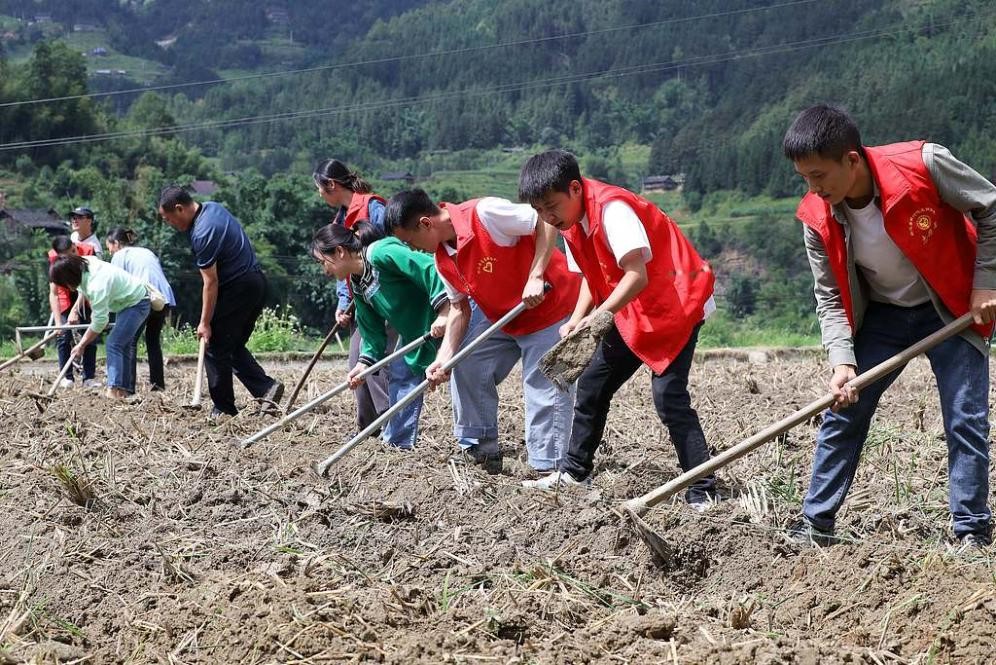
Hansen quickly joined Xie in the fields. Together with villagers, they loosened soil, planted seedlings, and built trellises in the harsh summer heat. Many young people had left for cities, so the work fell on those who stayed, working alongside volunteers like Hansen.
The first harvest of passion fruit brought hope. The fruit thrived, and incomes began to rise. Encouraged, more villagers started growing it. But farming rarely goes smoothly.
Pests soon spread through the fields, damaging leaves and threatening the harvest. An expert was called to help, advising that preventive measures should have been taken earlier. Now, they were racing against time.
Under pressure, Xie became visibly worried, not for himself, Hansen noticed, but for the villagers whose hopes depended on the crop.
Without hesitation, Xie and Hansen worked with the expert to change their plan: strengthening the plants with fertilisers, trimming affected branches, and improving care routines to save what they could.
When harvest season came back, to help get the fruit to market, Xie helped set up online sales and live-stream promotions to connect rural products.
Beyond passion fruit, Xie and his team moved between homes, checking livestock, helping build pig pens, treating sick animals, and studying market demand for local pigs to improve sales. Every task was done with the same goal: to make rural lives more stable and sustainable.
Over time, everyone could see the results. In November 2020, Zhadong Village officially escaped poverty. For many, this was not the end but a new beginning.
After that, Xie went to another village called Lianhua in Guangxi, and Hansen chose to follow him, continuing to help rural development.
For Hansen, his years in Guangxi changed how he saw development at the village level. What impressed him most was not just one project or harvest but the example of a local leader who worked hand in hand with villagers, facing uncertainties together and treating every setback as a challenge to solve, always putting the village’s future first.
Snow’s experiences in wartime and Hansen’s years in a rural village in Guangxi were different times and places. Yet a similar pattern appears: people who get close to China often see its society through daily lives shaped by resilience, teamwork, and change.
Through these personal stories, the question raised at the start comes back in a softer way, not as a statistic or slogan, but in the simple moments where change is truly felt.




Drop your comment
No comments yet — be the first to drop the gist 👇