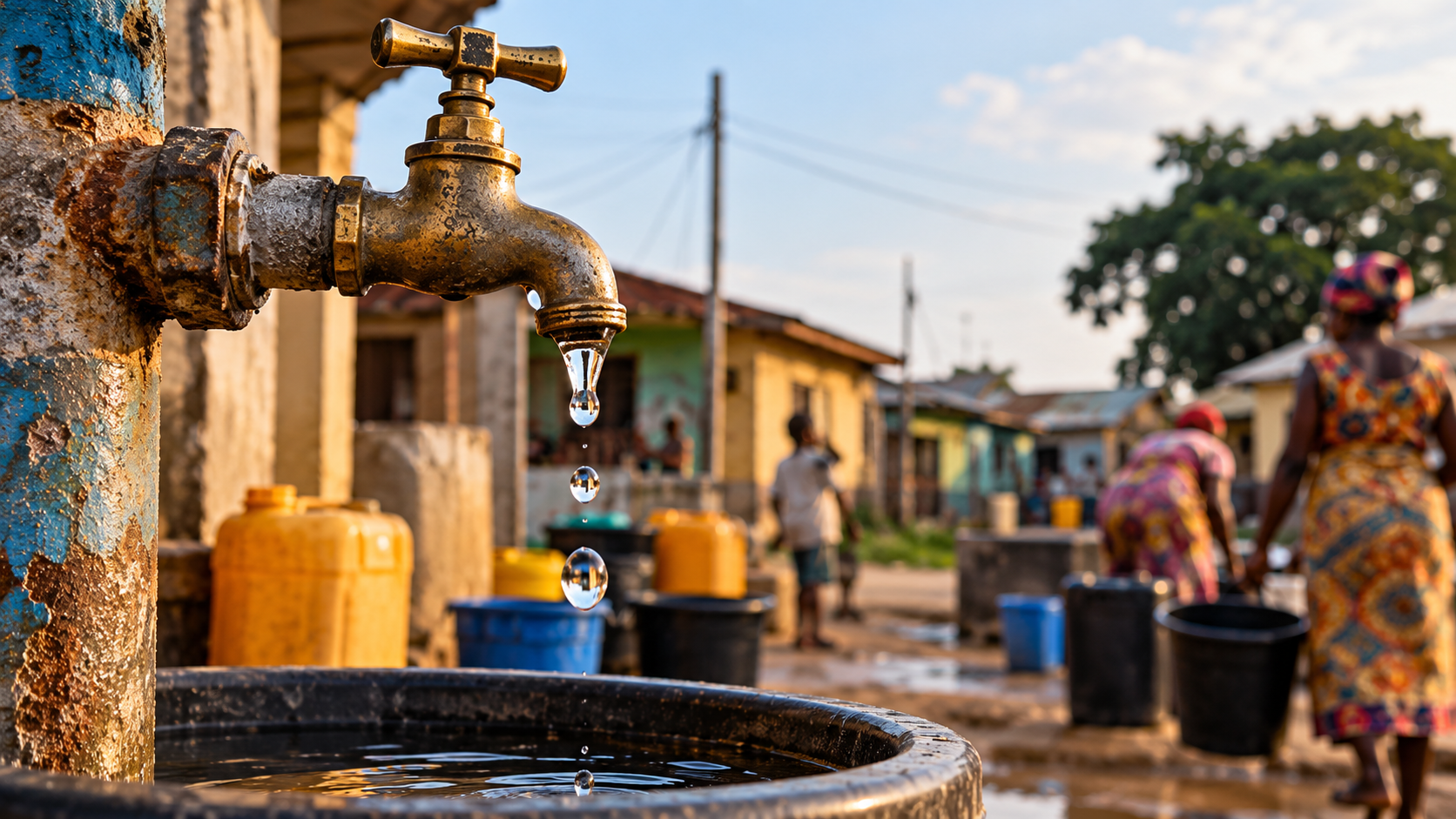
The Lagos Water Corporation (LWC) says its water supply serves only 34,424 households. This is about 1.03 percent of the 20 million people living in Lagos State.
Rasaq Anifowoshe, the Deputy Director of Corporate Affairs and Brand Management at LWC, shared this information in an interview with the News Agency of Nigeria (NAN) in Lagos.
Anifowoshe explained this when asked about the coverage and expansion of LWC's water services. "Using an estimated average household size of six persons, the number of residents connected is 206,444, which is about 1.03 percent of the state's population of 20 million," he said.
He also mentioned that the corporation has a water production capacity of about 210 million gallons per day (MGD). This is far below the daily water demand of around 540 MGD, according to the Lagos State Water Supply Master Plan.
"A review of the corporation’s 2025 production records shows an annual production of approximately 2,633.22 million gallons, translating to an average daily production of about 7.21 MGD. Based on these records, actual daily production is three percent of the installed capacity," he said.
NAN reports that these numbers show a big gap between the installed capacity, actual output, and the water demand in Lagos State. Anifowoshe pointed out that old pipelines, growing demand from population increases, and the need for repairs and upgrades are major challenges.
NAN noted that these issues affect the LWC's ability to provide water, especially to communities that depend on boreholes and private vendors. Many Lagos residents are spending thousands of naira on alternative water sources because of irregular public supply and limited connections.
Some Lagos residents talked to NAN about their worries over unreliable water supply, broken facilities, and low water pressure. At Iponri Housing Estate, Adebayo Solomon said his family spends about N1,500 daily on water from vendors. This adds up to N45,000 each month.
Solomon noted that if this continues for a year, it would total about N547,500. He mentioned that power outages sometimes affect water availability, forcing his family to manage stored water or pay more for supplies.
He said he would be happy to get an LWC connection if it meant regular water supply and less reliance on vendors. Another resident in Iponri, Abdulkareem Ibrahim, said he uses public boreholes from philanthropists since his area does not receive LWC water.
"I depend on public water from philanthropists. I fetch it in the morning or when I come back from work at night," Ibrahim said. He added that while the boreholes save him money, power cuts sometimes stop the water supply, making him buy from vendors.
"I am just grateful we have water, thanks to our generous neighbors," he said. In Oworonshoki, Amanda Ogbodo said she spends between N2,200 and N3,600 weekly on vendor-delivered borehole water.
Ogbodo said that adds up to between N8,800 and N14,400 over four weeks. She mentioned that LWC water has flowed more steadily in her area over the past four months, mainly from Friday afternoons to Saturday.
Yet, she said homes on higher ground still struggle because of low pressure. She recalled her business used to get LWC water, with eight or nine users sharing N10,000 monthly. Ogbodo said supply stopped for about four years after a pipe broke, and repairs were needed.
She said water returned sporadically in 2025 but has only recently become more regular. "Electricity shortages in the past two weeks have also reduced availability and increased costs. We plead with the government to help us fix the pipe and provide constant water access," she said.
At Costain, Eniola Adewale mentioned that a truckload of water costs between N1,200 and N1,500, with vendors often raising prices during shortages. She said her family relies on mobile vendors since public supply is far and irregular.


Adewale expressed distrust in vendor water since its source is unknown, so they use sachet water for cooking. Eunice David, a food vendor, said she spends a lot each month pumping water for her household.
David pointed out that a public water system that used to serve her community has been out of order for a while. "We don’t know what to do anymore. We need help from the government," she said, asking for regular and affordable public water.
On Opeoluwa Street, Apapa Road, Garuba Alasan said the public water system has been down for about 20 years. "I have lived here for about 30 years, and for the last 20 years, I have relied on private water sources for my needs," he said.
On Vaughan Street in Costain, Anthony Olamide, who runs a point-of-sale business, said residents have an LWC connection, but supply often depends on electricity. Olamide noted that residents pay N1,000 monthly for water, which helps cut costs when the public supply is available.
But power outages disrupt supply, forcing families to buy from vendors. At Olaogun Street, Abule-Nla Junction, Ebute Metta, Esther Emokpaire said her family spends between N1,000 and N1,500 for a truckload of vendor water.
She mentioned they usually buy water every two days, with prices changing based on availability. Emokpaire stated that while vendors say the water is clean, her family has not checked its quality.
"There was a time when my family got skin rashes after using water from vendors," she said. She also noted that shortages make it hard to get water, which sometimes leads to price hikes. Residents' stories show how unreliable supply, broken facilities, and low pressure force families to pay for alternatives, even in areas with public connections.
Their experiences raise questions about how far public water systems reach, the reliability of supply, and if promised improvements are making a difference. The Lagos State Government’s budget report for the second quarter of 2026 revealed that 36.2 percent of the approved budget for improving 15 existing mini and micro waterworks had been spent by June 30.
The report also noted spending equivalent to four percent of the budget for the Adiyan Phase II Waterworks project. These spending figures don’t show the current status of the projects or how much water they are supplying.
Discussing plans to increase public water coverage, Anifowoshe mentioned plans to repair and upgrade micro/mini treatment plants. "This will allow over 5,616,000 households to access water once repairs are complete, fulfilling our goal to provide clean water for Lagosians," he said.
He also pointed out plans to extend the distribution network to give more people access to safe water. The corporation is set to rehabilitate Ojokoro Mini Waterworks and build Lagos Island Micro Waterworks to improve supply.
Anifowoshe mentioned upgrading micro and mini water treatment plants as part of their strategy. This intervention will allow over 5.6 million households to access water when fully repaired.
He also talked about digitizing the distribution network to enable better monitoring and management of underground pipes and assets. According to Anifowoshe, this move will help reduce water loss and ensure better supply.
Plans are also on the table to build the Igbonla 100 MGD water treatment plant to boost supply along the Lekki-Epe corridor. "This will increase the corporation's production capacity to meet water demand in the Lekki-Epe area," he said.
For residents still spending thousands on alternative water sources, the success of these plans will depend on reliable supply, working facilities, and wider connections across Lagos State.


Drop your comment
No comments yet — be the first to drop the gist 👇