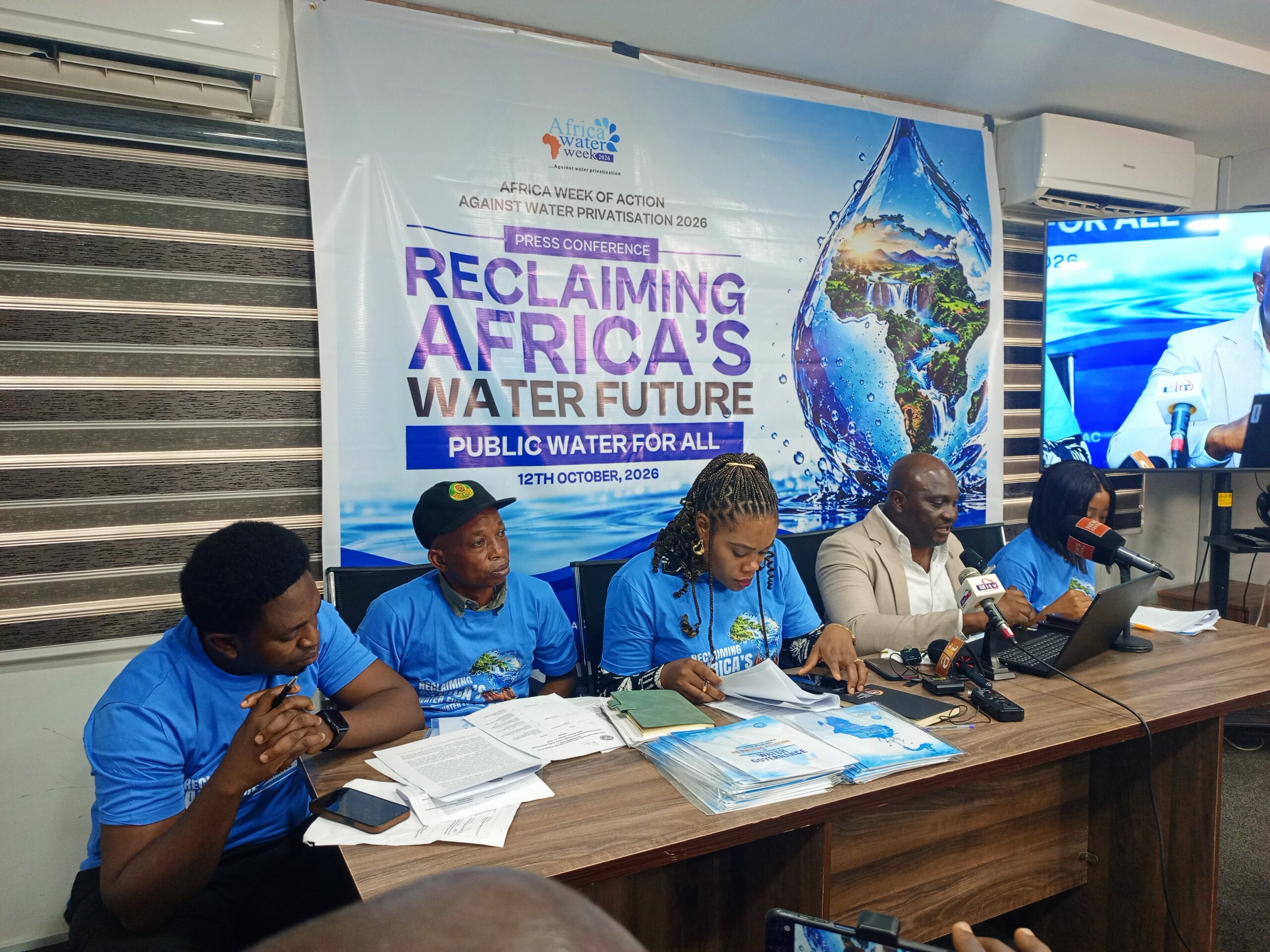
A group of development-focused organizations and individuals has warned that privatizing water services in Lagos might make water more expensive for poor residents. They are urging the state government to invest more in public water systems.
Rufus Olusesan, president of the Precision, Electrical and Related Equipment Senior Staff Association (PERESSA), shared this warning on Monday. He spoke during the Africa Week of Action Against Water Privatisation 2026, organized by the Our Water, Our Right Africa Coalition (OWORAC) in Lagos.
He pointed out that private companies might focus on profitable areas while neglecting underserved communities like Ajegunle and Makoko. “Water is not a commodity. It is a human right,” Mr Olusesan said.
During the event themed "Reclaiming Africa’s Water Future: Public Water for All,” he called on the Lagos State Government to allocate at least five percent of its yearly budget to water infrastructure. He mentioned that the current budget for water is less than one percent, although this figure wasn't independently verified.
He also called for the Iju, Adiyan, and Ishasi waterworks to be repaired. He urged for the completion of the Adiyan II project and for investigations into contractors who have not delivered on water projects they were supposed to complete.
In a joint statement read by Geoffrey Occansey of Ghana’s Water Citizens Network/Revenue Mobilisation Africa, OWORAC said that lack of public investment, population growth, urbanization, and climate issues have made water supply problems worse across Africa. The coalition is asking governments to improve public water systems instead of using their failings as excuses to hand services over to private companies.
The statement highlighted that in 2024, 2.1 billion people did not have access to safely managed drinking water. It also noted that 3.4 billion people lacked access to safely managed sanitation. In sub-Saharan Africa, around 167 million people were relying on limited drinking-water services that year.
The coalition stated that families without dependable public water supplies often rely on vendors, tankers, and private boreholes. This situation forces poorer residents to pay more for essential water services. Research on urban water access in sub-Saharan Africa showed that low-income households buying from vendors could pay 10 to 20 times more per unit of water than those connected to public networks.
“This is a poverty penalty where those with the lowest incomes end up paying the highest prices for an essential service,” the statement explained. It warned that commercial rates, concessions, public-private partnerships, and prepaid water meters could make inequality worse if access depended more on what households can afford.
The statement also mentioned a 2025 Global Witness investigation into a landfill managed by Veolia in Colombia, along with concerns about Veolia’s work in Gabon and Suez’s role in Senegal’s urban water system. The coalition argued that private sector involvement needs strong public oversight and does not automatically solve infrastructure and sanitation issues.
They are calling on African governments to publish contracts related to water, financing details, tariffs, and spending while including workers and affected communities in decisions about water management.
Opposition to involving the private sector in Lagos water services is not new. PREMIUM TIMES reported that the Amalgamated Union of Public Corporations, Civil Service, Technical and Recreational Service Employees (AUPCTRE) is against the Lagos State Government’s plan to run its waterworks through a public-private partnership (PPP).
The union accused the Lagos Water Corporation of using water scarcity to convince residents that private participation is the only way to improve supply. “It is disappointing that while many countries are moving towards re-municipalisation, Lagos State is pushing for privatisation,” the union said.
The Lagos State Government insists it is not privatizing its waterworks but is adopting a PPP model to meet the growing demand for water in the state. The Corporate Accountability and Public Participation Africa (CAPPA) also opposes this plan, saying water supply should stay publicly managed and affordable.
At Monday’s event, Mr Olusesan suggested creating a water board with government representatives, workers, community groups, and civil society organizations. He said the board should publish its budgets and spending every three months so residents can monitor public funds.
He also claimed that the Lagos Water Corporation laid off over 800 workers in 2024 to attract investors. He warned that replacing permanent staff with casual workers could hurt job security, pension rights, and the skills needed to maintain water systems.
A report indicated that the Lagos State Public Service Joint Negotiating Council (Trade Union) condemned the layoff of more than 370 workers from the corporation. In a petition to the state government, the council’s chairperson, Olusegun Balogun, claimed that the dismissals were done under the pretext of restructuring without proper communication with union representatives.
Mr Balogun asked the government to pause the process and engage with the affected unions, including AUPCTRE and the Senior Staff Association of Statutory Corporations, Government-Owned Companies and Associated Organisations. He also called for an inquiry into the corporation’s management and the use of World Bank loans meant to improve its operations.
The Renevlyn Development Initiative (RDI) accused the government of trying to privatize water services in Lagos through these layoffs. They urged the state government to reverse the job losses and enhance water supply across the state.
The reports of over 370 workers being dismissed and Mr Olusesan’s claim about over 800 workers in 2024 are from separate accounts. The corporation and the state government need to clarify the numbers and reasons behind these reported job losses.
At the event, Holiness Olufemi, a programme officer for water campaigns at CAPPA, presented OWORAC’s position paper on implementing the Africa Water Vision 2063. Titled "Implementing the Africa Water Vision 2063: An OWORAC Coalition Position on Water Justice, Public Control and Democratic Water Governance,” the paper calls for stronger public water systems, better government funding, and more community involvement in water management.
Ms Olufemi said this vision could improve access to water and sanitation in Africa, but its success relies on governments committing enough resources and ensuring that public spending leads to real results. One major proposal in the paper is a financing benchmark for water and sanitation across the continent, supported by national funding targets and transparent reporting.
Ms Olufemi pointed to the 2001 Abuja Declaration, where African leaders agreed to allocate at least 15 percent of their yearly budgets to health as a model for establishing a similar benchmark for water and sanitation.
Under the proposal, governments would be evaluated based on their budget allocations, the funds they release and spend, the infrastructure built, and the improvements in access to safe and affordable water.
The paper also suggests creating an African Water Accountability and Monitoring Mechanism to keep track of progress and hold institutions accountable. Mr Olusesan called for laws that recognize access to water as a human right and ban water privatization.
“Government must fund water corporations like it funds roads and airports,” he said. The campaign comes as the African Union declares 2026 as the Year of Assuring Sustainable Water Availability and Safe Sanitation Systems to Achieve the Goals of Agenda 2063.
OWORAC called on African governments to use the Africa Water Vision 2063 and the 2026 United Nations Water Conference to enhance public funding and boost community participation in water governance. “Public Water for All is not just a slogan. It is possible, it is affordable, it is our right,” Ms Olusesan said.
The joint statement was supported by water justice and civil society organizations from Nigeria, Ghana, Senegal, Sierra Leone, Zimbabwe, and Kenya, as well as the international group Corporate Accountability.
Drop your comment
No comments yet — be the first to drop the gist 👇