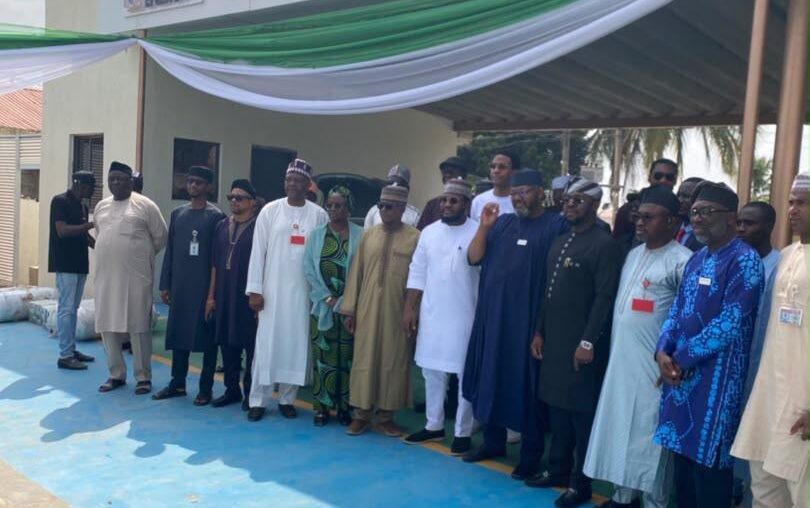
Nigeria now has about 160 operational Compressed Natural Gas (CNG) refuelling stations across the country. There are also 170 more facilities in different stages of development and licensing. The federal government is pushing to make alternative fuel more accessible and cheaper.
Ismaeel Ahmed, the Executive Chairman of the Presidential Compressed Natural Gas Initiative (PCNGI), shared this news on Friday. He spoke during the launch of a CNG Integrated Refuelling Unit (IRU) station along New Karu Road, Saint George Akume Way, Karu, Abuja.
Mr. Ahmed told everyone that this initiative has drawn around $2.6 billion in private-sector investments in less than two years. He believes the growing interest from investors shows that the market is ready.
“This is almost our 106th station across the country in less than two years. This is not beginning any longer. The market has been proven, and investors are trooping in,” he said.
He mentioned that the new stations are either being developed or are waiting for approvals and licenses from the Nigerian Midstream and Downstream Petroleum Regulatory Authority (NMDPRA). President Bola Tinubu has also ordered more infrastructure work. This includes 1,500 units to be deployed in February and 500 more in August. These are expected to start operating between this year and early next year.
Mr. Ahmed said expanding the CNG network is essential to increase its use in Nigeria, which has over 220 million people and about 12 million vehicles. He believes Nigeria must speed up developing alternative fuel sources to meet the growing transportation and energy needs.
“It took Nigeria about 60 years to build about 24,000 conventional petrol stations, most of which are privately owned. We are seeing a much faster adoption of CNG and electric vehicles, and the scale of interest is encouraging,” he said.
The PCNGI chairman noted that CNG-powered vehicles have lowered transportation fares by 30 to 40 percent on some routes where these buses operate. He pointed out that cities like Abuja, Lagos, and Kano, as well as routes between Kano and Katsina, are seeing passengers enjoy lower travel costs.
Passengers who used to pay between N3,000 and N4,000 on certain routes now pay about N1,500 when taking CNG-powered buses. The initiative aims to extend these benefits to all local government areas, especially those with many commercial vehicles and passenger traffic.
However, Mr. Ahmed admitted that the current number of buses is not enough to meet the demand. The government is working on getting more buses on the road and expanding access to CNG. When asked how the government calculated the 30-40 percent drop in fares, he explained that they compared the prices before and after CNG buses started operating on some routes.
He shared that the initiative got data from transport operators on previous fare prices and compared them with current fares. At the commissioning event, Temitope Fashedemi, the Permanent Secretary of the State House, said the new facility shows the federal government’s commitment to promoting CNG as a cheaper option after the petrol subsidy was removed.
Mr. Fashedemi stated that President Tinubu’s administration is pushing for CNG to help ease the impact of subsidy removal on Nigerians, especially in transportation and energy. He noted Nigeria's large natural gas resources that have often been underused and flared, which could provide cheaper energy options for homes and businesses.
He mentioned that the State House chose to show the viability of the initiative by refurbishing an old fuel depot on its compound and turning it into a CNG refuelling station. The government worked with the PCNGI and selected Rolling Energy Limited as the private operator to upgrade the facility.
Mr. Fashedemi said the State House provided the existing infrastructure and location. The private partner funded the upgrades. “The State House did not spend public funds on the facility. We provided the infrastructure and made the location available, while the private-sector partner invested in rehabilitating and upgrading it,” he said.
He added that the facility also has a vehicle conversion center where drivers can convert eligible vehicles to use CNG. The permanent secretary revealed that the State House has acquired some hybrid vehicles, and some buses on the premises also run on alternative energy. Some State House staff will also bring their vehicles for conversion soon, pending technical checks.
Mr. Fashedemi said the initiative aims to show that the government is ready to lead by example rather than just talk about alternative fuels. He called on private investors to look into opportunities in the CNG market, saying government support through infrastructure partnerships could help speed up the growth of refuelling stations.
Meanwhile, Mubarak Danbatta, CEO of Rolling Energy Limited, praised the project as a model of how government and private investors can work together. He thanked the State House for allowing the redevelopment of the abandoned facility, showing how the government can help private investment by providing access to existing infrastructure.
“What you are seeing here is the power of partnership. When private entities and governments come together, this is the result,” he said. He explained that the facility, known as an Integrated Refuelling Unit, combines the dispenser and compressor in one system. It has double-nozzle dispensers that let vehicles refuel from both sides.
According to him, the station can serve about 150 vehicles daily, depending on cylinder size and pressure. The vehicle conversion center is also set to convert about 12 vehicles every day. The rising investment in CNG infrastructure comes as Nigeria aims to diversify its energy sources and reduce reliance on petrol, especially after the petrol subsidy was removed in May 2023.
The Tinubu-led administration insists that adopting CNG technology is part of a bigger plan to lower the cost of living for Nigerians amid ongoing government reforms.
Drop your comment
No comments yet — be the first to drop the gist 👇