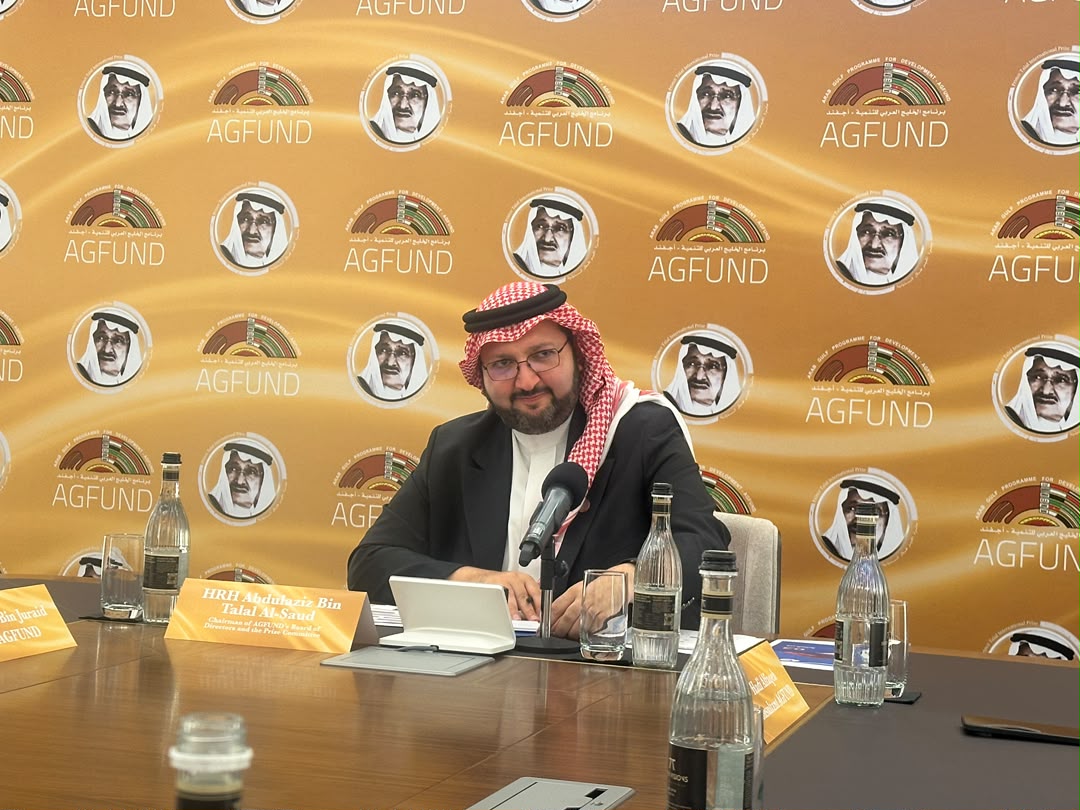
The Chairman of the Arab Gulf Programme for Development (AGFUND), Prince Abdulaziz bin Talal bin Abdulaziz Al Saud, said the fund is looking for partnerships with governments, local groups, and NGOs to boost its development work in Africa, including Nigeria.
The Saudi prince made this statement on Wednesday during a press conference with journalists in Armenia.
When PREMIUM TIMES asked about specific investments or programs AGFUND wants to support in Nigeria for young entrepreneurs, smallholder farmers, and community development, the prince said the organization aims to work with local partners. They want to identify development challenges in different African countries and create solutions that fit their needs.
The AGFUND Chairman shared the organization’s development focus, which includes tackling unemployment by supporting small and medium-sized enterprises (SMEs), entrepreneurs, and financial inclusion programs.
Nigeria, the most populous country in Africa, is still facing high unemployment rates. This is despite government efforts to create enough jobs for its growing population, especially young people. Many young talents are leaving the country, a trend popularly called “japa” in Nigeria.
According to the National Bureau of Statistics (NBS), Nigeria’s official unemployment rate is between 4.3 to 4.9 percent. But following an older NBS method before 2023, the unemployment rate was much higher, around 33.3 percent in late 2020. Most Nigerian workers are in the informal sector, with informal employment estimated at about 92.8 percent.
In response to PREMIUM TIMES’ question, Prince Abdulaziz bin Talal bin Abdulaziz Al Saud explained that AGFUND wants to help solve unemployment by supporting entrepreneurs instead of relying on the government to provide jobs for all graduates.
“When we talk about unemployment, you know, most of these countries, some of them are our countries as well, whoever graduates is always looking for a government position,” he said.
“Government position, they would say it’s much safer, it’s much secure, etc., but we want to stay away from these government positions because government will reach a day where they don’t have any more positions for new employees.”
Prince Abdulaziz said AGFUND is looking for ways to help small businesses and entrepreneurs grow. This includes financial inclusion banks that offer microloans and share knowledge with their clients.
“So, I think our part of what we’re doing is we’re trying to help SMEs. We’re trying to help entrepreneurs,” he said.
The initiative aims to help low-income people start businesses, grow their operations, and eventually hire others.
“So, these poor people, whoever they are, wherever they are, tomorrow they will become employers. They will have employees. And this is the effect that we want,” he said.
The AGFUND Chair said the approach builds on a mission that started in 2006, 2007 and is now expanding into Africa.
The organization was set up to support development projects that other funding bodies might overlook.



The prince mentioned AGFUND’s work on financial inclusion and microfinance banks, linked to the late Prince Talal, the founder of AGFUND, and Professor Muhammad Yunus of Bangladesh’s Grameen Bank.
He said AGFUND is now looking for partnerships with government bodies and NGOs to find specific needs and create programs to help communities become economically self-reliant.
He added that expanding these programs will need an understanding of cultural differences, regulations, and development needs across African countries.
The representative also warned against focusing only on large projects. He believes that smaller pilot initiatives could lead to better sustainable development.
“Sometimes we’re looking for the big projects, the mega-projects, the giga-projects. How many projects we’ve seen in the region have not succeeded? How many projects we’ve seen in Africa, for example, they have not succeeded?” he asked.
“The aspirations are very big and the dreams are very big, but sometimes you need a pilot project.”
The representative said AGFUND tests smaller initiatives before expanding successful ones, making changes to fit different regions.
Additionally, Prince Abdulaziz pointed out the varying economic and social issues facing African nations, such as instability and reduced global funding for development.
He said these challenges mean African countries should build on existing institutions and development platforms instead of starting new ones repeatedly.
Referring to the African Union’s Agenda 2063, he said the continent is entering a new phase of its long-term development vision. It needs to align existing efforts to tackle ongoing issues like unemployment.
“How can we align ourselves with whatever already exists? Why do we need to always create new platforms, find new solutions? No, the solutions are there. The platforms are there,” he said.
“All we need to do is just realign to stop having unemployment, if we can.”
AGFUND’s proposed expansion could open doors for Nigerian development organizations, government agencies, and NGOs to form partnerships aimed at improving access to finance and supporting entrepreneurship.
But the organization did not reveal how much money it plans to invest in Nigeria, how many people it hopes to help, or when it will start new projects in the country.


Drop your comment
No comments yet — be the first to drop the gist 👇