
The Tinubu government needs to explain itself to Nigerians. Until it does, people can question whether its anti-corruption efforts are mixed up with political survival.
Every government reaches a point where its actions reveal more than its words.
The story from the Tinubu government is hard to ignore: when a government feels politically threatened, state institutions suddenly focus on its opponents.
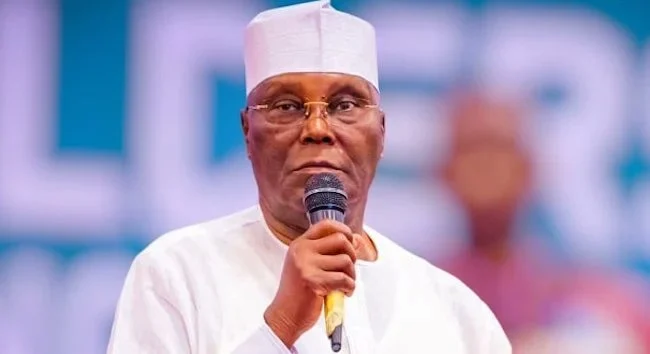
The latest situation is the move to investigate former Vice President and presidential candidate of the African Democratic Congress (ADC), Atiku Abubakar, by the Economic and Financial Crimes Commission (EFCC).
Nigerians should be asking not just: What is the allegation?
They should ask: WHY NOW?
In September 2017, Atiku challenged anyone to provide evidence of his involvement in corruption or stealing public funds. He has repeated this challenge over the years.
This is not someone hiding from scrutiny.
As Vice President from 1999 to 2007, Atiku faced investigations by President Olusegun Obasanjo’s government. He fought many legal battles from allegations against him and won important cases, strengthening our democracy.
For nearly two decades, different governments have controlled Nigeria.
Governments changed. Political parties changed. Presidents changed. Anti-corruption bodies kept working.
Yet, no government found it necessary to prosecute Atiku for corruption.
Until now. As Nigeria approaches another presidential election, Atiku is the main challenger to President Bola Tinubu.
Suddenly, an old allegation seems urgent.
Suddenly, the EFCC is involved. Suddenly, an opposition candidate is facing the kind of state attention that raises questions about political motives.
But there is something more troubling. It is hard to match the government's claim of transparency with President Tinubu’s ongoing legal battle in the United States to stop the release of FBI, DOJ, and DEA records about past investigations involving him.
These records include FBI documents and interviews from the early 1990s about drug-trafficking allegations. Tinubu’s lawyers have asked the US court to keep parts hidden, claiming privacy rights protect them.
To be clear, the existence of these records does not mean President Tinubu has done anything wrong.
But that is why the contrast is so clear.
How can the government demand full scrutiny of an opposition candidate while blocking the public from seeing records that could clarify long-standing questions about the President?
If transparency is the rule, it should apply to everyone. If accountability is the standard, it cannot be applied selectively. And if anti-corruption agencies are truly independent, they should not be used for political purposes.
Nigerians know the difference between real accountability and politically motivated accountability. They know corruption needs investigation, no matter who is involved.
But they also see that using state institutions can itself be a type of political corruption.
The Tinubu government must answer a simple question: what changed?
Did investigators find new evidence that previous administrations missed? Did new facts come to light? Or did Atiku simply become a political problem?
This question is crucial, especially with the growing concerns about how opposition politicians are treated and how state institutions are used in the run-up to 2027.
Each incident might have an explanation. But together, they create a worrying picture.
Nigerians should care. Democracy is not just about holding elections. It is about making sure the competition before those elections is fair and balanced.


An incumbent government has significant advantages: control over state resources, visibility, security agencies, regulatory bodies, and the machinery of government. This power comes with a duty not to use the state against political opponents.
The EFCC has an important job to do. But it should never be used to settle political disputes.
If Atiku has broken the law, let him be investigated. If there is solid evidence, let him be charged. If the courts find him guilty, let the law run its course.
But if the goal is to intimidate, embarrass, distract or weaken an opposition candidate before a major election, then Nigerians have every right to question the reason.
There is also a crucial point to note. The State Security Service (SSS) has reportedly told its lawyers to postpone their case against African Action Congress presidential candidate Omoyele Sowore until after the 16 January 2027 presidential election. This is to make sure the case does not interfere with his participation in the elections.
That raises a big question: if it is fair to keep a state prosecution from interfering with one opposition presidential candidate, why should this principle not apply to all presidential candidates?
Why should one candidate get space while another faces intense scrutiny as the election gets closer? The principle should apply to everyone.
The government must also remember a key fact: Atiku is not Nigeria. Tinubu is not Nigeria.
The EFCC belongs to the people. The SSS belongs to the people. The police belong to the people. The courts belong to the people.
These institutions do not belong to the APC, just like they did not belong to the PDP when it was in power.
The risk of using state institutions as weapons is that governments change, but institutions stay.
Those who set the precedent of using government power to weaken opponents may one day find themselves facing the same weapon.
This is about more than Atiku Abubakar. It is about the kind of democracy Nigerians want for their children.
Do we want elections where governments win with ideas, plans, and performance? Or do we want elections where incumbents use police, EFCC, ICPC, security agencies, and other institutions to make it hard for opposition?
That is the real issue. President Tinubu should trust his record enough to face Atiku and all other challengers at the polls.
If the government thinks Nigerians are happy with the poor economy, high insecurity, joblessness, low purchasing power, and the country’s direction, it should welcome the 2027 elections as a chance to renew its mandate.
It should not need the EFCC for political work.
Let Atiku campaign. Let Sowore campaign. Let all opposition candidates campaign. Let the APC campaign.
Then let Nigerians make their choice.
That is what democracy needs. What it does not need is a government using state institutions for political intimidation.
So the question remains: WHY NOW?
Why now, after almost 20 years? Why under this administration? Why as Atiku becomes a main challenger? Why now, when the political heat for 2027 is rising?
And why should Nigerians trust a government that demands transparency from political opponents while its own president resists releasing old US law enforcement records about controversial allegations?
The Tinubu government owes Nigerians an answer. Until it provides one that stands up to questioning, Nigerians have the right to wonder if this anti-corruption effort is really about political survival.
If Tinubu cannot beat Atiku at the polls, he should not try to beat him through state institutions.
That is not strength. It shows that the ballot box might not be enough.
History has not been kind to governments that think governing power means silencing opponents.

Drop your comment
No comments yet — be the first to drop the gist 👇