The biggest lesson for Nigeria is that it does not need one central body to run all its major elections at the same time. America has more resources and better systems to do this, but it does not follow this approach. This way of running elections comes from over two centuries of experience. America does not have a central electoral body like Nigeria’s INEC. Elections are managed by states and counties, even presidential elections.
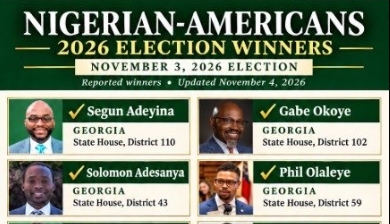
Nigerians are mostly focused on four things from the recent November midterm elections in America. First, they want to know why voters made their choices. Second, the win of the Democratic Party, which now controls both the Senate and the House of Representatives, and what this means for America and the world. Third, the success of 14 Nigerians in state and local elections. Fourth, the happiness of some Muslims that members of their faith got elected, showing that Muslims are making progress in American politics. They see this as a chance to support the interests of the Muslim world, especially for the Palestinians.
I have been looking at how elections are done in America because their presidential system is similar to ours in Nigeria. We cannot ignore the lessons from their experiences and problems. Nigeria should learn not only from America but also from other countries that practice democracy. Democracy has key principles that are necessary for it to work well. Federalism is also part of democracy, and Nigeria has adopted this system, which many other countries also use.
The Nigerian Constitution was designed with our cultural differences, history, and national goals in mind. This is why there are no midterm elections in Nigeria. When a position becomes vacant, a by-election is held. Interestingly, some African countries do not have by-elections. Political parties just put forward two candidates for each election. If the winner dies or leaves their position, the second candidate takes over. If Nigeria used this system, the State Security Service would need to protect the winning candidate heavily to prevent their assassination. But what is a midterm election?
In America, members of the House of Representatives serve for two years, and elections are held for new members at that time. These are called midterm elections because they happen halfway through the four-year presidential term. Senators serve for six years, but if a seat becomes vacant, it is filled during midterm elections. Some state governors are also elected during these elections, depending on their state laws. Therefore, some governors are elected at midterm elections, while others are elected in presidential election years.
In the last midterm elections, a total of 36 governors (out of 50), 35 senators (out of 100), and all 435 members of the House of Representatives were elected.
The key lesson for Nigeria is that it does not need a central body to run all its major elections at the same time. America has more resources and systems to do this, but it does not. This method comes from over 200 years of experience with elections. America does not have a central electoral body like Nigeria’s INEC. Elections are run by states and counties, including presidential elections. As we know, America has 50 states and over 3,000 counties, which are like local governments. They send in the results of presidential elections through a set process for counting and certification. However, the Electoral College, made up of 538 electors, decides the outcome of the presidential election, not the popular vote.
To win a presidential election, a candidate must get at least 270 out of 538 Electoral College votes. Interestingly, there have been times when candidates who got the most popular votes did not win the election because they did not have enough Electoral College votes. For instance, in 2000, Al Gore had 50,999,897 popular votes but only got 266 Electoral College votes. George W Bush had 50,456,002 popular votes and 271 Electoral College votes, so he won by just five votes.
In 2016, Hillary Clinton got 65,844,610 popular votes and 227 Electoral College votes, while Donald Trump got 62,979,636 popular votes and 304 Electoral College votes. He won by 77 Electoral College votes.
The Electoral College seems to have been created to prevent the general public, who might not be well-informed, from deciding the future of the country. Some argue that it was made to protect the interests of powerful groups who "own America." The idea is that it is easier for these groups to influence a few Electoral College members than to sway the entire public.
If no candidate gets the required number of Electoral College votes, the House of Representatives chooses the president, with each state delegation casting one vote. The Senate then elects the vice president from the top two candidates. This happened in 1800 and 1824, when Thomas Jefferson and John Quincy Adams were elected president.
The strength of the American system, which Nigeria should pay attention to, is its clever way of managing politics and addressing challenges in democracy.
In the US, the central government mainly sets broad policies, including campaign finance and technology use in elections. This is why state electoral commissions were introduced in Nigeria to eventually transfer all elections to states and local governments. Sadly, this plan does not seem to be working well. Some people are now asking INEC to take over local government elections from state electoral commissions. If this happens, it would mean going back to too much central control, which many Nigerians seem to prefer because of their past experiences with military rule, where orders come from the top down.
But Nigerians need to prepare for strong federalism and find ways to make it work better. Other countries have faced challenges in making their federal systems work, but they have managed to overcome them. This is what Nigeria should aim for instead of complaining about how things rarely work in the country. One interesting part of federalism is that communities are more likely to hold themselves responsible for their problems rather than blaming the central government.
It is easier to grow a country when all parts have clear goals that do not threaten national unity. A dedicated leader can connect with these parts to find their priorities and align them with national values that guide development plans and national interests.
Instead of pretending we are all nationalists with no ties to local interests, let us, as one of our founding fathers suggested, understand and embrace our differences. There is no other way.
Drop your comment
No comments yet — be the first to drop the gist 👇