
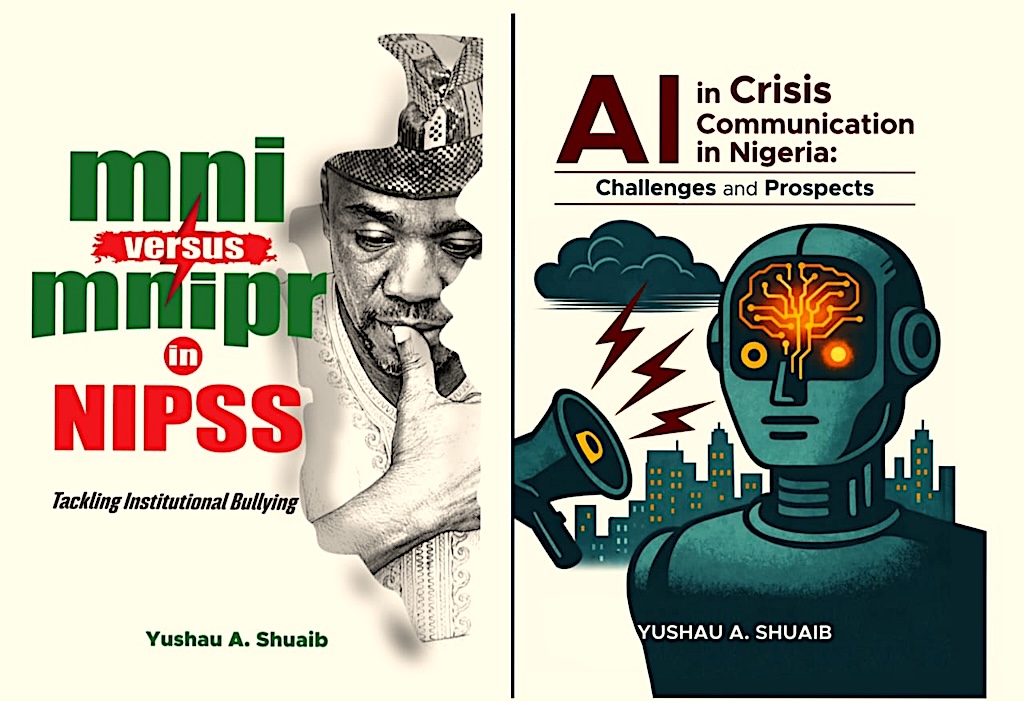
We often think that being an adult guarantees respect. After years of learning and growing in our careers, we expect institutions to treat us like grown-ups who can think for ourselves. But after reading Yushau A. Shuaib’s book, MNI versus MNIPR in NIPSS: Tackling Institutional Bullying, we faced a tough question: Can an institution take away the dignity adults have worked hard to earn in the name of discipline?
We first encountered this memoir at a special event where Shuaib, who runs Image Merchants Promotion Ltd (IMPR) and started the PRNigeria Young Communication Fellowship, urged young people to read and review the book in a week. We took on the challenge, and we are glad we did.
Shuaib has a unique perspective. With over thirty years in crisis communication and public relations, he knows how power works, how it persuades, intimidates, and sometimes uses force instead of good leadership. He has faced off against powerful figures like Dr Ngozi Okonjo-Iweala and Mr Lai Mohammed, as well as institutions like the Federal Civil Service and Access Bank, with some cases even going to court. This background gives the memoir its sharp focus and credibility.
The book is not just a complaint. It is not the whining of a man looking for sympathy. It reads more like a carefully put together case file, written by someone who has spent his life helping others deal with institutional crises and now looks at his own experiences.
At first glance, the title may sound like a boring argument about acronyms. But the memoir is not just about letters. It shows what happens when an institution that should nurture excellence starts treating capable adults like schoolchildren called to the principal’s office.
One story in the book shows this clearly. A participant casually stood with one hand in his pocket. A staff member shouted, “Pocketing!” The participant, confused, took his hand out. His mistake was not being rude; it was just how he was standing.
On its own, this moment seems trivial. But when we look at the many other examples Shuaib shares, it shows a worrying pattern. Participants were told not to use their professional titles or post-nominal letters earned through hard work. They had to stick to strict presentation styles, even when other methods made more sense. Responses to official questions had to be rewritten in a set NIPSS style. Shuaib recalls reading apology letters that “seemed out of character for accomplished professors, more like school children begging for forgiveness.” This line sticks with us because it shows the emotional cost of losing one’s professional identity to meet institutional demands.
Another shocking event was the public announcement of participants called before a disciplinary panel. Their names were read out loud during plenary sessions. For Shuaib, the issue was not the panel itself but how the summons was made public, it felt less like accountability and more like humiliation.
What makes these stories stand out is the high-profile people involved. As Shuaib points out, participants in NIPSS SEC 47 included those who had led military units, headed national institutions, created policies, and influenced public discussions. Yet, according to him, they were often treated like all those years of experience meant nothing the moment they got to NIPSS.
The more we read, the more the environment reminded us of our secondary school days. Assemblies where students stood in straight lines. Prefects with power that sometimes went beyond their duties. Public shaming. Obedience valued more than understanding. Many of these practices aimed to teach discipline, and they often did. But they also built a culture where asking questions felt like disrespect.


Shuaib’s memoir hints that similar issues might exist in some Nigerian institutions, where being senior is confused with being entitled, and hierarchy is used to belittle others. His story pushes back against this idea, arguing that professionalism should mean treating others with dignity, even in a hierarchy.
At many points, participants accepted unfair treatment just to finish the program. One participant advised, “If you cannot beat them, do whatever they ask you to do so that you can have peace and the MNI badge.” Shuaib’s question, “Is MNI badge akin to joining a cult?”, is a powerful one. It shows that survival became more important than honest discussion.
To be fair, institutions like NIPSS aim to develop leaders. High standards, discipline, and accountability are necessary. The real question is not whether discipline should exist, but how it is used. There is a big difference between correcting someone and belittling them.
Adults do not stop being adults just because they enter a training program. Respect should not vanish because someone wears a participant’s tag instead of an official title. Institutions that train leaders should show the leadership values they want participants to take into society: fairness, dialogue, respect, and understanding.
One line from the book stuck with us long after we read it: “This was institutionalised bullying dressed up as discipline.” Whether readers fully agree or not, this statement makes us think. Discipline loses its power when it relies more on fear than respect.
What stops the memoir from being bitter is its storytelling. Shuaib writes with clear details but avoids drama. He lets the events, suspension, silence, nomination, resistance, tell their own story. A lesser writer might have used this material to settle scores. Shuaib uses it to argue that truth and strength can outlast even the strongest systems of power, as long as one refuses to let silence take over.
There is also bravery in the way the book is written and presented. Shuaib does not share this as a quiet complaint. He shares it as a public account, putting his name on every page. That alone gives the memoir a credibility that anonymous complaints lack.
MNI versus MNIPR in NIPSS deserves attention beyond the institution at its center. It is a lesson on how bullying works in Nigerian professional life, through intimidation disguised as discipline, through hierarchy mistaken for superiority, and through the expectation that those treated unfairly will keep quiet.
Its strength lies in its details and restraint: a professional’s story of being treated like a schoolboy inside an institution meant to create Nigeria’s best, and his refusal to accept that treatment as normal. For anyone interested in accountability, professional dignity, or simply a compelling story of strength under pressure, this memoir is worth reading.




Drop your comment
No comments yet — be the first to drop the gist 👇