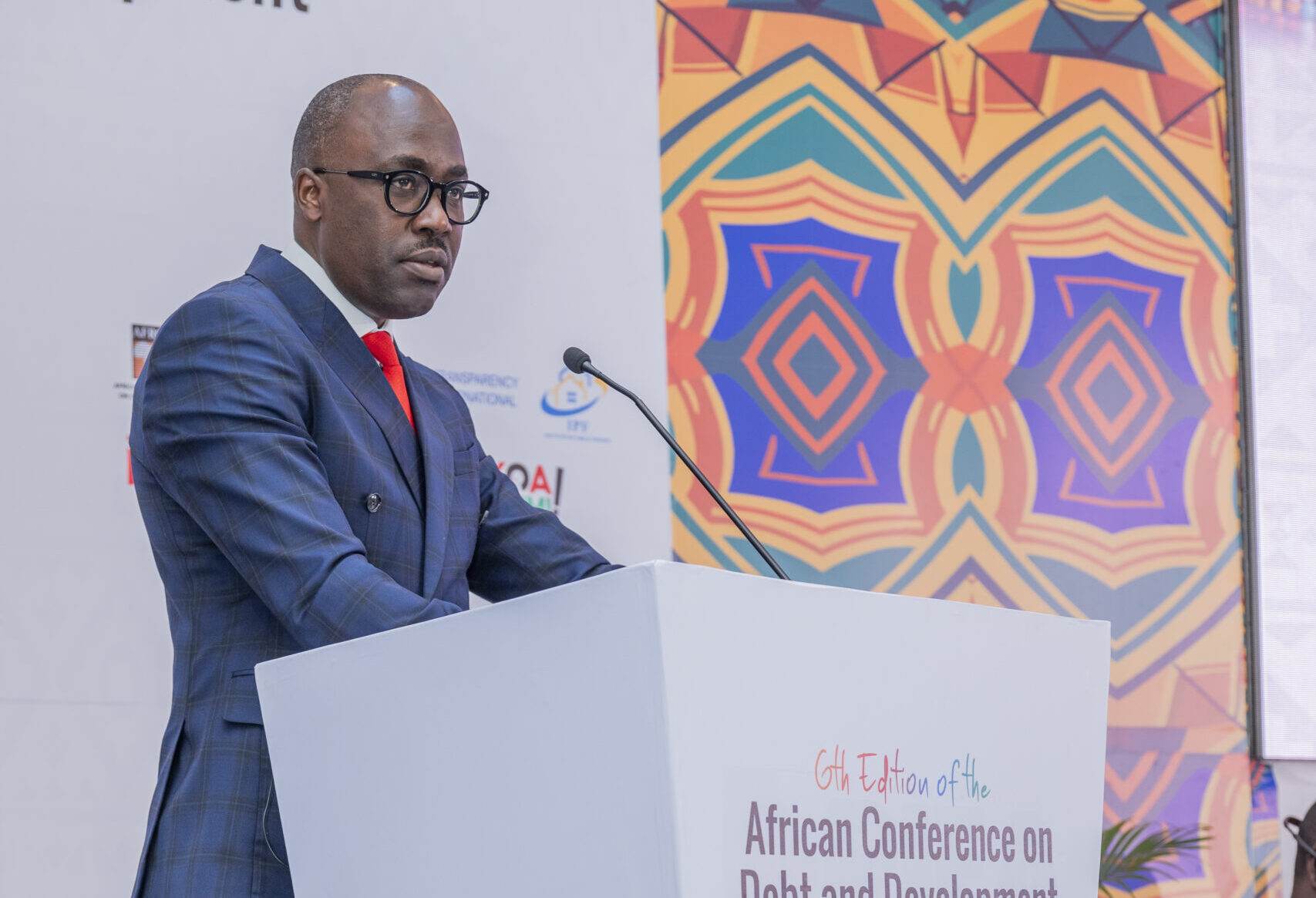
African countries spend around $90 billion each year to pay off debt. They also pay an extra $75 billion in high interest due to the risk involved in borrowing. This was said by Kenya’s Principal Secretary for Foreign Affairs, Korir Sing’oei.
Mr Sing’oei mentioned that this situation forces African governments to choose between paying off debt and spending on health, education, and climate projects. He added that Africa needs about $1.3 trillion yearly to meet the Sustainable Development Goals.
He spoke on Friday in Nairobi, Kenya, during the closing event of the sixth African Conference on Debt and Development (AfCoDD VI). This event was organized by the African Forum and Network on Debt and Development (AFRODAD).
“Africa pays $90 billion a year in debt service. That is more than aid and climate finance combined,” Mr Sing’oei stated.
He explained that the continent’s debt issues are not just because of missed payments. He argued that African nations usually default less than people think. Instead, they pay more due to the added risk premium on loans.
He called the extra $75 billion in interest a “trust tax.” He said, “This Africa risk premium forces an unpleasant choice between servicing expensive debt and investing in the health, education and climate resilience of our people.”
The pressure is also seen in Nigeria. The government reported that it will have to pay N10.61 trillion in extra debt-related costs from June 2023 to December 2025. This amount is N4.14 trillion more than the N6.47 trillion spent on key infrastructure during that time, according to the Ministry of Finance.
Most of the additional cost, N9.37 trillion, was due to the naira losing value and affecting external debt payment. Higher interest rates added N1.24 trillion to the cost of domestic debt.
These extra costs account for about 34.6 percent of the government’s N30.64 trillion spending during this period. In contrast, strategic infrastructure accounted for just 21.1 percent.
Nigeria’s situation shows the larger problem Mr Sing’oei highlighted: while governments can get financing, changes in exchange and interest rates can make repayments much higher.
Nigeria’s Finance Minister and Coordinating Minister of the Economy, Taiwo Oyedele, said the economic reforms that led to these costs have placed a heavy burden on the country.
The government linked the rise in external debt costs mainly to the naira’s depreciation due to foreign exchange reforms. Also, higher policy rates made domestic borrowing more expensive.
Mr Sing’oei mentioned that the cost of borrowing has become a key issue for Africa's foreign policy. He said it should not only be the concern of finance ministries.
“In the 1960s, foreign policy on the continent was about political independence and political sovereignty,” he said. “In the 1990s, it shifted to aid, when Africa was asking for more support.”
“Today, I submit, the central theme of foreign policy for Africa is the cost of capital.” He noted that Africa’s financial needs are too large for foreign policy bodies to stay out of discussions about loans and financial instruments.
He explained that many foreign policy officials lack the knowledge of complex financial issues. On the other hand, finance officials may not fully understand the politics behind international loans. This gap can lead African countries to negotiate financing deals that are not in their favor.
The type of creditors Africa has also changed a lot. Mr Sing’oei said that in the 1990s, about 70 percent of Africa’s debt was owed to Paris Club creditors. Now, about 40 percent is held by private investors in places like London, Hong Kong, and the Gulf states.
This shift has made debt negotiations harder. He mentioned Zambia, where restructuring took four years due to disagreements between China and the Paris Club.
Kenya’s Eurobond talks also involved traders from Paris, London, New York, and other cities. “This is not just a loss of finance; it is also a loss of sovereignty,” Mr Sing’oei said.
He pointed out that some loans come with strict conditions, like collateral and mineral agreements. Defaulting can lead to lower credit ratings and limited access to additional funds.
The high cost of loans also makes it harder for Africa to tackle climate change. Mr Sing’oei noted that Africa holds about 60 percent of the world's best solar resources, yet only gets about one percent of green finance.
“We cannot build green industrialization when we are borrowing at 12 percent in dollars,” he explained. “We are borrowing expensive money to solve a climate crisis we did not cause.”
He said debt should be part of Africa’s climate discussions at forums like the African Union, the European Union, the G20, and climate negotiations.
Mr Sing’oei mentioned that African governments are already looking for ways to reduce their reliance on costly loans. One approach is a united front in debt talks.
He noted that the African Common Position on Debt, adopted this year in Lomé, Togo, should help countries negotiate together instead of separately.
“It means not 54 solo negotiators on the part of each African country, but a collectivized negotiation,” he said. He also supported the idea of a Debtors Club, which aims to strengthen the position of developing nations in financial discussions.
He emphasized that governments should partner with civil society organizations for research and negotiation strategies.
Another plan is the African Credit Rating Agency, set to launch in Mauritius in October. Mr Sing’oei said this agency will help African nations assess their own risks and challenge high borrowing costs.
“African leaders have been establishing the African Credit Rating Agency, which we launch in Mauritius in October,” he noted. He stressed that the goal is not to stop borrowing altogether.
Africa needs both loans and investment to grow, but loans should come with fair terms and, when possible, through concessional financing.
Mr Sing’oei called for better cooperation among African financial institutions. He mentioned the African Development Bank, Afreximbank, and the Trade and Development Bank, which have mainly operated separately but are now joining forces.
He encouraged the use of debt-for-food and debt-for-climate swaps but warned that climate finance should not be another way to undermine African sovereignty.
His last suggestion was to reform the G20 Common Framework for debt treatment. He said this framework should act faster when countries start having debt issues instead of waiting until things get critical.
He welcomed the African Union’s upcoming participation in the G20, saying it would give Africa a stronger voice in global financial discussions.
Mr Sing’oei said Africa aims to cut its borrowing premium by about 200 basis points over the next three to four years. He estimated that this could save African countries around $20 billion each year.
“That $20 billion is enough to fund the African Union’s Agenda 2063 infrastructure agenda,” he stressed.
Drop your comment
No comments yet — be the first to drop the gist 👇