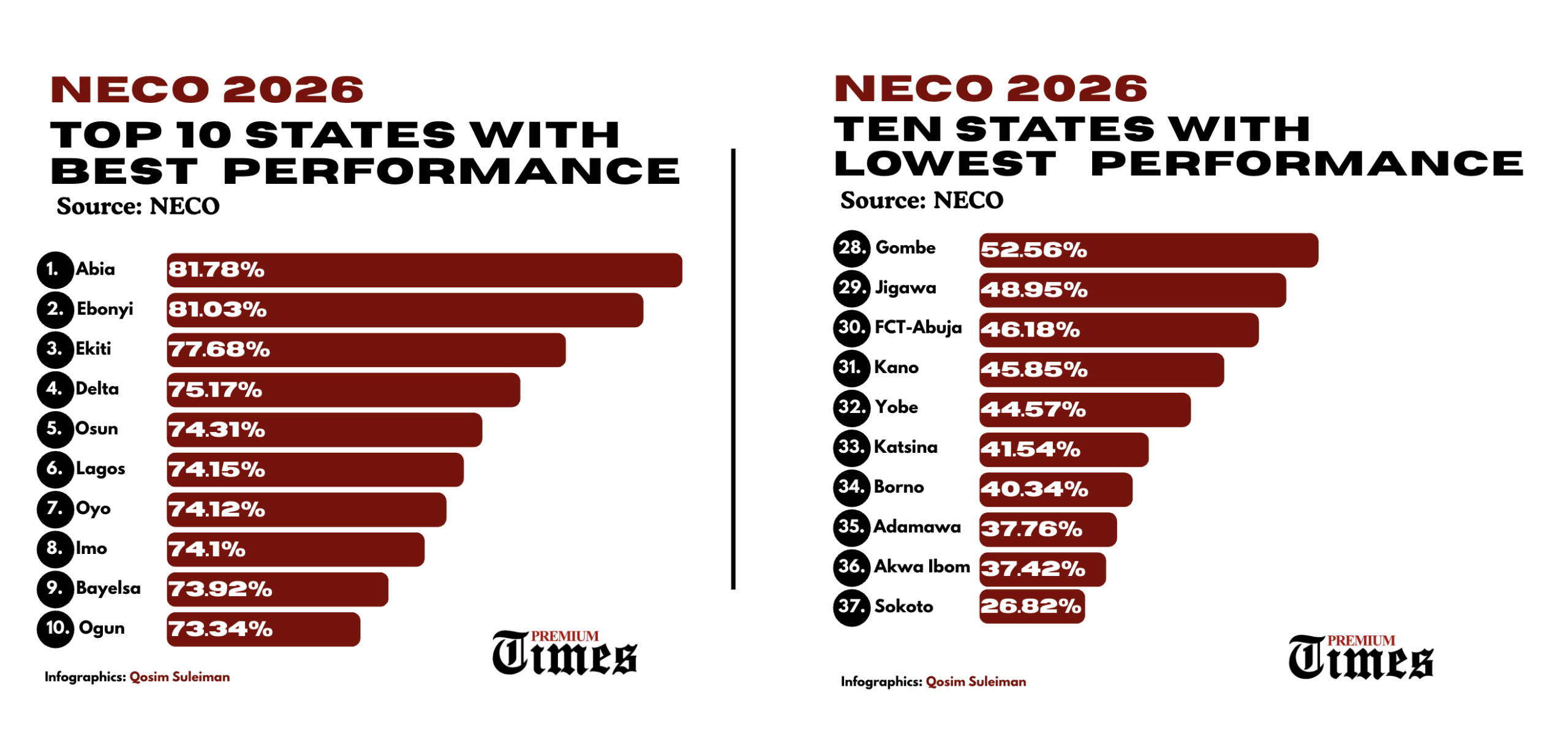
Akwa Ibom State has faced one of its worst results in the National Examinations Council (NECO) Senior School Certificate Examination. The state ranked 36th among Nigeria’s 36 states and the Federal Capital Territory, with only 37.42 per cent of candidates getting at least five credits, including English Language and Mathematics.
The 2026 NECO data obtained by PREMIUM TIMES shows that 7,754 out of 20,720 candidates from Akwa Ibom met the required benchmark. Sokoto State performed the worst, with only 26.82 per cent of its candidates meeting the same standard.
This result is a big drop from the state’s past performances. In 2025, Akwa Ibom ranked 12th nationally, with 13,090 out of 19,513 candidates achieving the five-credit requirement, which was 67.08 per cent. In 2024, the state had 67.32 per cent, placing it 18th in the country. The current 2026 result shows a decline of nearly 30 percentage points from 2025.
Akwa Ibom's 2026 performance makes it the only Southern Nigerian state in the bottom 10. Rivers State was next, ranking 22nd with 56.38 per cent, and Enugu came 25th with 54.52 per cent.
South-east and South-south Lead the Rankings
The 2026 results show clear regional differences. Abia State held the top spot nationally for the second year, with 81.78 per cent of its candidates meeting the five-credit benchmark. Ebonyi followed closely with 81.03 per cent. Delta State ranked fourth nationally with 75.17 per cent. Imo was eighth with 74.10 per cent, while Bayelsa was ninth with 73.92 per cent.
In total, five states from the South-east and South-south made it into the top nine nationally. Other states from these regions did significantly better than Akwa Ibom. Edo ranked 11th with 71.18 per cent, Anambra was 12th with 69.70 per cent, and Cross River was 18th with 62.18 per cent.
Abia’s consistent performance is impressive. The state has kept the first position in the NECO ranking since 2024, when it recorded 83.40 per cent, while Akwa Ibom achieved 67.32 per cent.
Funding Concerns
The sharp decline in Akwa Ibom's performance is surprising given the state has a lot of public resources to support education. PREMIUM TIMES reported in July that Governor Umo Eno’s administration collected at least N2.934 trillion in revenue in its first 38 months.
The analysis of the state’s finances found that detailed spending information was missing from public documents. This makes it hard to see how the revenue was used, especially in education. The government claimed it set aside funds for examination-related expenses. In July, it announced N1.968 billion for exam fees for students in public schools.
But just paying exam fees does not solve issues in teaching and learning that affect student readiness for exams. PREMIUM TIMES reported that Governor Eno’s 2026 budget allocated N94.41 billion to education from a total budget of N1.158 trillion, which is just 8.15 per cent.
This education budget is less than those of several southern states that did much better in the 2026 NECO. Delta, which ranked fourth, allocated 11.98 per cent of its 2026 budget to education. Abia and Ebonyi, the top two states in the NECO ranking, set aside 19.93 per cent and 19.86 per cent respectively for education.
Issues in Akwa Ibom’s Education System
A review of the education roadmap in Akwa Ibom revealed serious problems in the education system. These include not enough teachers, a student-teacher ratio of 120:1, poorly trained teachers, and insufficient teaching materials. The plan recommended hiring and training 2,000 secondary school teachers and 3,000 primary school teachers in eight months starting from November 2020.
The long-term goal was to bring the student-teacher ratio down to 40:1 by 2030. The roadmap highlighted the importance of teacher quality and support as key areas needing attention. The 2026 NECO results now serve as a benchmark to see how well these recommendations were put into practice.
Government Silence on the Issue
PREMIUM TIMES reached out to the Commissioner for Education, Ubong Umoh, for comments on the state’s poor performance. The questions included what caused the results, whether the ministry had seen any learning challenges before the exams, and if there was an assessment of the decline.
The ministry was asked about teacher shortages in subjects like English Language and Mathematics, as well as spending on teacher recruitment and school resources. Mr Umoh did not answer calls or the media inquiry before this report was published.
This silence raises questions about whether the sharp drop in performance is just a one-time issue or a sign of deeper problems in Akwa Ibom’s secondary education system. The difference between the 2025 and 2026 results is alarming: from 67.08 per cent and 12th place to 37.42 per cent and 36th place in just one year. Now, there is a renewed focus on whether the state's education policies and budgets are leading to real improvements in learning.


Drop your comment
No comments yet — be the first to drop the gist 👇