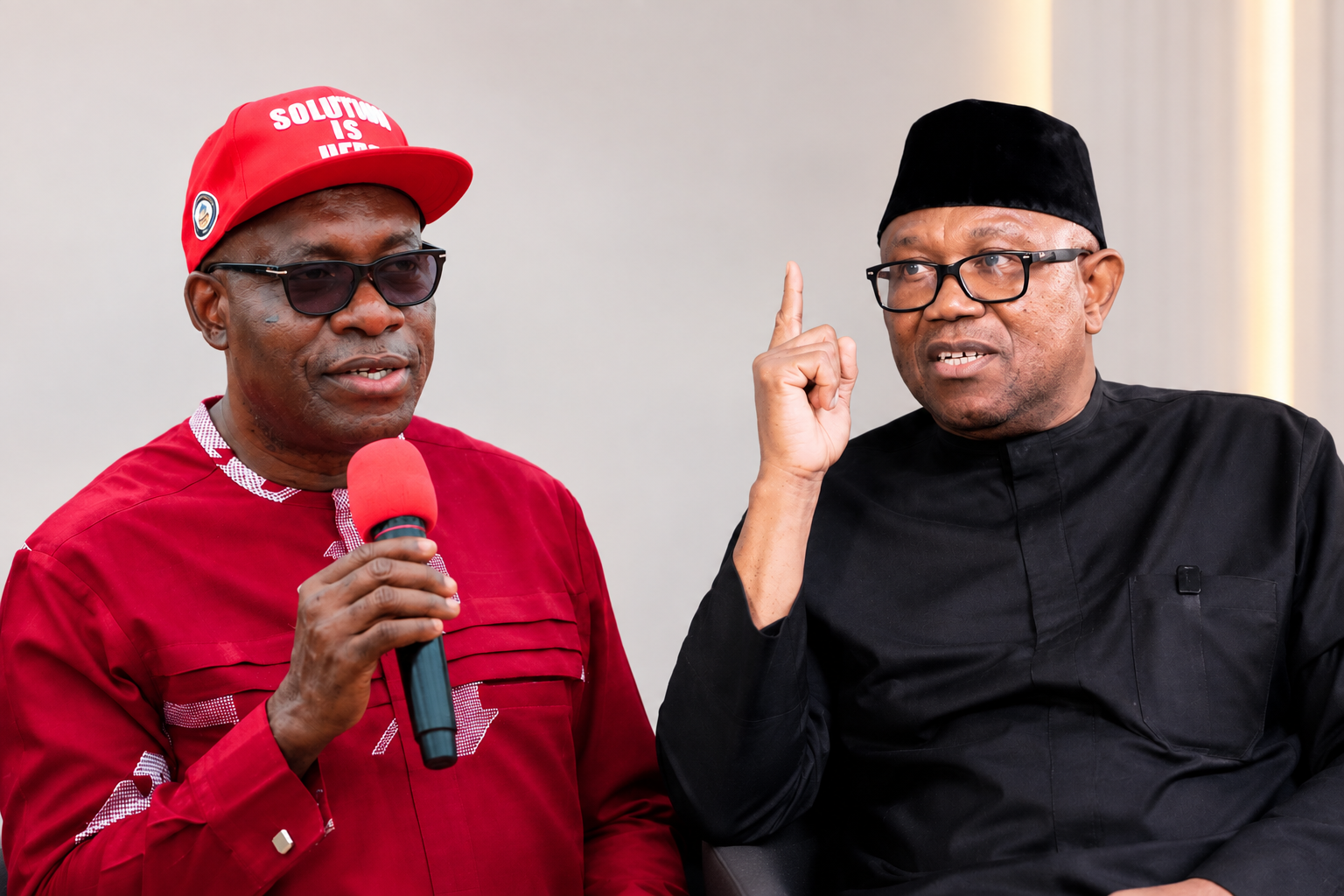
Records from the Debt Management Office (DMO) show that Anambra State's external debt increased a lot during Peter Obi's time as governor. But these figures are much lower than the $123.77 million that the current state government claims were borrowed during his administration.
The DMO data shows that Anambra's external debt was $16.87 million in December 2006. This was the same year Mr Obi came back to office after winning a court case against his impeachment by the Anambra State House of Assembly.
By December 2013, just before Mr Obi left office on March 17, 2014, the state's external debt rose to $30.32 million. This is an increase of about 80 percent during his time as governor.
These figures are important in the ongoing argument between Mr Obi, who plans to run for president in 2027 under the Nigeria Democratic Congress, and the Anambra State Government led by Charles Soludo. They are discussing the financial issues that new administrations face after taking over.
PREMIUM TIMES reported that Mr Obi has often said he left office without owing anyone money. This includes salaries, pensions, and payments to contractors for jobs that were completed and approved.
But the Anambra State Government claims that Mr Obi's administration left eight external loans that the following governments are still paying off.
What the DMO Records Show
According to DMO debt records analyzed by PREMIUM TIMES, Anambra's external debt was $16,869,393 in December 2006.
The debt dropped to $15,192,742 in December 2007 but rose again to $18,892,185 in December 2008. It was at $17,313,839 in December 2009.
Starting in 2010, the DMO began giving updates on external debt every six months.
The state recorded $17,903,645 in June 2010 and $21,304,916 by December of that same year.
The debt further increased to $23,722,253 in June 2011 and $24,446,469 by December 2011.
It grew to $25,370,842 in June 2012 and $26,708,648 by December.
By June 2013, Anambra's external debt had reached $27,312,541, and by December 2013, it was $30,323,574.
The December 2013 figure put Anambra 31st among the 36 states and the Federal Capital Territory in terms of external debt, making it the sixth-lowest in the country at that time.
The next DMO report for June 2014, after Mr Obi left office, showed Anambra's external debt at $41,459,335.
The increase from December 2013 to June 2014 happened after Mr Obi's time as governor and cannot be blamed on his administration alone.
The DMO's December 2013 figure matches what the agency published in its debt records.
However, there is no record from the DMO as of March 2014 when Mr Obi left office as governor of Anambra. This makes it hard to know the exact amount of the state's external debt on March 17, 2014, when he handed over to Willie Obiano.
Domestic Debt Also Fluctuated
The DMO started publishing domestic debt records for states from December 2011.
Anambra's domestic debt was N6.4 billion in December 2011 and rose to N14.3 billion in December 2012.
But the revised DMO figure for 2013 showed the state's domestic debt was N3.026 billion as of December that year.
This means Anambra's external debt went up during this time, but its domestic debt was much lower by the end of 2013 compared to a year earlier.
Peter Obi's Admission
Meanwhile, Mr Obi confirmed the DMO's figures during an interview on Arise News’ Prime Time on Thursday night.
His numbers are a bit different, especially about the external debt he took over, but they were for different periods than those in the DMO records.
"So at the time I assumed the office of the state (as governor), our foreign debts recorded was about $18 million.
“At the time I left office in March 2014, our foreign debt position was about $30 million," he said.
Mr Obi's mention of "about $30 million" means he agrees it was close to that amount.
The DMO's records did not show Anambra's exact external debts as of March 2014 when Mr Obi left office.
So, his claims can't be completely challenged, even if his numbers closely match the DMO's $30.32 million figure.
Also, Mr Obi's claim of inheriting "about $18 million" from the previous government before him is not verifiable.
This is because the DMO's records of external debt for Anambra as of March 17, 2006, when he became governor, are unavailable.
The December 2013 DMO record on the state’s external debts was released about three months before Mr Obi's administration ended.
Obi's Handover Letter and Obiano's Later Admission of Inherited Funds
PREMIUM TIMES looked at a copy of the handover letter Mr Obi gave to Mr Obiano, who left office in 2022 after two terms before handing over to Mr Soludo.
This letter has been shared online since Mr Obi left office.
The letter, called “2014 Anambra State Handover Report,” was dated March 17, 2014, the last day of Mr Obi's time as governor.
“As Friday 14 March, 2014 was the final working day of my Administration, I also forward herewith, the summary of the full financial statement of Anambra State (copies of which are herein attached) as at close of business on that day," Mr Obi wrote in the letter.
In the letter, he said N27 billion was allocated for local investment while N25.6 billion was for foreign currency investment, which is about $156 million.
He also noted N28.27 billion was for the certified state/ministries, departments, and agencies of the government while N10 billion was funds returned to the state by the federal government.
These figures added up to N91.67 billion in total assets and balances in the state's account at that time.
But Mr Obi said he set aside N5 billion out of the N91.67 billion for paying estimated liabilities.
He said these liabilities included salaries, pensions, and gratuities for March 2014 and approved payments for completed projects.
After deducting the N5 billion for liabilities, the total left in the state’s account came to N86.67 billion.
PREMIUM TIMES reports that Mr Obiano's acknowledgment of the handover letter does not mean he confirmed the funds were available. This is because Mr Obiano's government did not publicly confirm the financial records at that time.
The state’s financial records as presented by Mr Obi's administration were not checked by both the outgoing and incoming governments together.
But while on a Channels TV programme before the 2017 governorship election, Mr Obiano seemed to confirm some details in the handover letter.
“My predecessor (Mr Obi) left N9 billion in cash and N25.6 billion in script issues, these are sovereign wealth funds and shares in other banks," he said when asked about what he found when he took over.
He added: “If you put N9 billion to that (N25.6 billion), you get N35.5 billion, but he issued cheques worth over N15 billion before he left.”
Mr Obiano's comments suggest Mr Obi left over N50.5 billion in the state's treasury.
Government Identifies Eight Loan Facilities
The Anambra Government has stated that the DMO figures do not fully show the loan obligations from Mr Obi's time as governor.
It identified eight external loans taken from 2007 to 2013, worth a total of $123.77 million.
These loans were for projects in areas like malaria control, agriculture, healthcare, education, community development, and erosion control.
The government said $92.35 million was still owed as of June 30, 2026.
Commissioner Responds to PREMIUM TIMES
PREMIUM TIMES asked the Anambra State Government to explain the difference between its $123.77 million in loans and the DMO’s $30.32 million external debt as of December 2013.
The newspaper also wanted to know how much of the loans had been used and recognized as Anambra’s debt by March 17, 2014, and the remaining balance on each loan at that time.
In response, the Commissioner for Information and Value Reorientation, Law Mefor, said Mr Obi signed the eight World Bank loans, committing the state to them.
“He signed up the eight World Bank loans thereby committing Anambra to those loans. The state is now being charged for servicing those loans,” Mr Mefor said.
He added that Mr Obi “used some of the loans” but did not pay any of the amounts taken before leaving office.
Mr Mefor stated the government's concern was not about borrowing for development, but about Mr Obi saying he left no loan burdens behind.
“Nobody is against taking loans or the importance of the loans Obi took. The issue is Mr Obi saying he didn’t pass down loan liabilities,” he said.
The commissioner also claimed DMO records showed Mr Obi left over N2 billion in domestic loan debts, and that these loans were not mentioned in his handover notes.
He said the government wants the records clarified so future administrations are not blamed for paying loans that Mr Obi claims did not exist.
Mr Mefor directed PREMIUM TIMES to the Commissioner for Finance, Izuchukwu Okafor, for more details.
When contacted, Mr Okafor declined to speak on the issue.
Obi Rejects Government's Account
PREMIUM TIMES reported that Mr Obi disagreed with the government’s claim that he left Anambra with the loan debts it mentioned.
He insisted that he did not borrow money or issue bonds for the state while in office and has challenged the government to prove its claims.
The former governor also questioned the $123.77 million figure, pointing out DMO records that show Anambra's total external debt was $30.32 million at the end of 2013.
He argued that the development funds mentioned by the government involved the federal government and international agencies and should not be seen as money he personally borrowed and left unpaid.
The DMO records indicated Anambra had $30.32 million in external debt at the end of 2013 and N3.03 billion in domestic debt according to revised figures for that period.
The government’s story links eight external loan facilities worth $123.77 million to Mr Obi's administration.
But the government’s response to PREMIUM TIMES shows that only some of those loans were used during Mr Obi's time.
This raises the key question: what was the actual amount disbursed and owed by Anambra on each loan as of March 17, 2014, when Mr Obi handed over?
Finding the answer would need the relevant loan agreements, disbursement records, and balances at the time of handover to match the government's claims with the DMO's debt figures.
Peter Obi's Argument
Mr Obi has denied taking any loans while in office. He explained that the eight loans mentioned by the government were “concessionary development-support funds” that the federal government secured for states to meet specific needs.
The former governor then argued that even if the $123.7 million debt was correct, his over $150 million savings or the $10 million income from those savings each year is enough to cover the debts.
Drop your comment
No comments yet — be the first to drop the gist 👇