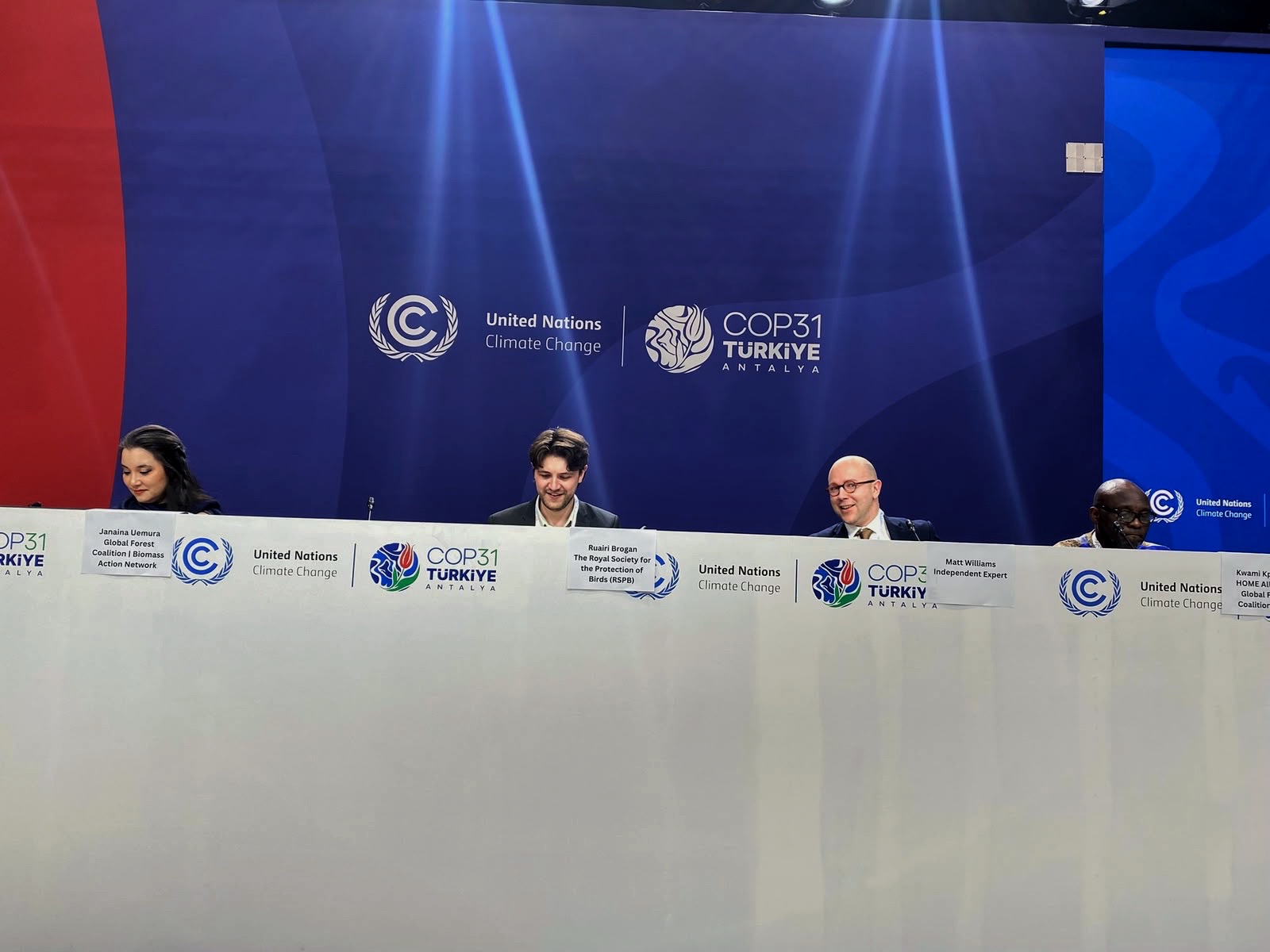
At least six billion tonnes of carbon dioxide from burning wood and other biomass for energy have been recorded as zero in countries' energy accounts since 1990. This is according to a report by the Royal Society for the Protection of Birds (RSPB) released at the UN climate summit in Antalya, Turkey.
RSPB, a British charity focused on conservation, shared its findings on Monday. The amount of emissions is roughly equal to what the United States produces annually.
Bioenergy is energy produced from organic materials like trees, crops, and food waste, according to the RSPB.
Matt Williams, an independent energy analyst, carried out the analysis. He told people at a press conference that he looked at the greenhouse gas reports countries have sent to the UN since 1990. Some countries did not report every year. Others left parts of their reports blank.
"And because of missing data, this is probably an underestimate," Mr Williams said.
The gap comes from guidance from the Intergovernmental Panel on Climate Change. This guidance assigns the carbon from cut wood to the forest sector of the country where the trees are cut. The country that burns the wood often records the emissions in its energy sector as zero. It usually does not have information on whether the trees are replaced.
This guidance dates back to the 1990s when most biomass was burned in the country that grew it. Mr Williams noted that wood pellets are now traded globally. Five major economies have spent nearly $250 billion on subsidies for bioenergy from 2002 to 2024, according to research by the Environmental Paper Network.
Ruairi Brogan, a senior policy officer at the RSPB, said the charity wants the panel to change its guidelines so that emissions are counted where biomass is burned.
"It’s not just fossil fuels that have to go at this COP," Mr Brogan said.
The current accounting treats wood burned in poorer countries differently. Janaina Uemura of the Global Forest Coalition, which held the press conference with the RSPB, explained that household fuelwood in those countries is counted as emissions that can become carbon credits. In contrast, wood burned in power stations in richer countries is counted as zero.
A carbon credit represents one tonne of emissions avoided. A buyer can count it against its own emissions. In March, Nigeria authorized the stove maker BURN to sell 5.2 million such credits internationally. UpEnergy, a Uganda-based developer, also received approval for nearly four million credits.
According to the National Clean Cooking Policy, 62 percent of Nigerian households cook with wood. Wood fuel is the top cause of forest degradation in Nigeria. The country burns about 34.7 million tonnes more wood each year than its forests can sustainably give, based on a World Bank study from last year.
The organizers also criticized technologies that capture or remove carbon dioxide. Kwami Kpondzo, from the Global Forest Coalition and HOME Alliance in Togo, said removal methods that rely on biomass would take land from communities in developing countries.
"The only way to cut the emissions is to do it at the source," Mr Kpondzo said.
A record 700 carbon capture lobbyists registered for COP31. This is more than the 699 delegates in the 50 smallest national delegations combined, as stated by the Centre for International Environmental Law on Monday.
Nigeria's long-term low-emission strategy focuses on gas power plants with carbon capture and storage, according to Climate Action Tracker.
Both carbon removal and bioenergy are issues in the first draft of the summit's main decision, released on Monday. Two paragraphs make room for carbon removal technologies. A third paragraph promotes Turkey's goal of 35 percent electrification by 2035 "regardless of the electricity mix," according to campaign group 350.org.
The RSPB wants bioenergy excluded from that target before ministers adopt the decision on Friday, 20 November.
"Big bioenergy is a dangerous distraction. Now leaders must listen," Mr Brogan said.
Drop your comment
No comments yet — be the first to drop the gist 👇