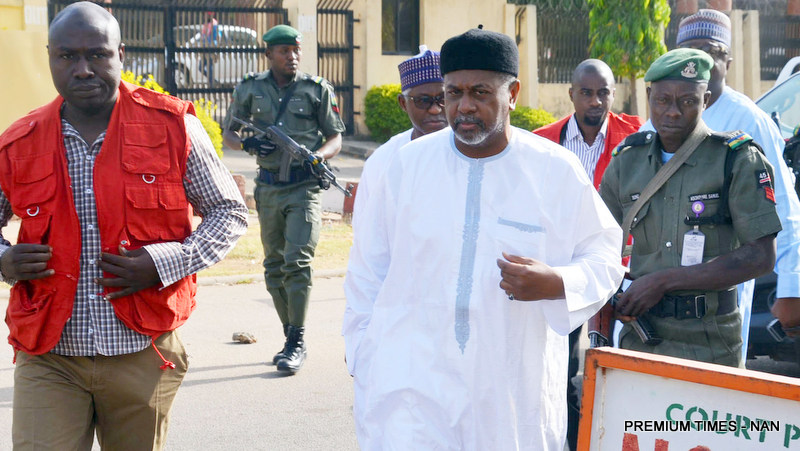
The Federal Capital Territory High Court in Maitama, Abuja, on Friday rejected important evidence that the Economic and Financial Crimes Commission (EFCC) presented. This evidence was meant to support its N33.2 billion fraud charges against former National Security Adviser Sambo Dasuki and his co-defendant.
The court rejected seven extra-judicial statements that were linked to Mr Dasuki’s co-defendant, Aminu Baba-Kusa. The EFCC had taken these statements when Mr Baba-Kusa was in custody in 2015.
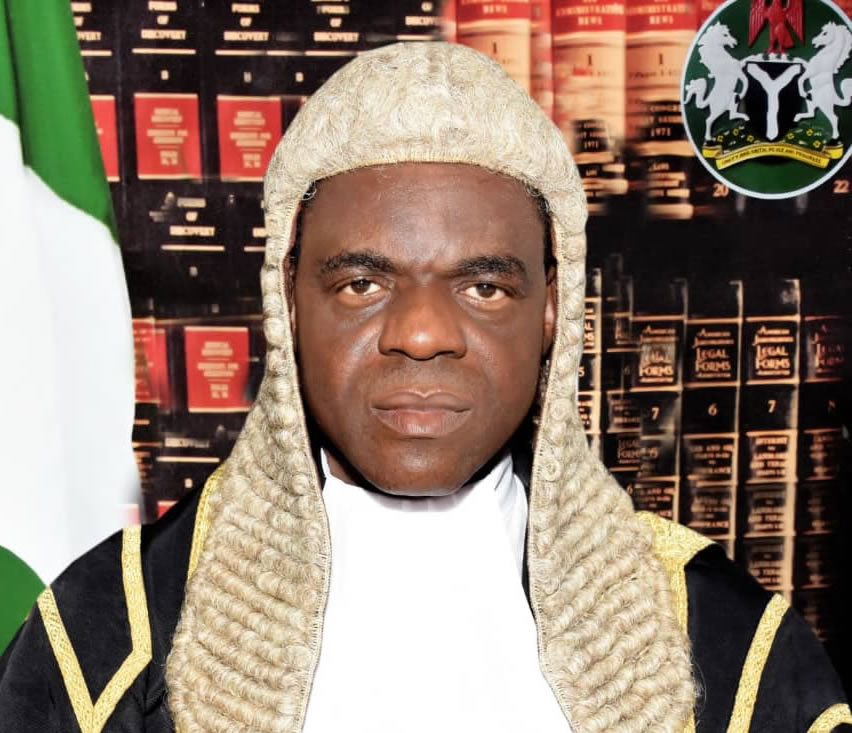
Trial judge Charles Agbaza turned down the statements in a ruling after nearly eight months of a trial-within-trial. This trial focused on whether the statements could be accepted as evidence.
Mr Agbaza ruled that the statements “failed to comply with Sections 15(4) and 17(2) of the Administration of Criminal Justice Act.” It is not clear how important these rejected statements are to the prosecution’s case.
The judge stated that the EFCC did not provide “credible evidence that the seven statements complied with the provisions of the ACJA.” Mr Baba-Kusa is a businessman and retired Group Executive Director at the Nigerian National Petroleum Corporation.
Mr Dasuki and Mr Baba-Kusa are facing joint trial for allegedly diverting N33.2 billion meant for arms and security funds that were under the NSA office.
The EFCC is also prosecuting Mr Baba-Kusa’s companies, Acacia Holdings Limited and Reliance Referral Hospital Limited. These companies allegedly received part of the funds from the Office of the National Security Adviser under Mr Dasuki’s watch.
This trial has been going on for over a decade and has faced many delays and adjournments that have slowed it down.
The EFCC had to re-arraign the defendants in March last year after the case was assigned to the current trial judge, Mr Agbaza. This meant starting the trial again after about 10 years of complicated proceedings.
They denied the charges again, just as they had done before the previous judge. The main trial paused again on 14 January when the EFCC attempted to present Mr Baba-Kusa’s statements as evidence through its first witness.
The judge ordered a trial-within-trial to investigate Mr Baba-Kusa’s claim. This sub-trial began on 24 February. Mr Baba-Kusa’s lawyer argued that the statements were obtained under duress, leading the judge to initiate the trial-within-trial to determine if the statements were given freely.
The defense said that a statement taken while someone is in an underground cell cannot be considered voluntary. They also pointed out there was no compliance with Section 15(4) and 17(2) of the ACJA.
The EFCC called three witnesses during the trial-within-trial. All were EFCC investigators who spoke about how Mr Baba-Kusa’s statements were obtained. Salihu Kadir stated that Mr Baba-Kusa wrote his statements voluntarily and was not coerced.
Mr Kadir mentioned there was a CCTV recording, but he asked the court to remember that it was done about 10 years ago and was not required by law.
On 24 February, Halima Kazeem, an assistant commandant at the EFCC, said Mr Baba-Kusa was treated well while in custody in 2015. Similarly, Michael Adariku, an assistant commander at the EFCC, denied that Mr Baba-Kusa was kept in an underground cell during the investigations.
When Mr Baba-Kusa testified in June as the sole defense witness, he confirmed that he wrote the statement and that cautionary words were given to him before he wrote them. But on Friday, the judge ruled against accepting the statements because there was no audio-visual recording.
The judge explained that the purpose of audio-visual recording is for the court to assess the circumstances during the taking of the statements, whether they were given freely or under pressure from the prosecution.
EFCC’s lawyer Oluwaleke Atolagbe requested a copy of the ruling to study it. He wants to decide the next steps for the prosecution, which may include an appeal.
After this, the judge adjourned the case until 13 November. In the main trial, the EFCC has called one witness, Mr Adarikun. He testified about how N2.2 billion meant for election security was allegedly diverted from the NSA office under Mr Dasuki’s leadership.
So far, he has talked about transfers from the NSA’s account, approved by Mr Dasuki, to Mr Baba-Kusa. Mr Baba-Kusa allegedly used this money to buy properties and foreign currencies.
This long-running trial has faced many adjournments in its early years, mainly because the State Security Services refused to release Mr Dasuki on bail despite several court orders.
Mr Dasuki was the NSA from 2012 to 2015 during a time of serious Boko Haram attacks in Nigeria’s North-east under former President Goodluck Jonathan.
The N33.2 billion fraud trial is one of several cases filed by the EFCC after funds meant for arms procurement were allegedly mismanaged. An audit panel set up by President Muhammadu Buhari found that around $2 billion was unaccounted for. These funds were under Mr Dasuki’s management.
Mr Dasuki is also on trial with former Sokoto State Governor Attahiru Bafarawa, his son Sagir Bafarawa, former Minister of State for Finance Bashir Yuguda, and Dalhatu Investment Limited for N4.6 billion arms procurement fraud. They are accused of diverting N4.6 billion from the NSA’s account, which was meant for arms procurement to fight Boko Haram.

Drop your comment
No comments yet — be the first to drop the gist 👇