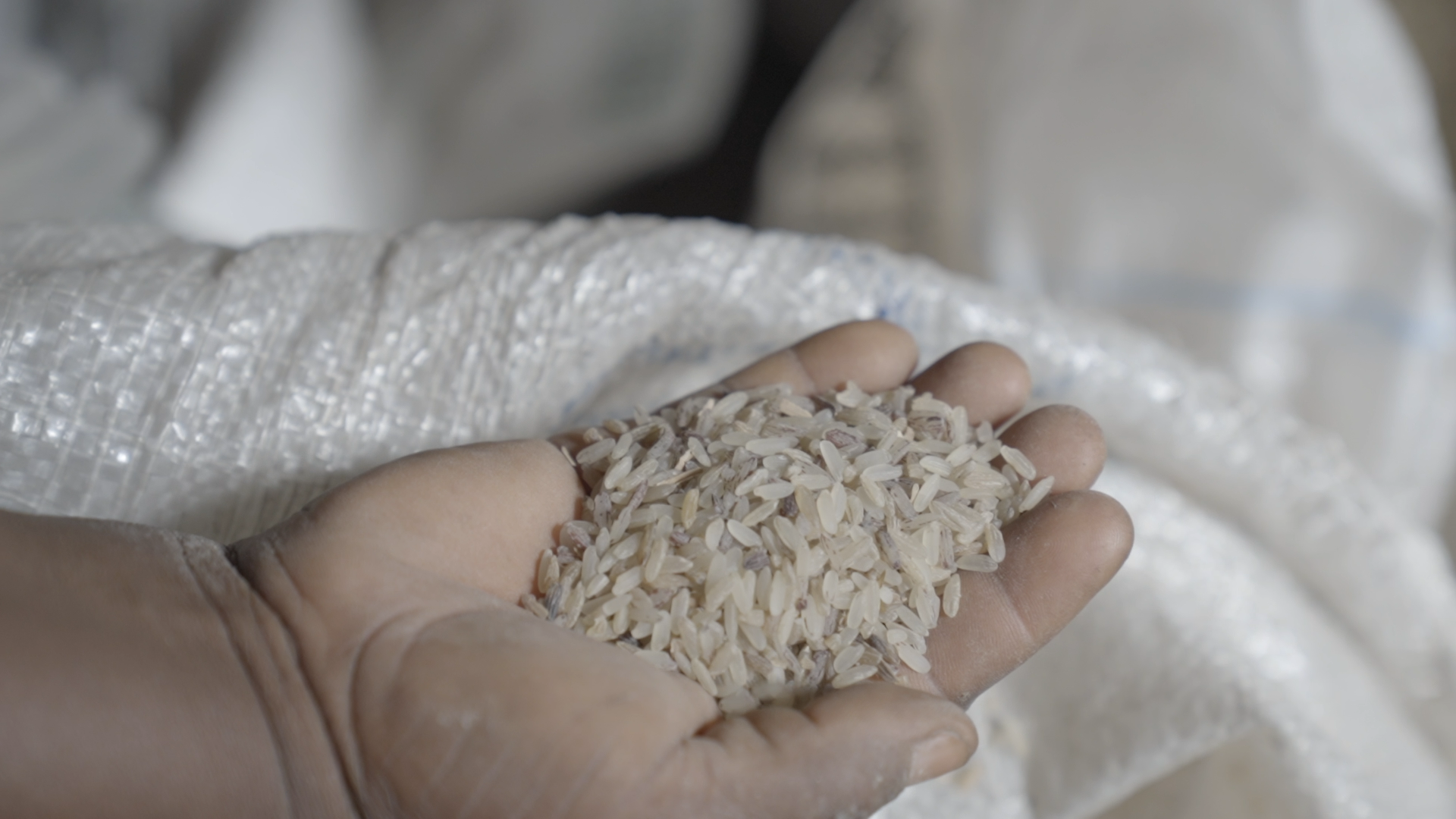
In 2024, Abu Ibrahim raised one million naira for rice farming in the Orun-Igbemo community of Ekiti State, Nigeria. This area is known for its Ofada rice, also called Igbemo rice.
Ofada rice is an upland variety grown on dry soils. Farmers depend on rainfall for its growth. This farming method is common in South-West Nigeria, especially among the people of Orun and Igbemo.
"I planted two hectares. We expected rain in April, but it didn’t come until the following month. Then it rained once and stopped for over 15 days," the 28-year-old Mr Ibrahim recalled. "The rice spoiled under the ground, and there was nothing to harvest."
In May, PREMIUM TIMES visited several rice farms in Igbemo, Aisegba, Ijan, and Orun. Many farmers said long dry spells, heavy rains, and floods hurt their crops in the 2023, 2024, and 2025 farming seasons.
"Many people did not farm rice this year because of what happened last year. And what happened has started happening this year again," said Isiaka Tajudeen, another rice farmer, pointing to another delay in rain.
Ekiti is second only to Ogun State in producing Ofada rice in Nigeria. Farmers across 10 local government areas grow upland or swamp rice, also known as lowland rice.
Upland farming depends on rain.
"We usually clear the bush from December to March. Between the end of March and April, we spray chemicals and start planting," Mr Tajudeen explained the traditional farming cycle.
But this pattern has changed. Farmers now wait to plant until the rains start, mostly in May or June. This year, the rains began in May.
"Those who planted earlier have faced losses; birds ate their seeds, and that is due to the lack of rain," Mr Tajudeen said.
The ongoing dry spell has created a cycle of lower yields for farmers. They remembered that over ten years ago, rains came regularly in February or March and lasted longer. Back then, they had abundant harvests. A hectare produced 11 to 13 bags of rice, while two hectares gave 20 to 25 bags, one farmer recalled.
Mr Tajudeen said he planted two hectares last year but harvested "only eight bags." He noted that many of his peers also did not harvest much.
"This year, I planted with faith in God because this is the only means I have to care for my wife and four children," he added.
Tunde Adeyemi, chairperson of the Rice Farmers Association of Nigeria (RIFAN) in Ekiti State and national youth leader of Farmers in Nigeria, backed Mr Tajudeen's claims.
"I used to cultivate 60 to 70 hectares, but I have cut down to seven or eight hectares," Mr Adeyemi said.
He explained that he used to spend N150,000 to cultivate a hectare, but now he needs N600,000 to N700,000. A hectare yields about two-and-a-half to three tonnes, with a tonne selling for N120,000 to N130,000. "Do the math," he said. "I had to start growing other crops just to feed my family."
During the visits, PREMIUM TIMES noticed many farms shifting toward maize and cassava cultivation, a trend seen in academic studies.
"I planted over two hectares of maize, keeping just one hectare for rice," Mr Ibrahim told PREMIUM TIMES at his farm.
Farmers like Messrs Ibrahim and Adeyemi are feeling the effects of climate change, but government policies meant to help them seem disconnected from their realities.
In 2025, the Ekiti State Government announced it insured 10,000 farmers as part of its Area Yield Insurance Cover scheme.
Ebenezer Boluwade, the state’s Commissioner for Agriculture and Food Security, said the scheme was created to protect farmers from unforeseen risks and climate-related problems after the losses they faced in previous years.
The scheme is under an insurance policy with Leadway Insurance and PULA Advisors.
It is part of the wider national "Africa 10 Million Climate-Resilient Farmers Initiative," managed by the Vice President's Office and the Presidential Food Systems Coordinating Unit (PFSCU).
The Ekiti State Government claimed to have financed 50 percent of the project.
But farmers in the areas visited told PREMIUM TIMES they had never heard of this scheme.
The RIFAN chairman was also unaware of it.
"I have never heard of such," he said.
However, Commissioner Boluwade insisted the scheme included farmers who benefitted from the government's earlier interventions.
"Let me clarify. We insured about 7,000 farmers and were the first state in Nigeria to pay the premium. Priority was given to farmers who received any of our production support like free land clearing, 50 percent subsidy on mechanisation, seeds, agrochemicals, and fertilisers."
The commissioner explained that the insurance covers rice and cassava farmers.
"The farmers cut across two commodities, rice and cassava. The insurance policy with Leadway Insurance and PULA Advisors was publicised through our extension channels, radio, and social media."
"However, 33 farmers were randomly selected across the state for verification and assessments before and after harvesting, to agree on the insured amount. I believe if you interviewed any of these farmers, they would confirm that EKSG provided an insurance policy for the farming communities. We plan to increase to 10,000 farmers in 2026," he added.
Yet this account sharply contrasted with the situation on the ground, as revealed by interviews with local rice growers and key leaders in the farmers' association. None of the over a dozen rice farmers interviewed for this report had benefited from the scheme.


Some believed the beneficiaries were political farmers linked to the government.
Climate change also impacts swamp or lowland rice farmers, who face heavy flooding when it rains.
These farmers grow rice in naturally waterlogged wetlands and floodplains.
Adeyemi Obafemi in Ijan-Ekiti said they often wait until the rains fully start before planting.
But the change in rain patterns, which often starts late and lasts longer than expected, sometimes into December, raises river levels and leads to flooding of their farms.
"There are two rivers around here where we farm, the Ogbese and Isesi. Everything was normal before. They weren’t causing floods like now," Mr Obafemi said.
"About ten years ago, we would have enough rain by July for farming, and by September the rain would have eased enough for harvest. But now, the rain continues until October, often washing away our rice," he said.
"There was a year we lost over N100 million to this flood; one private insurance firm came and gave us about N40 million. And this flooding keeps happening every year."
One story highlighted the desperate situation of Idowu, a 47-year-old swamp rice farmer, who died after flood damage to his farm last year.
Mr Adeyemi shared the tragedy. Idowu was one of the largest rice farmers in the state.
"He took a loan from the bank for about N16 million and couldn't pay. We raised around three to four million naira to help him. The flood was too much. His whole farm was underwater for about three weeks, right at harvest time. It was terrible.
"The bank was on his case. The insurance company gave him around N1.2 million. One day, he went to the farm, called us later, and said his health was failing. And that was the end," Mr Adeyemi said.
Ironically, Kehinde Ajilosun, an Igbemo rice trader at the Oja Oba market in Ado-Ekiti, told our reporter that many non-indigenes in the state do not buy the local rice.
"The locals love it because of its health benefits, especially for diabetes patients, but others don’t often buy it. It’s also more expensive than foreign rice," Mrs Ajilosun said.
PREMIUM TIMES noticed that foreign brands dominate the market. Only about 10 traders sell Igbemo rice at Oja Oba and Awedele markets in the state capital.
Rice is a staple food in Nigeria. With over 200 million people, the country’s rice consumption has gone beyond seven million metric tonnes each year for the past five years. In 2024, it reached about 7.6 million metric tonnes, up from 7.55 million in 2023 and 7.5 million in 2022.
But while consumption is rising, local production is falling, leading to a heavy reliance on imports to meet demand.
According to the United States Department of Agriculture (USDA), Nigeria's rice production dropped to 5.23 million metric tonnes in 2024, down from 5.61 million in 2023 and 5.41 million in 2022.
In 2024, imports jumped to 2.4 million metric tonnes from 1.89 million in 2023.
Mr Adeyemi said farmers need help to adapt to the changing climate.
"NIMET (the Nigerian meteorological agency) is trying, but most of the predictions don't match what happens."
He talked about the need for irrigation farming but noted that many farmers can't afford it.
"We have dams in Ekiti, but when you think about the cost of pumping water to the farms, it’s more than what you will make from rice production. The fuel costs are too high."
He mentioned that during the Federal Government Anchor Borrowers Programme (ABP), Ekiti registered 35,000 rice farmers, but many have stopped farming rice.
Mr Adeyemi also criticized the practice of giving out fertiliser as a way to empower farmers, saying this approach has not really worked.
For years, Nigerian authorities have supplied fertilisers and agrochemicals to help farmers. However, many farmers are unhappy with this method's results in boosting agricultural output.
In a WhatsApp chat, Mr Boluwade, the agriculture commissioner, called Ekiti the largest rice producer in the South-West. "We are nearing 200,000 metric tons a year," he stated.
"We are collaborating with different agencies, both local and international, to create tools and strategies for sustainable rice production. We recently visited some African countries with support from the Global Centre for Adaptation in the Netherlands, guided by the International Institute for Tropical Agriculture (IITA), to set up Agricultural Transformation Centres (ATCs) for a resilient seed system value chain."
The commissioner also mentioned a partnership with rice-producing firms to reach these goals.
"A commercial rice mill named JMK Rice will begin production soon. It has two mills but will start with a 5-ton/hour mill capacity. This will greatly impact the rice value chain in the state," he said.
He added that Ekiti has been chosen as the first pilot state for a new Nigeria-Brazil agricultural technology initiative aimed at helping farmers deal with climate change challenges.



Drop your comment
No comments yet — be the first to drop the gist 👇