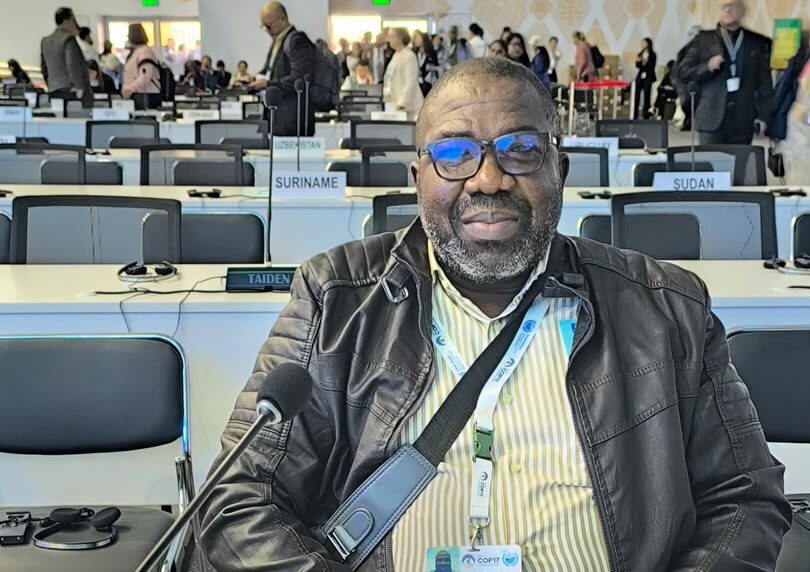
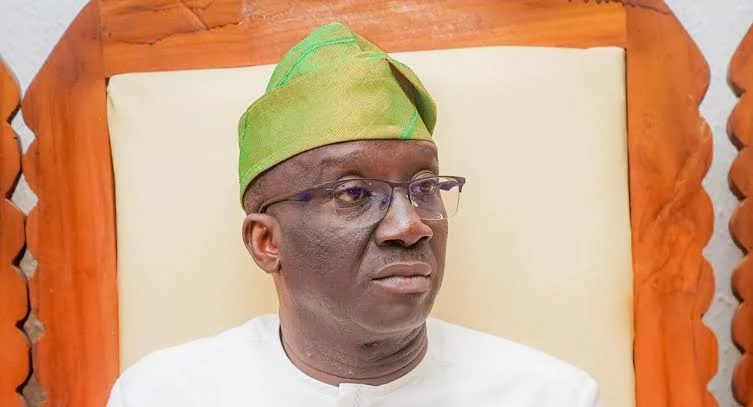
In an interview with PREMIUM TIMES at COP17 in Ulaanbaatar, Mongolia, Oluseyi Ifatimehin, a Professor of Geography at Kogi State University, Nigeria, and a Science and Technology Correspondent for the United Nations Convention to Combat Desertification, discussed the scientific and institutional challenges facing Nigeria and other African nations. He suggested stronger land and drought observatories, artificial intelligence, satellite technology, local knowledge, and better science-policy connections to address these issues.
PT: What are the major scientific gaps hindering Nigeria and other African countries from effectively dealing with land degradation and drought?
Ifatimehin: I believe Africa does not mainly lack scientific knowledge. The bigger issues are gaps in data continuity, localized evidence, tech use, and the ability to turn evidence into decisions. For Nigeria, a major gap is the absence of enough continuous, interoperable data on soil health, land degradation, groundwater, vegetation, drought indicators, and land-use changes. Satellite data is becoming more available, but it needs to be paired with trustworthy ground observations to create useful information for farms, watersheds, and communities.
Another gap is our ability to predict. We need to shift from asking, “Where has degradation or drought happened?” to “Where is it likely to happen next? When will it occur? How severe will it be? What actions should farmers and governments take now?”
A third gap is the lack of consistent investment in African scientific bodies, laboratories, field-monitoring networks, data systems, and skilled personnel. Nigeria should focus on building stronger national and regional land and drought observatories, integrating satellite and ground data, improving universities and research institutions, and developing indicators to measure results. These could include the number of hectares of restored land, changes in soil organic carbon, vegetation recovery, water availability, and the number of farmers receiving timely warnings.
PT: Why is there a gap between research institutions and policymakers, and how can COP17 help bridge that gap?
Ifatimehin: The gap exists partly because research and policymaking often work on different timelines and speak different languages. Researchers might create excellent papers, but policymakers need clear answers to practical questions: What is the issue? What will it cost? What interventions work? Where should they be implemented? What results can we expect in three to five years? There is also a lack of connection between universities, government ministries, agencies, and communities. Research funding is often project-based, while policy implementation needs long-term evidence and monitoring. COP17 can help by strengthening the UNCCD Science-Policy Interface and encouraging countries to set up stronger national science-policy systems. Universities should not only be seen as places for publications; they should become knowledge partners in national land-restoration programs.
As part of this, two Nigerian universities, Federal University Lokoja and Confluence University of Science and Technology, Osara, shared proposals at the COP17 side events.
FUL proposed two projects: ECO-HUB for Land Restoration Technical Education, focusing on ecopreneurship, restored land, resilient food systems, and shared prosperity, and Building a University-led Knowledge Curriculum and Research Platforms for Sustainable Rangeland Resource Governance, Livestock Reform, and Peace-building for Nigeria’s Sub-humid and Humid Ecological Zones.
CUSTECH presented Measuring Nature, Building Skills and Restoring Land: Bio-resource Quantification, Ecosystem Evaluation, and Land Degradation Neutrality Capacity in Kogi State, Nigeria.
For Nigeria, I want to see a clear method where scientific baselines, measurable targets, independent monitoring, and periodic evidence reviews go hand in hand with major land-restoration policies and programs. The ultimate test is simple: Can scientific evidence change a government decision, improve an investment, or affect what happens on the farm? If yes, then we are closing the science-policy gap.
PT: What technologies can Nigeria realistically use to predict drought and lessen its impacts?
Ifatimehin: Nigeria does not need to wait for future technology. Much of what we need is already available; the challenge is how to integrate it and use it widely.
First, we have satellite Earth observation. Satellite systems can track vegetation stress, soil moisture, rainfall changes, surface water, and land-use changes across Nigeria. This helps the government spot drought conditions faster than traditional field surveys.
Second, artificial intelligence and machine learning can mix satellite data with rainfall, temperature, soil, crop, hydrological, and historical drought data to find patterns and generate local drought-risk forecasts. Third, we need multi-hazard early-warning systems. Nigeria should connect weather and water forecasts with agricultural advice so that warnings become useful messages, for example, telling farmers when to plant, which crop to use, when to save water, or where livestock might run into water shortages.
Fourth, climate modeling and seasonal forecasting can aid planning months ahead. But technology alone is not enough. Nigeria needs a complete drought information system that connects observation to forecasting, early warning, communication, early action, and impact assessment. A clear goal could be ensuring that drought warnings reach vulnerable farmers and pastoralists before they make critical decisions, not after losses have already happened.
PT: How can modern science and Indigenous knowledge work together at the community level?
Ifatimehin: We should not have to choose between modern science and Indigenous knowledge. They should complement each other. Farmers and pastoralists have generations of knowledge about rainfall patterns, soil types, pasture availability, water sources, drought signs, livestock behavior, and locally adapted crops. Modern science offers remote sensing, climate modeling, soil analysis, forecasting, and new technologies.
The best approach is to create knowledge together. Scientists should collaborate with communities to compare Indigenous observations with meteorological, ecological, and satellite data to see what is reliable and where it works. For instance, if pastoral communities have traditional signs for predicting pasture or water shortages, these can be checked against satellite vegetation data, rainfall forecasts, and groundwater information. Where both sources give consistent signals, the resulting early-warning system is likely to be more trusted and adopted.
We should also ensure that communities are not just seen as recipients of scientific information but as knowledge partners.
A measurable way forward would be to set up community demonstration sites where restoration methods are jointly designed, tested, and monitored, using indicators like vegetation recovery, soil health, water availability, livestock productivity, and household livelihoods.
PT: What should governments, universities, and development partners do differently to turn African innovations into practical solutions?
Ifatimehin: Africa needs to rethink how it measures research success. A scientific paper is important, but it should not be the end goal.
Governments should create clear paths for turning innovations into implementation, where promising technologies are identified, tested in the field, evaluated, and then added to national programs and procurement systems.
Universities should improve tech-transfer offices, innovation hubs, demonstration farms, and partnerships with farmers, pastoralists, government, and industry. Research funding should also cover field validation, scaling, and adoption, not just lab work.
Development partners should go beyond funding short-term pilot projects. When a technology shows it works, funding should help it transition from pilot to demonstration, scaling up and institutional adoption.
The private sector is key too because governments and donors alone cannot cover the needed scale.
For Nigeria, I suggest a Land Restoration Innovation Pipeline with clear steps: Research → Field testing → Independent validation → Community adoption → Investment readiness → Scale-up → Impact measurement. Success should not just be measured by the number of papers or projects, but by real outcomes like hectares restored, farmers and pastoralists reached, increases in soil and water productivity, drought losses avoided, jobs created, technologies commercialized, and lasting improvements in livelihoods.
My main message from COP17 is that Africa does not need to start from scratch with science; it needs to connect the science we have to decisions, financing, and actions. Nigeria has universities, research institutions, satellite technologies, climate scientists, local knowledge, and an expanding innovation ecosystem. The time is now to link these resources through better science-policy institutions, digital knowledge platforms, reliable financing, and measurable actions. "Restoring Land, Restoring Hope" must mean moving from knowledge to action and from isolated projects to solutions that can be scaled up nationally and locally.



Drop your comment
No comments yet — be the first to drop the gist 👇