
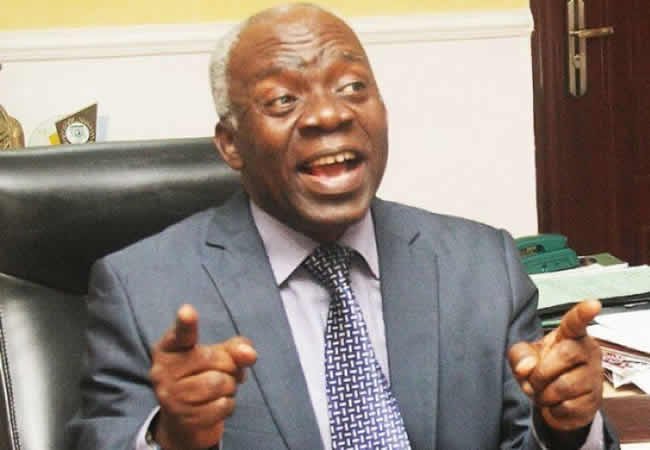
Human rights lawyer Femi Falana has called on Nigerians to look beyond the federal government. He wants them to demand more accountability from state and local governments about how they manage public funds and provide essential services.
Mr Falana spoke on Thursday in Lagos. He was the keynote speaker at the public screening of LG Billions in the Dark, a documentary about local governance in Osun State produced by DevReporting.
The documentary looks at the long-standing crisis over local government leadership in Osun. It shows the problems this creates for public finances and service delivery. It also highlights the huge gap between the billions of naira allocated to the state’s 30 local government areas and the poor state of roads, water, sanitation, healthcare, and education in many communities.
Mr Falana noted that this issue is not just in Osun State. He explained that the crisis of local governance comes from the weakening of local councils and lack of accountability at the grassroots.
He said many Nigerians have lost faith in local governments. This is because elections held by State Independent Electoral Commissions (SIECs) are often rigged to benefit ruling parties.
“The local government or the State Independent Electoral Commissions in Nigeria conduct the worst elections in Africa, where the members of the ruling party, or rather the ruling party must produce all the chairs and the councillors,” he said.
Mr Falana also criticized how state authorities still control local government finances. This is despite a Supreme Court judgment in July 2024.
On July 11, 2024, the Supreme Court confirmed the financial autonomy of Nigeria’s 774 local governments. It ruled that funds meant for the councils should go directly to them from the federation account.
Mr Falana said this ruling has not yet been fully implemented in many states.
“In those days, it was an offence to disobey the judgment of the Supreme Court. In fact, even under the military regime, it was unthinkable,” he said.
“Today, judgments of courts are disobeyed by state governments, federal and even local governments.”
He urged citizens to take responsibility for demanding accountability from public officials. He said they should not leave governance issues just for politicians.
“We have enormous resources in this country, yet our communities remain underdeveloped,” he said. “We cannot continue to focus exclusively on Abuja while ignoring what happens in our states and local government areas. Every citizen has a responsibility to demand accountability.”
In her opening remarks, the Vice-Chancellor of the University of Lagos (UNILAG), Folasade Ogunsola, said effective local governments are key to national development because they are closest to the people.
Mrs Ogunsola said local councils should be central to urban planning and management. This is especially important as Nigerian cities grow faster than the infrastructure and institutions supporting them.

“They understand their communities, the location of vulnerable populations, the demands of local infrastructure, and the pressures facing neighbourhoods,” she said.
She urged local governments to go beyond basic administration. They should support local businesses, markets, and informal enterprises while improving public spaces and essential services.
Mrs Ogunsola, a professor of Medical Microbiology, said the recent move for direct funding for local governments is a positive step, even though challenges remain.
Mr Falana also stressed that citizens should use the Freedom of Information Act (FOI) to get information from the government.
He said citizens can ask local governments how much money they have received and how it is being spent.
The publisher of PREMIUM TIMES and CEO of the Centre for Journalism and Innovation Development, Dapo Olorunyomi, who chaired the event, called the documentary an example of accountability journalism.
“Holding public institutions and officers accountable for their responsibilities to citizens is what can make them stay on their toes, and that is what DevReporting did with its documentary,” he said. “And that is accountability journalism.”
The event also included the launch of the Development Reporting Africa Foundation (DRAF), the non-profit side of DevReporting, and a panel discussion on local governance and accountability.
The panel featured Comfort Idika-Ogunye of Jiti Ogunye Chambers; Moyosore Adebanjo, Executive Chairman of Onigbongbo Local Council Development Area (LCDA), Lagos State; Wale Adedayo, former Chairman of Ijebu East Local Government Area, Ogun State; Vera Amaechi, a lecturer in the Department of Political Science at UNILAG; and Joshua Osiyemi, Head of Tracka at BudgIT.
The panellists called for transparency in local government finances. They suggested publishing budgets and spending online in easy-to-read formats. They also urged councils to engage the public and educate residents about local government functions and how public resources are used.
They added that stronger citizen participation is needed, especially from women, young people, and persons with disabilities. They encouraged civil society organizations to extend accountability efforts beyond state capitals into local communities.
The panel also highlighted the need to use digital tools to monitor government projects, report problems, and track public programmes.
The convener and Team Lead of DevReporting, Mojeed Alabi, said the documentary and the foundation launch show a shared commitment to improve society through development reporting and accountability.
Drop your comment
No comments yet — be the first to drop the gist 👇