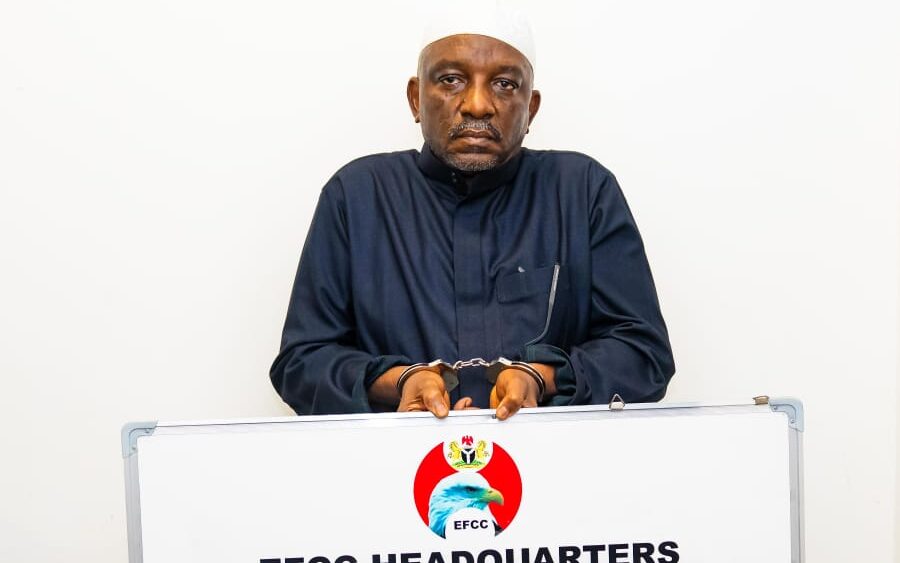
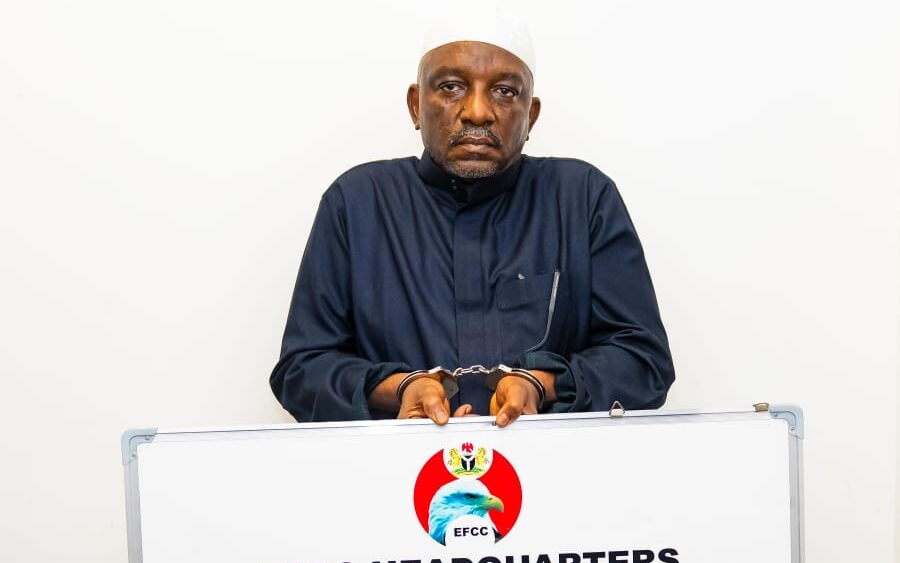
When the Economic and Financial Crimes Commission (EFCC) announced the re-arrest of former Minister of Power Saleh Mamman in May, people were more shocked by his sad picture than the news itself. He looked dejected in handcuffs, holding a booking board. This picture showed his downfall.
On 7 May, the Federal High Court in Abuja convicted Saleh Mamman of money laundering involving N33.8 billion meant for Nigeria’s electricity projects. Twelve days later, on 19 May, the court sentenced him on all 12 charges brought against him by the EFCC.
He received seven years for each of 10 counts, two years for one count, and three years for another count. The sentences added up to 75 years for the 68-year-old man, as they will run one after another.
His case sheds light on how corruption has hindered efforts to improve electricity in Nigeria. Despite huge spending in the power sector over the years, Nigerians still face serious power shortages.
Corruption in Power Projects
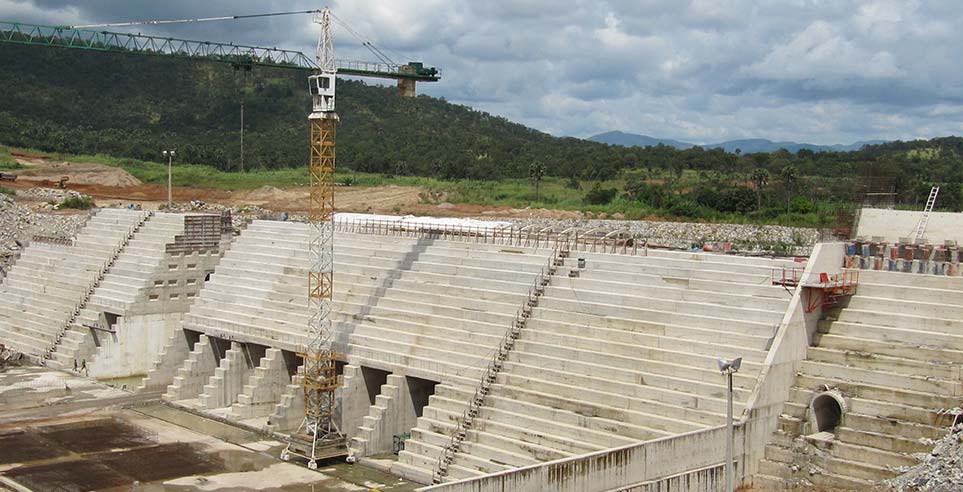
Mr Mamman’s trial focused on stealing funds meant for the Mambilla and Zungeru hydropower schemes. Together, these projects were supposed to add nearly 4,000 megawatts to Nigeria's electricity supply.
The Zungeru Hydroelectric Power Station, a 700-megawatt plant in Niger State, started construction in 2013 and is close to being finished. The Mambilla Hydropower Project in Taraba State, designed to produce 3,050 megawatts, has been stuck since the 1970s.
The EFCC charged Mr Mamman with 12 counts of money laundering under the Money Laundering (Prohibition) Act, 2011. They accused him of misusing billions released for these power projects for personal luxury and buying property in Abuja.
The first count alleged that Mr Mamman worked with some ministry officials and private companies to convert over N33.8 billion in funds for the projects in 2019. The next counts detailed how he spent part of this money on luxury items and more property in Abuja.
Trial and Evidence
The EFCC arraigned him in July 2024 on the 12 counts of money laundering. He denied the charges. On 12 July 2024, the court granted him N10 billion bail with two sureties. During the trial, the EFCC called 17 witnesses and presented about 43 pieces of evidence. Mr Mamman did not bring any witnesses to defend himself.
New filings reviewed by PREMIUM TIMES shed light on Mr Mamman’s extravagant spending habits using money meant for power projects. These documents highlight how he used public funds and how his conviction is historic.
Luxury Purchases
The prosecution showed how Mr Mamman paid for a N200 million property in Abuja using cash from the power project funds. They said he worked with a man named Samson Bitrus, who helped him make the payment without going through a bank. Bitrus allegedly paid $655,700 in cash for the property, equivalent to N200 million at that time.
Mohammed Asheik Jidda, who represented the seller, testified during the trial. He confirmed the cash transaction and said it broke the law against cash payments over N5 million without a bank.
Bitrus also testified about his role in the property deal. He said he found the property and helped Mr Mamman negotiate the purchase. After the deal, he managed the property and collected rent, which went into an account linked to Mr Mamman.
Money Laundering Scheme
Counts 6 to 12 accused Mr Mamman of diverting billions from the Mambilla and Zungeru projects for personal use. The prosecution stated that he used the stolen funds in various ways between 2019 and 2022.
An EFCC investigator, Abubakar Kweido, testified that money meant for the power projects was moved from the Federal Ministry of Power accounts to many Bureau de Change operators with no contracts with the ministry. He listed several companies involved in this scheme.
Mr Kweido’s investigation revealed that the stolen money went to pay for Mr Mamman's accommodation and other personal expenses. They also presented evidence showing that the funds were misused even after Mr Buhari removed Mr Mamman from office in September 2021.
Conviction and Sentencing
On 7 May, the judge, Mr Omotosho, convicted Mr Mamman, finding him guilty on all 12 counts. He noted that the prosecution proved Mr Mamman and his associates stole at least N22 billion. The judge ordered his arrest for sentencing.
On 19 May, the EFCC arrested Mr Mamman in Kaduna after a search. He is also facing separate N31 billion fraud charges in Abuja. After his conviction, he received a record sentence of 75 years because the judge ordered each count to run consecutively.
Legal experts say this is the longest sentence for corruption in Nigeria's history. The judge's decision sends a clear message about the seriousness of corruption in the country.
Reactions to the Sentence
Auwal Musa, from the Civil Society Legislative Advocacy Centre, praised the sentence but said it should lead to recovering stolen funds. Tunde Salman, from the Good Governance Team Nigeria, noted that this verdict shows that Nigeria is becoming serious about fighting corruption. He added that strong sentences can deter future corruption.
Drop your comment
No comments yet — be the first to drop the gist 👇